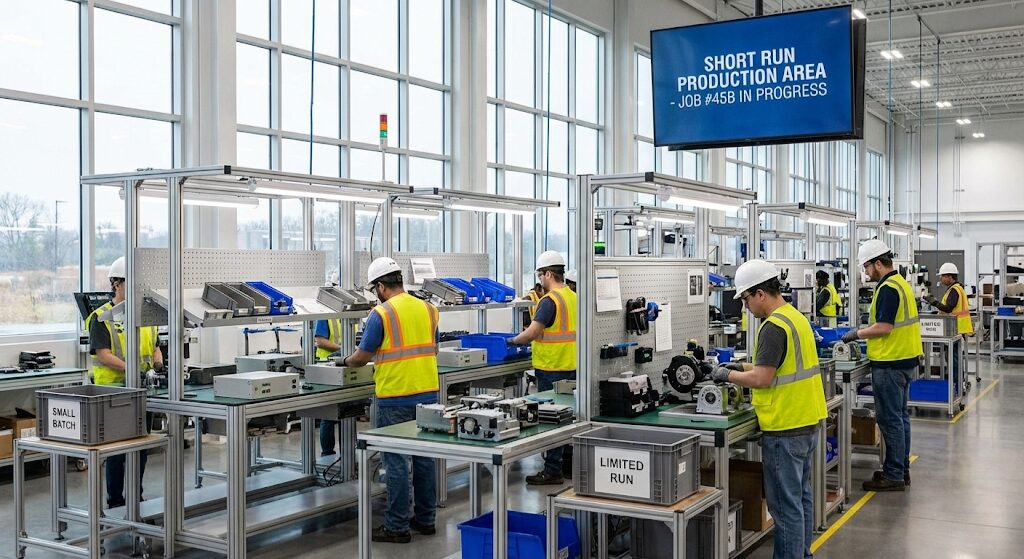
1. Introduction to Economic Time Horizons
When business managers and economists evaluate a company’s ability to manufacture goods, they don’t look at calendars. They don’t measure operational flexibility in terms of days, weeks, or months. Instead, they view the business landscape through the lens of specific “economic time horizons.” The most fundamental of these horizons is the short run.
Imagine a successful local bakery that suddenly goes viral on social media. Overnight, the demand for their signature croissants triples. The owner can quickly order more flour, buy more butter, and perhaps ask the existing staff to work overtime. However, she cannot magically spawn a second oven, double the square footage of the kitchen, or build a new storefront by tomorrow morning. This scenario perfectly encapsulates the constraints of economic time.
To truly understand how firms scale, how supply curves are shaped, and how market equilibrium is reached, we must explicitly define the term short run production. By mastering this concept, you unlock the ability to analyze business strategy, cost minimization, and the fundamental limits of corporate growth.
2. How to Define Term Short Run Production
In microeconomics, the definition is incredibly precise. We define the term short run production as a conceptual period of time during which at least one factor of production is fixed, and the quantity of output can only be altered by changing the variable inputs.
The “No Calendar” Rule
It is vital to understand that the short run has no set chronological duration. For a freelance graphic designer whose only capital is a laptop, the short run might only last a few days (the time it takes to buy a second laptop and hire an assistant). For an oil refinery or an automobile manufacturer, the short run might last five to ten years, as it takes massive amounts of time to plan, permit, and construct a new multi-billion-dollar facility.
Because the firm is trapped within its current physical capacity (the fixed inputs), any attempt to increase production must be squeezed out of the existing infrastructure. Before analyzing how this works, it is helpful to understand what is production and its 4 most important factors (Land, Labor, Capital, and Entrepreneurship). In the short run, Capital and Land are almost universally the fixed factors, while Labor and raw materials act as the variable factors.

Master the Economics of Production
Want to deeply understand cost curves, production functions, and corporate scaling strategies? Equip yourself with a top-tier Microeconomics textbook used by Ivy League business schools.
Browse Economics Textbooks on Amazon3. The Anatomy of Inputs: Fixed vs. Variable
To operationalize our definition of short-run production, we must dissect the inputs a firm uses to create goods.
| Input Type | Economic Definition | Real-World Examples |
|---|---|---|
| Fixed Inputs | Resources whose quantity cannot be easily or quickly changed in response to a desire to alter production levels. They represent the firm’s maximum capacity constraint. | Factory buildings, heavy machinery (ovens, stamping presses), long-term land leases, specialized robotics. |
| Variable Inputs | Resources whose quantity can be rapidly adjusted up or down to directly correlate with the desired level of output. | Hourly labor (wages), raw materials (steel, flour, wood), electricity, shipping packaging. |
In the short run, a factory manager looks at their fixed inputs as “sunk” or unchangeable constraints. If a massive surge in market demand occurs—which requires an understanding of how to define the law of demand and draw a demand curve—the manager cannot build a new factory. They can only hire more labor to run the existing machines 24 hours a day.
4. The Ironclad Rule: The Law of Diminishing Marginal Returns
The defining characteristic of short-run production is an economic phenomenon known as the Law of Diminishing Marginal Returns. This law states that if a firm continually adds variable inputs (like workers) to a fixed input (like a single factory), the additional output produced by each new worker will eventually begin to decline.
Imagine our coffee shop example from earlier. You have one espresso machine (the fixed input).
- You hire Worker 1. They take orders, steam milk, and pull shots. Production is decent.
- You hire Worker 2. Now they can specialize. One takes orders, one pulls shots. Production more than doubles due to teamwork. This is Increasing Marginal Returns.
- You hire Worker 3. They manage the milk steaming. Production goes up, but the machine is getting crowded.
- You hire Worker 4 and 5. There is only one espresso machine. Workers are now bumping into each other, waiting in line to use the equipment, and getting in the way. Production might still technically increase slightly, but the extra coffee produced by the 5th worker is vastly lower than the extra coffee produced by the 2nd worker. This is Diminishing Marginal Returns.
The Inevitability of Inefficiency
The law of diminishing returns is not caused by hiring lazy or unskilled workers. It is an unavoidable mathematical consequence of fixed capital constraint. You simply cannot infinitely cram variable labor into a fixed space and expect linear growth.
5. Visualizing the Short-Run Production Function
Economists use the production function to mathematically represent the relationship between inputs and outputs. In the short run, the equation is typically written as Q = f(L, K̄), where Q is output, L is the variable labor, and K̄ represents the fixed capital.
By analyzing the data, economists break short-run production into three distinct stages:
- Stage 1: Increasing Returns. Both Marginal Product (the extra output per new worker) and Average Product are rising. The fixed capital is being underutilized, so adding labor vastly improves efficiency through specialization.
- Stage 2: Diminishing Returns. Marginal Product begins to fall, but remains positive. Total output is still growing, but at a slower, decelerating rate. Rational firms will always choose to operate in this stage.
- Stage 3: Negative Returns. The workspace is so crowded that adding another worker actually causes total output to fall. Marginal Product drops below zero. No rational firm operates here; you are paying a worker to actively hinder production.

Calculate Marginal Costs with Precision
Whether calculating marginal product, average variable costs, or profit maximization points, a high-powered graphing or financial calculator is essential for business students and operations managers.
View Professional Calculators6. Translating Production into Short-Run Costs
Production physics directly dictate business costs. Because of the limitations we discussed in the short-run production function, the cost curves of a business take on very specific, predictable shapes.
- Total Fixed Costs (TFC): Costs that do not change with output. Even if the factory produces zero units, rent, insurance, and equipment leases must be paid. On a graph, TFC is a flat, horizontal line.
- Total Variable Costs (TVC): Costs that rise as output rises. This represents the wages paid to labor and the purchase of raw materials.
- Total Cost (TC): The sum of TFC and TVC.
The U-Shaped Marginal Cost Curve
The most important curve for a manager is Marginal Cost (MC)—the cost of producing exactly one more unit. The MC curve is typically U-shaped. It drops initially due to increasing returns to scale (specialization), but eventually, it sweeps aggressively upward. Why? Because of diminishing marginal returns. As each new worker becomes less productive due to capital constraints, the firm is paying the same hourly wage for fewer units of output, meaning the cost per unit skyrockets.
7. The Short Run vs. The Long Run
To fully grasp the concept, it helps to contrast the short run with its counterpart: the long run.
The Long Run Dynamics
The long run is defined as the period of time where all inputs are variable. There are no fixed costs. The firm is no longer constrained by its current factory size. It can build new facilities, purchase new land, adopt entirely new technologies, or even choose to exit the industry entirely.
The Short Run Constraints
In the short run, the firm is locked in. If market demand surges, they can only squeeze so much output out of their existing capital before marginal costs become astronomical. If market demand plummets, they are still legally obligated to pay for their fixed costs (rent, leases), even if they halt production.
8. Strategic Managerial Decisions in the Short Run
Understanding these constraints allows managers to make mathematical, profit-maximizing decisions. The most crucial short-run decision a firm must make during an economic downturn is the Shutdown Point.
If a firm is losing money, should it immediately close its doors? Not necessarily. In the short run, the firm must pay its fixed costs regardless of whether it operates. Therefore, the rule is:
- If the market price covers Average Variable Costs (AVC), the firm should continue producing, even at a loss. Any revenue above AVC helps pay down the unavoidable fixed costs.
- If the market price drops below Average Variable Costs, the firm should shut down immediately. Producing goods is now actively increasing the firm’s losses beyond its fixed costs.
To understand how these market prices are established, you must investigate what is the price mechanism and how to price goods. The invisible hand of the market dictates whether a firm can survive its short-run cost structure.
9. Macroeconomic Implications of the Short Run
The concept of the short run scales up from individual factories to the entire global economy. In macroeconomics, the Short-Run Aggregate Supply (SRAS) curve is heavily studied.
In the macroeconomic short run, prices and wages are often considered “sticky.” Labor contracts prevent wages from dropping immediately during a recession, and menu costs prevent businesses from changing their prices every single day. This stickiness explains why economies experience volatile business cycles, recessions, and periods of high unemployment.
Furthermore, when measuring the total wealth of a nation, constraints in short-run aggregate supply directly impact the final GDP figures. To understand how these constraints translate into national wealth, one must study the components of national income (Consumption, Investment, Government Spending, and Net Exports) and how they react to short-run supply shocks.

Optimize Your Business Operations
Move beyond theory. Discover how top executives use data analytics and operations management strategies to minimize short-run costs, maximize capital efficiency, and scale their businesses effectively.
Explore Business Strategy Books10. Conclusion: Navigating the Constraints of Reality
To define the term short run production is to accept the physical reality of business. Firms cannot scale infinitely at the drop of a hat. They are bound by the bricks and mortar of their factories, the steel of their machinery, and the merciless mathematics of the law of diminishing marginal returns.
By understanding these short-run constraints, business leaders can accurately forecast their cost curves, identify the exact point where hiring an extra worker becomes a liability, and make intelligent decisions about when to expand into the long run. The short run may be a conceptual timeframe, but its impact on profitability, market supply, and global economics is intensely real.
Explore More Business Strategies at Edmics