
1. The Heart of Corporate Finance: Defining the Function
Every business, regardless of its size, industry, or geographic location, operates on a single universal fuel: capital. However, securing capital is only half the battle. How that capital is deployed, protected, and multiplied determines whether a company achieves market dominance or spirals into bankruptcy.
At the center of this complex economic machinery stands the financial manager. The function of a financial manager goes far beyond the archaic stereotype of a “bean counter” sitting in a back room crunching numbers on a ledger. Today, the financial manager is a forward-looking strategist, a risk mitigator, and a core architect of corporate growth. Their fundamental objective is singular and uncompromising: to maximize the wealth of the firm’s shareholders.
To achieve this overarching goal, the financial manager must navigate highly volatile markets, decipher complex tax codes, and make multi-million dollar decisions based on statistical probability. In this comprehensive guide, we will dissect the specific daily, monthly, and yearly functions that define this indispensable corporate role.
2. From Bookkeeper to Strategist: The Evolution of the Role
Historically, finance departments were viewed as purely administrative. Their job was to record historical transactions, ensure the balance sheet balanced, and prepare the company for tax season. They looked backward.
Modern financial management has undergone a radical transformation. With the advent of automated accounting software, the administrative burden has drastically decreased. Consequently, the modern financial manager is expected to look forward. They take the historical data prepared by the accountants and use it to build predictive financial models, execute scenario analyses, and guide executive decision-making. They have evolved from strict bookkeepers into vital business partners.

Master Corporate Finance
Elevate your financial acumen. Equip yourself with top-rated Corporate Finance textbooks to master the formulas, theories, and real-world applications used by Wall Street professionals.
Browse Finance Books on Amazon3. Core Function 1: Capital Budgeting & Investment Decisions
Perhaps the most glamorous and high-stakes function of a financial manager is Capital Budgeting. This is the process of evaluating and selecting long-term investments that align with the company’s strategic goals.
 [Image of Capital Budgeting Process]
When a company considers opening a new manufacturing plant, acquiring a smaller competitor, or launching a massive new product line, the financial manager must mathematically prove that the venture will generate a positive return. To do this, they rely heavily on the financial and nonfinancial benefits of a firm engaging in strategic planning. They calculate complex metrics such as:
- Net Present Value (NPV): Discounting future cash flows back to today’s dollars to see if an investment creates tangible value.
- Internal Rate of Return (IRR): Finding the precise percentage rate of return an investment is expected to generate.
- Payback Period: Calculating exactly how many years it will take for the initial investment to pay for itself.
If the math does not support the investment, it is the financial manager’s solemn duty to push back against over-enthusiastic marketing or operations teams.
4. Core Function 2: Capital Structure & Financing Decisions
Once an investment is selected, a new problem arises: How do we pay for it? This introduces the second core function: determining the firm’s Capital Structure.
A company generally has two ways to raise capital:
- Debt Financing: Borrowing money from banks or issuing corporate bonds. Pros: You retain full ownership. Cons: You must pay mandatory interest, increasing bankruptcy risk.
- Equity Financing: Selling shares of the company to investors. Pros: No mandatory interest payments. Cons: You dilute your ownership and give up a portion of all future profits.
The financial manager must find the perfect balance between debt and equity to minimize the company’s Weighted Average Cost of Capital (WACC). Too much debt makes the company fragile; too much equity dilutes the shareholders.

Calculate WACC and NPV Instantly
Stop relying on messy spreadsheets. From calculating Net Present Value to determining the precise cost of capital, a professional financial calculator is the ultimate tool for corporate finance managers.
View Financial Calculators5. Core Function 3: Working Capital Management (Liquidity)
While capital budgeting deals with five-to-ten-year horizons, Working Capital Management deals with tomorrow morning. A wildly profitable company can still be forced into bankruptcy if it runs out of cash to pay its immediate obligations.
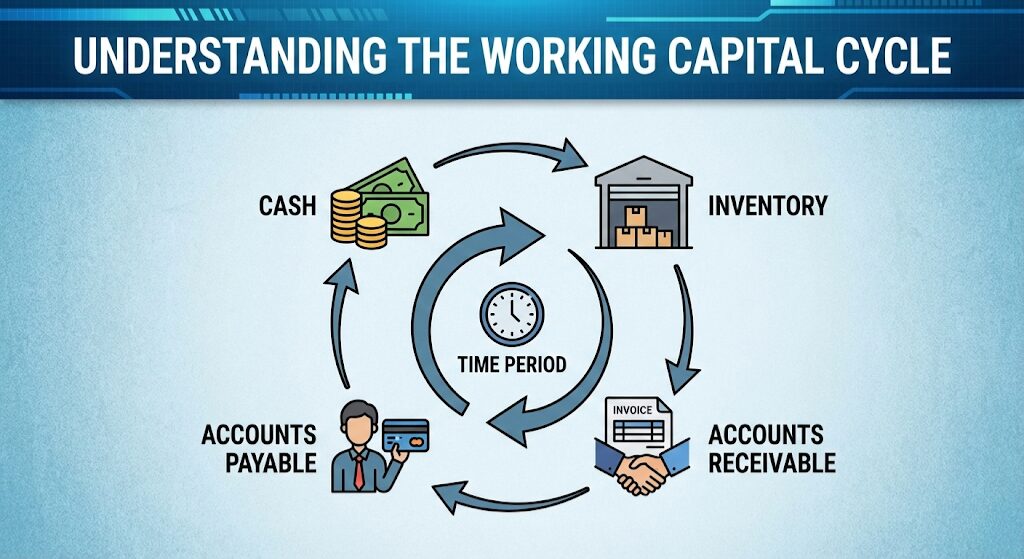
The financial manager must ruthlessly monitor the firm’s short-term assets and short-term liabilities. This requires a deep understanding of the concepts of working capital. They must manage the Cash Conversion Cycle by:
- Collecting Accounts Receivable as fast as possible.
- Delaying Accounts Payable to suppliers without damaging relationships.
- Optimizing inventory levels so cash isn’t needlessly tied up in warehouses.
Furthermore, they must constantly analyze the difference between gross working capital (total current assets) and net working capital to ensure the company maintains an adequate liquidity cushion against sudden economic shocks.
6. Core Function 4: Dividend Policy & Retained Earnings
When a company finally generates a net profit at the end of the year, the financial manager faces another critical crossroad. What should be done with that cash? They advise the Board of Directors on the Dividend Policy.
The Dividend Dilemma
Option A: Distribute the profits to shareholders as cash dividends. This rewards investors immediately but drains the company of capital.
Option B: Keep the profits inside the company as Retained Earnings. This allows the company to fund its own future growth without taking on new debt.
If the financial manager believes they can reinvest that money into high-yield projects, they will urge the company to retain the earnings. This internal reinvestment triggers a massive snowball effect. To understand the sheer mathematical power of corporate reinvestment, one must grasp why earning interest on interest is the primary engine of long-term wealth creation. Retained earnings allow a corporation to compound its value exponentially over decades.
7. Core Function 5: Risk Management & Compliance
The global market is a dangerous place. Currency exchange rates fluctuate wildly, commodity prices spike due to geopolitical conflicts, and interest rates shift based on central bank decrees. The financial manager acts as the corporate shield against these variables.
Through a process known as Financial Risk Management, managers use sophisticated tools like derivatives, options, and futures contracts to “hedge” against these risks. For example, if an American company buys parts from Europe, the financial manager will lock in a specific Euro-to-Dollar exchange rate months in advance to ensure currency volatility doesn’t wipe out their profit margins.
Additionally, they must ensure absolute compliance with federal tax laws, SEC regulations, and international financial reporting standards (IFRS) to protect the company from devastating legal penalties.

Build Bulletproof Financial Models
Excel is the language of finance. Discover advanced data analysis and financial modeling guides that will teach you how to build dynamic forecasts, track KPIs, and automate risk assessment models.
Shop Financial Modeling Books8. Hierarchy: Accountant vs. Financial Manager vs. CFO
To truly understand the role, it helps to see where the financial manager sits within the corporate hierarchy. They bridge the gap between historical data collection and ultimate executive authority.
| Role | Primary Focus | Time Orientation | Key Deliverables |
|---|---|---|---|
| Accountant / Controller | Accuracy, compliance, and recording transactions. | Backward-Looking (What happened?) | Balance Sheets, Income Statements, Tax Returns. |
| Financial Manager | Analysis, capital allocation, and risk mitigation. | Forward-Looking (What will happen?) | NPV models, Budget Forecasts, Investment Proposals. |
| Chief Financial Officer (CFO) | Ultimate strategic vision and stakeholder relations. | Macro-Future (Where are we going?) | Mergers & Acquisitions, Wall Street Guidance. |
9. Essential Skills for the Modern Financial Manager
The days of relying solely on arithmetic are over. Today’s financial managers must be multi-disciplinary experts. To succeed in this high-pressure role, professionals must master a blend of hard technical skills and soft interpersonal abilities:
- Advanced Data Analytics: Proficiency in SQL, Python, or advanced Excel macros to parse through massive corporate datasets.
- Strategic Foresight: The ability to look at a spreadsheet and instantly visualize the real-world operational impacts on the factory floor.
- Communication Mastery: The ability to translate complex financial jargon into simple, actionable advice for non-financial executives and board members.
- Regulatory Acumen: A deep, updated understanding of tax codes, ESG (Environmental, Social, and Governance) reporting, and compliance laws.
10. Objectives of Financial Management: Profit vs. Wealth Maximization
Before a financial manager can decide how to raise capital or where to invest it, they must first answer a deceptively simple question: what is the ultimate objective of financial management? For decades, business schools taught a single-minded answer — profit maximization. Today, that view is considered dangerously incomplete, and understanding why is essential to understanding everything else the modern financial manager does.
The Case for Profit Maximization
On the surface, profit maximization seems like the obvious goal. A company that earns higher profits can pay better wages, invest in new technology, and reward its owners. Profit maximization is easy to measure, easy to communicate to employees, and directly tied to the efficient use of resources. If a manager can produce the same output with fewer inputs, or generate more revenue from the same cost base, profits rise and, in theory, everyone benefits.
However, profit maximization suffers from three critical flaws that make it unsuitable as the sole guiding objective of a financial manager. First, it ignores the timing of returns. A project that produces $1 million in profit ten years from now is not equivalent to a project that produces $1 million in profit next year, yet a pure profit-maximization lens treats them identically. Second, it ignores risk. Two projects can promise the exact same profit figure while carrying wildly different probabilities of failure, and profit maximization alone gives the financial manager no framework for distinguishing between them. Third, and perhaps most damningly, profit maximization is vague — profit before tax, profit after tax, earnings per share, and total profit can all move in different directions depending on the accounting choices made, making the objective slippery and open to manipulation.
Why Wealth Maximization Wins
Wealth maximization, also referred to as shareholder value maximization or the maximization of the market price of a share, resolves each of these flaws. It explicitly incorporates the time value of money by discounting future cash flows back to the present. It explicitly incorporates risk by adjusting the discount rate upward for riskier ventures. And it is unambiguous — a rising share price is a single, objective, market-verified number that cannot be manipulated by clever accounting the way reported profit sometimes can.
Wealth Maximization in Practice
When a financial manager evaluates a decision through the lens of wealth maximization, they are really asking one question: will this action increase the present value of the cash flows available to shareholders, adjusted for both timing and risk? Every capital budgeting, financing, and dividend decision discussed elsewhere in this guide is, at its core, an attempt to answer that single question.
Critics sometimes argue that wealth maximization is too narrow because it appears to prioritize shareholders over employees, customers, and the broader community. In practice, sustainable wealth maximization requires satisfied customers, motivated employees, and goodwill within the community — a company cannot maximize long-term shareholder value while simultaneously alienating the stakeholders it depends on. This is why modern financial managers increasingly frame wealth maximization alongside stakeholder considerations rather than in opposition to them.
11. Scope & Importance of Financial Management in an Organization
The scope of financial management has expanded dramatically over the past several decades. What was once confined to raising funds and keeping records now touches virtually every strategic decision a company makes. Understanding the full scope of the discipline helps explain why the financial manager has become one of the most influential figures in the modern corporation.
The Traditional Scope
Under the traditional approach, which dominated financial thinking until roughly the middle of the twentieth century, the scope of financial management was limited to three narrow activities: estimating the funds required by the business, identifying sources from which those funds could be raised (primarily banks and bond markets), and handling the legal and procedural aspects of security issuance. This traditional view treated financial management as an episodic activity — something that happened only when the company needed to raise money — rather than a continuous, strategic function.
The Modern, Expanded Scope
The modern approach treats financial management as a continuous process embedded in every corner of the business. Its scope now includes:
- Investment Decisions: Determining how total assets should be allocated among various projects, both long-term (capital budgeting) and short-term (working capital).
- Financing Decisions: Determining the appropriate mix of debt and equity to fund those assets at the lowest possible cost.
- Dividend Decisions: Determining how much of the firm’s earnings should be distributed versus retained for reinvestment.
- Liquidity Decisions: Ensuring the firm always has enough cash on hand to meet its obligations without holding so much idle cash that returns suffer.
This expanded scope is why the importance of financial management cannot be overstated. Every department in a company — marketing, operations, human resources, research and development — ultimately competes for a share of a finite pool of capital, and it is the financial manager’s job to allocate that capital in a way that serves the overall goals of the organization rather than the parochial interests of any single department.
Why Financial Management Matters to Every Business
The importance of sound financial management becomes starkly visible when it is absent. Businesses with strong products and enthusiastic customers fail every year simply because nobody was managing the cash flow, the debt load, or the capital allocation decisions responsibly. Effective financial management provides the following benefits to an organization:
- It helps the firm acquire necessary funds at the lowest possible cost.
- It ensures funds are used efficiently, avoiding both waste and scarcity.
- It helps the firm plan for growth by identifying which investments genuinely add value.
- It improves the firm’s ability to survive economic downturns by maintaining adequate liquidity and a sustainable capital structure.
- It increases the confidence of investors, lenders, and credit rating agencies, which in turn lowers the firm’s cost of capital.
12. The Four Types of Financial Decisions Every Manager Must Make
While earlier sections of this guide explored capital budgeting, capital structure, working capital, and dividend policy individually, it is useful to step back and see these functions as they are traditionally classified in financial theory: as four interlocking categories of decision-making that together define the entire discipline.
| Decision Type | Core Question | Time Horizon | Primary Tools |
|---|---|---|---|
| Investment Decision | Where should the firm’s money be put to work? | Long-term | NPV, IRR, Payback Period |
| Financing Decision | How should those investments be funded? | Long-term | WACC, Debt-Equity Ratio |
| Dividend Decision | How much profit should be paid out versus retained? | Medium-term | Payout Ratio, Retention Ratio |
| Liquidity Decision | How much cash should be kept on hand right now? | Short-term | Current Ratio, Cash Conversion Cycle |
What makes financial management genuinely difficult is that these four decisions are never made in isolation. A decision to fund an investment with debt (a financing decision) changes the firm’s risk profile, which changes how much cash it should prudently hold (a liquidity decision), which in turn affects how much profit is realistically available to distribute to shareholders (a dividend decision). A skilled financial manager must model these interdependencies simultaneously rather than solving each puzzle independently.
13. Sources of Business Finance: Where the Capital Actually Comes From
Every financing decision ultimately traces back to a specific source of funds, and the financial manager must know the complete menu of options available, along with the tradeoffs of each. These sources are typically divided into long-term and short-term categories.
Long-Term Sources of Finance
- Equity Shares: Ownership stakes sold to investors in exchange for permanent capital. No repayment obligation, but ownership is diluted and dividends (if paid) are not tax-deductible.
- Preference Shares: A hybrid instrument offering fixed dividends like debt but without a mandatory legal obligation to pay them in a loss-making year.
- Debentures & Corporate Bonds: Long-term debt instruments sold to institutional and retail investors, typically carrying a fixed coupon rate.
- Term Loans: Loans from commercial banks or development finance institutions, usually secured against specific assets, repaid over a fixed schedule of years.
- Retained Earnings: Internally generated funds that require no external negotiation, no dilution, and no interest payments, making them the cheapest source of long-term capital available to a mature, profitable firm.
Short-Term Sources of Finance
- Trade Credit: Credit extended by suppliers, allowing a company to receive goods now and pay for them later, effectively an interest-free loan if paid within terms.
- Bank Overdrafts & Cash Credit: Flexible short-term borrowing facilities that let a company draw funds up to a pre-approved limit as working capital needs fluctuate.
- Commercial Paper: Unsecured, short-term promissory notes issued by large, creditworthy corporations directly to money-market investors at rates typically below bank lending rates.
- Factoring & Invoice Discounting: Selling accounts receivable to a third party at a discount in exchange for immediate cash, accelerating the cash conversion cycle discussed earlier in this guide.
Selecting the right source of finance is never a purely mechanical exercise. The financial manager must weigh the cost of each source, the flexibility it offers, the covenants and restrictions attached to it, and the impact on the firm’s overall capital structure and credit rating before committing to any single option.
Go Deeper on Sources of Finance
A well-thumbed corporate finance textbook remains one of the best references for comparing the true cost of debt, equity, and hybrid instruments side by side.
Browse Finance Books on Amazon14. Financial Planning & Forecasting: Charting the Road Ahead
If capital budgeting decides where the company is going, financial planning is the roadmap that gets it there. Financial planning is the process of estimating the capital required by the business and determining its precise composition, so that neither excess idle capital nor a sudden funding shortfall derails operations.
The Financial Planning Process
- Sales Forecasting: Nearly every other financial projection begins with an estimate of future sales, since revenue drives working capital needs, production schedules, and capital expenditure requirements.
- Pro Forma Statements: Building projected income statements, balance sheets, and cash flow statements that show what the company’s financial position will look like under the forecasted scenario.
- Budgeting: Translating the pro forma statements into departmental budgets that allocate specific spending authority across the organization.
- Variance Analysis: Continuously comparing actual results against the budget and forecast, investigating significant deviations, and adjusting future plans accordingly.
Short-Range vs. Long-Range Financial Plans
Financial managers typically maintain two parallel planning horizons. Short-range financial plans, often called operating plans, cover a period of one to two years and focus heavily on working capital, cash budgets, and monthly liquidity needs. Long-range financial plans, sometimes called strategic financial plans, extend three to five years or more and focus on capital expenditure programs, capital structure targets, and dividend policy trajectories. A financial manager who only plans for the next quarter risks starving the company of the long-term investment it needs to remain competitive, while one who only plans for the distant future risks running out of cash next month.
Why Forecasting Errors Compound
A small error in the initial sales forecast does not stay small. Because inventory levels, staffing plans, receivables, and capital expenditure decisions all cascade from that single sales number, a forecasting mistake early in the planning process can ripple through the entire financial plan, which is why sensitivity analysis and scenario planning have become standard practice for prudent financial managers.
15. Understanding the Cost of Capital
Every dollar a company raises, whether through debt or equity, carries a cost. The cost of capital represents the minimum rate of return a company must earn on its investments to satisfy the investors who supplied that capital. It is arguably the single most important number in all of corporate finance, because it serves as the discount rate used in nearly every NPV calculation discussed earlier in this guide.
Cost of Debt
The cost of debt is relatively straightforward to calculate: it is the effective interest rate a company pays on its borrowings, adjusted downward for the tax deductibility of interest payments. Because interest expense reduces taxable income, debt is often referred to as a “tax shield,” making it, on an after-tax basis, cheaper than its stated interest rate would suggest.
Cost of Equity
The cost of equity is more elusive because equity investors have no contractual right to a fixed return the way bondholders do. Instead, financial managers typically estimate the cost of equity using the Capital Asset Pricing Model (CAPM), which ties the required return to the risk-free rate, the equity risk premium, and the company’s specific volatility relative to the broader market (its “beta”).
Weighted Average Cost of Capital (WACC)
Because most companies use a blend of debt and equity, the financial manager combines the two costs into a single blended figure known as the Weighted Average Cost of Capital, weighting each component by its proportion of the firm’s total capital structure. WACC then becomes the hurdle rate that every prospective investment must clear. A project offering a 9% expected return is only worth pursuing if the firm’s WACC is below 9%; if WACC sits at 11%, that same project actually destroys shareholder value even though it appears “profitable” on paper.
16. Financial Ratio Analysis: The Manager’s Diagnostic Toolkit
Raw financial statements are dense and difficult to interpret at a glance. Financial ratio analysis converts that raw data into standardized, comparable metrics that reveal the true health of a business. A skilled financial manager relies on four broad categories of ratios.
| Ratio Category | What It Measures | Example Ratios |
|---|---|---|
| Liquidity Ratios | The firm’s ability to meet short-term obligations | Current Ratio, Quick Ratio |
| Leverage Ratios | How much debt the firm relies on relative to equity | Debt-to-Equity, Interest Coverage |
| Efficiency Ratios | How effectively the firm uses its assets | Inventory Turnover, Asset Turnover |
| Profitability Ratios | How much profit the firm generates relative to sales or assets | Net Margin, Return on Equity (ROE) |
Ratio analysis becomes truly powerful only when used comparatively — against the company’s own historical trend, against direct competitors, and against industry benchmarks. A current ratio of 1.5 might look healthy in isolation, but if every competitor in the industry maintains a ratio of 2.5, it may signal a genuine liquidity weakness that warrants management attention.
Run Ratio Analysis Faster
A dedicated financial calculator speeds up ratio calculations, WACC estimates, and time-value-of-money problems during live budget reviews.
View Financial Calculators17. The Financial Manager’s Role in Mergers & Acquisitions
Few events test a financial manager’s skill set as thoroughly as a merger or acquisition. When one company considers acquiring another, or merging its operations with a competitor, the financial manager sits at the center of the entire transaction.
Valuation
Before any deal can be negotiated, someone must determine what the target company is actually worth. Financial managers typically triangulate a valuation using discounted cash flow analysis, comparable company multiples, and precedent transaction analysis, then present a defensible valuation range to the board and negotiating team.
Due Diligence
Once a target is identified, the financial manager leads or supports a rigorous due diligence process, scrutinizing the target’s financial statements, off-balance-sheet liabilities, contractual obligations, and litigation risk to ensure there are no hidden landmines buried in the transaction.
Deal Structuring & Financing
The financial manager must also decide how the deal itself will be paid for — cash, newly issued stock, assumed debt, or some combination of the three — while managing the impact on the combined entity’s post-merger capital structure and credit rating.
Post-Merger Integration
Finally, the financial manager tracks whether the promised synergies, cost savings, and revenue growth actually materialize after the deal closes, since a large percentage of mergers ultimately fail to deliver the value originally projected during the acquisition pitch.
18. Technology & Fintech in Modern Financial Management
No modern discussion of the function of a financial manager would be complete without addressing the rapid technological transformation reshaping the discipline. Financial managers today rely on an entirely different toolkit than their counterparts from even fifteen years ago.
Enterprise Resource Planning (ERP) Systems
Large organizations rely on integrated ERP platforms to unify accounting, procurement, inventory, and financial reporting into a single real-time data source, drastically reducing the manual reconciliation work that once consumed entire finance departments.
Artificial Intelligence & Predictive Analytics
Machine learning models now assist financial managers in forecasting demand, detecting fraudulent transactions, flagging anomalous spending patterns, and even stress-testing capital structure decisions against thousands of simulated economic scenarios in seconds rather than weeks.
Treasury Management Systems & Automation
Automated treasury platforms allow financial managers to sweep cash across global subsidiary accounts, execute currency hedges, and monitor liquidity positions in real time, functions that once required teams of analysts working with static spreadsheets.
Rather than replacing the financial manager, these technologies have elevated the role. Routine data processing has been automated, freeing financial managers to spend a greater proportion of their time on judgment-intensive strategic work: interpreting what the data means and deciding what the company should do about it.
19. Qualifications, Certifications & Career Path
Becoming a financial manager typically requires a structured combination of formal education, professional certification, and progressively senior work experience.
Educational Foundation
Most financial managers begin with a bachelor’s degree in finance, accounting, economics, or business administration. Many pursue a Master of Business Administration (MBA) with a finance concentration to accelerate their progression into management roles.
Professional Certifications
- Chartered Financial Analyst (CFA): Widely regarded as the gold standard for investment analysis and portfolio management expertise.
- Certified Public Accountant (CPA): Particularly valuable for financial managers who rose through the accounting and controllership track.
- Certified Management Accountant (CMA): Focused specifically on internal financial planning, analysis, and strategic decision support.
- Financial Risk Manager (FRM): Specialized certification for financial managers concentrating on risk management and derivatives.
A Typical Career Trajectory
Most professionals enter the finance function as a Financial Analyst, spend several years learning modeling and forecasting, then advance to Senior Analyst or Finance Manager. From there, high performers typically progress to Director of Finance, then Vice President of Finance, and ultimately Chief Financial Officer for those who combine deep technical expertise with executive-level communication and leadership skills.
20. Salary & Job Outlook for Financial Managers
Compensation for financial managers varies considerably based on company size, industry, geography, and level of seniority, but the role consistently ranks among the highest-paid positions in corporate business functions. Base salary is frequently supplemented by significant annual performance bonuses tied directly to company profitability, cost savings achieved, and successful execution of major capital projects.
Beyond compensation, the long-term job outlook for financial managers remains strong. As businesses grow more complex, as global markets become more interconnected, and as regulatory reporting requirements continue to expand, the demand for skilled professionals who can translate financial data into strategic decisions continues to grow across virtually every industry, from healthcare and manufacturing to technology and financial services.
21. International & Global Financial Management
For any company operating across borders, the financial manager’s responsibilities expand to include an entirely additional layer of complexity known as international financial management. This discipline addresses the unique challenges that arise when cash flows, assets, and liabilities are denominated in multiple currencies and subject to the laws of multiple jurisdictions.
Managing Currency Exposure
Multinational financial managers must actively manage three distinct types of currency exposure: transaction exposure (the risk that exchange rates move between signing a contract and settling payment), translation exposure (the risk that consolidating foreign subsidiary financial statements changes reported earnings), and economic exposure (the longer-term risk that currency shifts affect the company’s competitive position).
Transfer Pricing & Cross-Border Tax Strategy
Financial managers at multinational corporations must also carefully structure the pricing of goods, services, and intellectual property transferred between subsidiaries in different countries, ensuring compliance with international transfer pricing regulations while legitimately optimizing the company’s global effective tax rate.
Navigating Political & Sovereign Risk
Beyond currency and tax considerations, international financial managers must assess sovereign risk — the possibility that a foreign government imposes capital controls, expropriates assets, or introduces sudden regulatory changes that materially affect the value of overseas operations.
22. Corporate Governance & Ethics in Financial Management
The immense financial authority wielded by a financial manager comes with a corresponding obligation to act ethically and transparently. Corporate governance refers to the systems, principles, and processes by which a company is directed and controlled, and financial managers sit at the very center of that system.
Fiduciary Responsibility
Financial managers owe a fiduciary duty to the shareholders and, in many jurisdictions, a broader duty of care to creditors, employees, and the public. This means every financial decision must be made honestly, with reasonable diligence, and in the genuine best interest of the company rather than for personal gain.
Internal Controls & Financial Reporting Integrity
Following major corporate accounting scandals in the early twenty-first century, regulators around the world introduced stringent internal control requirements, such as the Sarbanes-Oxley Act in the United States, which places direct personal accountability on senior financial executives for the accuracy of the company’s financial statements.
ESG & Sustainable Finance
Increasingly, financial managers are also expected to integrate Environmental, Social, and Governance (ESG) considerations into capital allocation decisions, recognizing that long-term shareholder wealth maximization is inseparable from sustainable, responsible business practices in the eyes of modern investors, regulators, and customers alike.
23. Pros and Cons of a Career in Financial Management
If you are considering stepping into this role, you must weigh the immense rewards against the heavy psychological toll of managing corporate wealth.
The Advantages
- High Compensation: Financial managers command some of the highest salaries and performance bonuses in the corporate world.
- Strategic Impact: You are not a bystander; your models and decisions directly shape the destiny of the company.
- Job Security: Every industry requires financial expertise, providing deep career stability regardless of economic cycles.
The Disadvantages
- Extreme Pressure: A single miscalculation in an NPV model can cost the company millions and cost you your job.
- Long Hours: During earnings season, budget planning, or major acquisitions, 70+ hour work weeks are standard.
- Bearer of Bad News: You are frequently required to say “no” to ambitious projects pitched by other departments if the math doesn’t align.
24. Conclusion: The Architects of Corporate Wealth
The function of a financial manager is the ultimate balancing act. They must guard the company’s daily liquidity with the vigilance of a watchdog while simultaneously hunting for long-term growth opportunities with the aggression of an entrepreneur. They sit at the exact intersection of data, strategy, and risk.
By mastering capital budgeting, optimizing capital structure, and maintaining airtight working capital management, the financial manager ensures that a business doesn’t just survive the chaotic modern market, but actively thrives in it. They are the architects of corporate wealth.
Explore More Corporate Finance Guides at Edmics