📋 Table of Contents ▼
- Introduction
- What Is Motivation in Management?
- Types of Motivation
- Key Motivation Theories
- Advantage 1 — Boosts Productivity
- Advantage 2 — Reduces Turnover
- Advantage 3 — Improves Work Quality
- Advantage 4 — Drives Innovation
- Advantage 5 — Builds Commitment
- Advantage 6 — Enhances Employee Wellbeing
- Advantage 7 — Improves Customer Outcomes
- Advantage 8 — Strengthens Adaptability
- Financial Impact of Motivation
- Motivation & Management Principles
- Barriers to Motivation
- Practical Strategies for Managers
- FAQs
- Conclusion
Advantages of Motivation in Management: The Complete Organizational Playbook
Motivation is not a soft management concern — it is the operational variable with the largest demonstrable impact on organizational performance. The advantages it delivers span productivity, quality, retention, innovation, financial returns, and the long-term competitive positioning of every organization that takes it seriously. This guide examines each of those advantages with the depth they deserve.
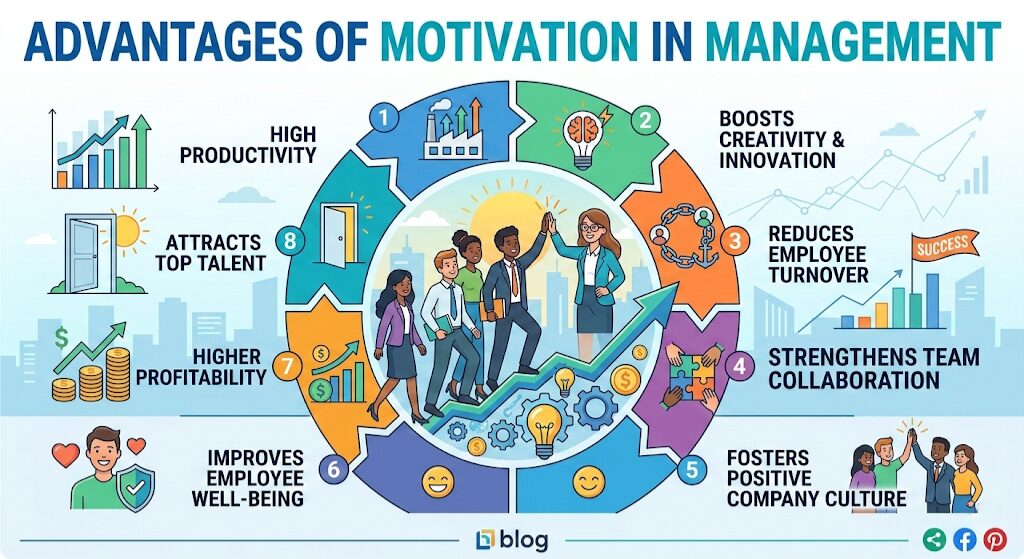
Every manager makes decisions about motivation, whether consciously or not. The structure of a job, the way feedback is delivered, the degree of autonomy granted, the recognition practices in place, the quality of team relationships, the clarity of organizational purpose — all of these are motivational design choices that collectively determine whether employees bring their full capabilities to work or carefully conserve them.
The evidence on the consequences of these choices is unambiguous. Organizations that invest in creating genuine motivational conditions for their people consistently and substantially outperform those that treat motivation as a secondary concern. The advantages documented across decades of organizational research are not marginal — they are transformative. Understanding each one in depth, and the mechanisms through which they operate, equips managers to make more intentional, more effective motivational choices at every level of their organization.
What Is Motivation in Management?
In management science, motivation is defined as the set of internal and external forces that initiate work-related behavior, determine its form, direction, intensity, and duration, and shape an employee’s willingness to exert sustained effort toward organizational objectives. It is not a single state or a fixed personality trait — it is a dynamic condition that fluctuates in response to the motivational conditions the organization creates, or fails to create.
The distinction between motivation and mere compliance is critical for management practice. A compliant employee does what is required to avoid negative consequences — meeting minimum performance standards while conserving discretionary effort, creativity, and genuine engagement. A motivated employee goes beyond compliance: they take initiative, apply creative problem-solving, volunteer for challenges, support colleagues, seek continuous improvement, and treat organizational goals as genuinely their own. The gap between these two behavioral modes is where the real value of motivation resides.
“Management is nothing more than motivating other people.” — Lee Iacocca, former CEO of Chrysler Corporation
Motivation in management is therefore not just a psychological curiosity — it is the central operational challenge of every manager at every level of every organization. Understanding its nature, its drivers, and its advantages is foundational to effective management practice. To understand how motivation integrates with the full scope of the management function, it helps to explore the definition and scope of management — specifically how the directing and leading functions of management are fundamentally motivational in their nature and purpose.
Types of Motivation in the Workplace
Motivation in organizational settings is usefully categorized across several dimensions. The most theoretically important distinction — with the most significant practical implications — is between intrinsic and extrinsic motivation.
Intrinsic Motivation
- Arises from the work itself — its interest, challenge, meaning, and enjoyment
- Driven by internal rewards: mastery, autonomy, purpose, curiosity
- Self-sustaining and self-amplifying — grows stronger with engagement
- Associated with higher quality, more creative outputs
- More durable — persists even without external reinforcement
- Fostered by: autonomy, meaningful work, growth opportunity, clear purpose
- Undermined by: excessive control, surveillance, contingent rewards that feel controlling
Extrinsic Motivation
- Arises from outside the work — rewards, recognition, status, compensation
- Driven by external outcomes: salary, bonuses, promotion, praise, titles
- Effective for routine, well-defined tasks with clear performance metrics
- Can crowd out intrinsic motivation if applied inappropriately to interesting work
- Requires ongoing provision — performance diminishes when rewards are removed
- Fostered by: fair pay, recognition programs, performance-linked rewards
- Undermined by: perceived unfairness, reward unpredictability, comparison inequity
Beyond this primary distinction, management practice commonly works with financial motivation (direct monetary rewards — salary, bonuses, profit-sharing, equity), non-financial motivation (recognition, career development, flexible working, meaningful work, autonomy), and social motivation (belonging, team cohesion, leadership relationships, organizational purpose). Comprehensive motivational management addresses all three dimensions, recognizing that different employees, roles, and contexts respond most powerfully to different motivational levers.
Key Motivation Theories Underpinning Management Practice
The advantages of motivation in management are not assertions — they are the accumulated findings of several decades of theoretical development and empirical research across the behavioral sciences. Six foundational theories provide the intellectual scaffolding on which evidence-based motivational management rests.
Maslow’s Hierarchy of Needs (1943)
Establishes that human needs exist in a hierarchy from physiological survival to self-actualization, and that management must address the active need level to produce motivational engagement. The foundation of humanistic management thinking.McGregor’s Theory X and Theory Y (1960)
Argues that management assumptions about human nature are self-fulfilling — Theory Y assumptions (people are capable, motivated, and self-directing) create the conditions for the motivational advantages documented throughout this guide.Herzberg’s Two-Factor Theory (1959)
Distinguishes hygiene factors (which prevent dissatisfaction but don’t motivate) from motivators (achievement, recognition, growth, responsibility) which create genuine positive motivation. Critical for compensation and job design strategy.Vroom’s Expectancy Theory (1964)
Motivation = Expectancy × Instrumentality × Valence. People are motivated when they believe effort will lead to performance, performance to reward, and the reward is genuinely valued. Essential for incentive design.Adams’ Equity Theory (1963)
Employees assess their motivation in relation to perceived fairness — comparing their input/outcome ratio to relevant others. Perceived inequity demotivates regardless of absolute reward level. Critical for pay and recognition design.Deci & Ryan’s Self-Determination Theory (1985)
Three basic psychological needs — autonomy, competence, and relatedness — must be satisfied for optimal functioning and wellbeing. The most empirically robust modern motivation framework, with strong cross-cultural evidence.Understanding these frameworks collectively provides the conceptual tools for diagnosing motivational problems and designing effective interventions. A manager whose team shows declining performance may find the issue lies in expectancy (people don’t believe effort leads to success), equity (people feel unfairly rewarded relative to peers), autonomy (work is over-controlled), or belonging (team relationships are fractured) — and each diagnosis points to a different solution. The principles of management, particularly those governing the directing function, provide the broader framework within which these motivational tools are deployed.

“The Progress Principle” — Teresa Amabile & Steven Kramer
Based on a landmark multi-year study of knowledge workers’ inner work lives, this book reveals that the single most powerful motivator at work is making progress on meaningful work — and shows managers exactly how to create those conditions every day.
View on Amazon →Advantage 1 — Significantly Increases Productivity and Performance
Motivation is the Engine of Discretionary Performance
- Gallup research shows highly engaged employees are 17–20% more productive than disengaged counterparts
- Motivated employees exert discretionary effort — going beyond what is merely required
- They work with greater focus, initiative, and creative problem-solving
- Productivity gains are sustained over time rather than spiking only under pressure
- Output quality improves alongside quantity — motivated people care about both
Productivity is the first and most extensively documented advantage of motivation in management, and it is also the most immediately consequential for organizational performance. The mechanism is straightforward but profound: motivation determines the degree to which employees invest their full capabilities — cognitive, creative, physical, relational — in their work rather than the minimum required to satisfy performance criteria and avoid negative consequences.
The difference between minimum required performance and full-capability performance is enormous. In knowledge work — which now accounts for the majority of economic value creation in developed economies — the gap between a disengaged employee doing enough to get by and a highly motivated employee operating at their ceiling can easily be a factor of two, three, or more in output value, not merely output volume. A motivated software engineer does not just write more code; they write better-architected, better-tested, more maintainable code that creates far more long-term value. A motivated sales professional does not just make more calls; they build more authentic customer relationships that generate higher lifetime value.
The Discretionary Effort Mechanism
The technical concept through which motivation translates into productivity is discretionary effort — the difference between the minimum effort required to keep one’s job and the maximum effort one is capable of contributing. Management can demand the minimum through policy and oversight. It cannot mandate the maximum. The maximum is always and entirely voluntary — the product of genuine motivation, not compulsion.
Research by Towers Watson found that organizations with high employee engagement show operating margins more than three times those of organizations with low engagement, even when controlling for industry, organizational size, and other performance variables. This finding reflects the compounding effect of discretionary effort across every function and every interaction in the organization — each one slightly better because the people involved are genuinely invested in the outcome.
Advantage 2 — Dramatically Reduces Employee Turnover and Absenteeism
Motivated Employees Stay — and Show Up
- Replacing an employee costs 50–200% of their annual salary (SHRM research)
- Motivated employees are significantly more likely to remain with their employer
- Absenteeism rates are 37% lower in engaged workforces (Gallup)
- Reduced turnover preserves institutional knowledge, team cohesion, and client relationships
- Lower recruitment costs free resources for higher-value investments
Employee turnover is one of the most financially significant and chronically underestimated costs in business. The Society for Human Resource Management (SHRM) estimates that replacing a single employee costs between 50% and 200% of that employee’s annual salary when accounting for recruitment, onboarding, training, lost productivity during the vacancy period, productivity ramp-up for the new hire, and the disruption cost to the remaining team. For skilled, senior, or specialized roles, the true cost often exceeds this estimate substantially.
Motivation is one of the strongest predictors of voluntary turnover. Employee engagement surveys consistently find that the primary reasons employees leave — lack of growth opportunity, poor management relationships, insufficient recognition, limited autonomy, inadequate pay relative to perceived contribution, and poor organizational culture — are almost entirely motivational in nature. They are not primarily leaving for more money (though adequate compensation matters); they are leaving for better motivational conditions.
The Retention Dividend
Organizations that invest in creating genuine motivational conditions benefit from what might be called the retention dividend: compounding advantages that accumulate as tenure increases. Long-tenured employees carry institutional knowledge that new hires must spend months or years developing. They have established customer and supplier relationships that represent genuine organizational assets. They have developed tacit skills and contextual intelligence that classroom training cannot replicate. And they contribute to the team stability and cultural consistency that enable new employees to integrate and develop quickly.
The absenteeism dimension of this advantage is equally significant. Research by Gallup consistently finds that disengaged employees take significantly more sick days than their engaged counterparts — not necessarily because they are more physically unwell, but because the motivational cost of attendance when work feels meaningless or unpleasant is simply too high to overcome on difficult days. Motivated employees — people who find their work genuinely engaging, their colleagues genuinely supportive, and their contributions genuinely valued — have a powerful internal reason to attend that disengaged employees simply do not possess.
Advantage 3 — Improves the Quality and Consistency of Work Output
Motivated People Care — and Caring Produces Quality
- Motivated employees apply greater care, attention, and cognitive investment to their work
- They proactively catch and correct their own errors before they escalate
- Error rates and defect rates are demonstrably lower in highly engaged teams
- Quality becomes intrinsically important — not just a compliance requirement
- Continuous improvement ideas emerge naturally from people who genuinely care about their work
Quality and motivation are connected through a mechanism that quality management systems alone cannot replicate: genuine caring about outcomes. A quality management system can specify what “good” looks like, require documentation, build in inspection steps, and penalize defects. But it cannot make an employee care whether their work is genuinely good — that is a motivational condition, not a procedural one.
Motivated employees develop what psychologists call ownership cognition about their work — they experience their outputs as extensions of themselves and therefore invest the kind of attention and pride in their quality that external monitoring can only approximate. They catch potential problems before they occur because they are genuinely paying attention. They seek feedback because they want to improve, not because improvement is required. They set higher personal quality standards than minimum requirements because the gap between adequate and excellent feels personally important to them.
Quality Motivation in Knowledge Work
In knowledge-intensive roles — consulting, research, software development, design, financial analysis — the quality gap between motivated and unmotivated work is particularly dramatic. Knowledge work quality is fundamentally dependent on cognitive engagement: the depth of analysis, the creativity of the solution, the quality of the judgment, the clarity and precision of the communication. These are not deliverable through compliance. They are only available through genuine motivation — specifically, the intrinsic motivation that comes from finding the work genuinely interesting, challenging, and meaningful.
This quality advantage connects directly to effective communication within organizations. The five Cs of effective writing — clarity, conciseness, completeness, correctness, and courtesy — are quality standards that require genuine attention and care to meet consistently. Motivated employees who take pride in their communication produce documentation, reports, and correspondence that are significantly more effective than the technically adequate output of disengaged workers simply going through the motions.
Advantage 4 — Drives Innovation and Creative Problem-Solving
Motivation Unlocks the Creative Capacity Organizations Desperately Need
- Intrinsic motivation is the strongest predictor of creative and innovative performance (Amabile)
- Motivated employees volunteer ideas, challenge assumptions, and pursue improvement proactively
- Psychological safety — an output of motivational management — enables risk-taking essential for innovation
- Companies with high engagement report innovation rates 2× higher than low-engagement counterparts
- Motivation sustains the persistence that complex innovation requires through failure and iteration
Innovation is perhaps the advantage of motivation that receives the least systematic attention but that is most consequential for long-term organizational survival. In stable markets, a demotivated but technically competent workforce can produce adequate outputs to sustain performance. In rapidly changing markets — which describes virtually every competitive environment in 2025 — the capacity for continuous adaptation, creative problem-solving, and genuine innovation is the primary source of durable competitive advantage.
Teresa Amabile’s decades of research on creativity in organizations consistently demonstrate that intrinsic motivation — the genuine engagement of curious, challenged, autonomy-experiencing employees — is the single most powerful driver of creative performance. Creativity cannot be commanded. It cannot be incentivized through simple pay-for-performance structures. It emerges when people are genuinely engaged with interesting problems, when they feel psychologically safe to propose unconventional ideas without fear of ridicule, when they have the autonomy to explore solution paths that are not pre-specified, and when they care enough about the outcome to persist through the inevitable failures that innovation requires.
Psychological Safety as a Motivational Output
Google’s Project Aristotle — a multi-year study of team performance across hundreds of Google teams — identified psychological safety as the single most important factor distinguishing high-performing from low-performing teams. Psychological safety is the shared belief that the team environment is safe for interpersonal risk-taking — that proposing an unusual idea, challenging a colleague’s assumption, or admitting uncertainty will not result in ridicule, punishment, or exclusion.
Psychological safety is, in motivational terms, a consequence of belonging and esteem needs being adequately met within the team. When managers create genuine motivational conditions — treating people with consistent respect, recognizing contributions genuinely, sharing credit fairly, and demonstrating that novel thinking is valued rather than penalized — they create the psychological safety conditions that enable the creative and innovative performance their organizations need.

“Intrinsic Motivation at Work” — Kenneth W. Thomas
A practical, research-grounded guide to building the conditions for intrinsic motivation in organizations — covering the four intrinsic rewards (sense of choice, competence, meaningfulness, progress) and how managers can systematically cultivate them.
View on Amazon →Advantage 5 — Builds Deep Organizational Commitment and Loyalty
Motivated Employees Treat Organizational Goals as Their Own
- Committed employees go beyond their defined role when the organization needs it
- They become organizational ambassadors — attracting talent and customers through authentic advocacy
- Organizational commitment correlates strongly with performance across all measured dimensions
- Committed employees are more resilient through organizational difficulty and change
- They contribute to organizational knowledge through active engagement rather than passive compliance
Organizational commitment — the degree to which an employee identifies with, is involved in, and is emotionally invested in their organization — is both a consequence of and a reinforcer of motivation. Committed employees are not merely satisfied with their jobs; they are genuinely invested in the organization’s success. They experience organizational wins as their own wins and organizational challenges as challenges they share ownership of. This psychological identification transforms the relationship between employee and organization from a transactional exchange into a genuine partnership.
Commitment operates through three distinct mechanisms. Affective commitment — emotional attachment to the organization — produces the highest quality motivational engagement because it is intrinsically driven. Normative commitment — a felt obligation to remain and contribute — maintains stable performance but without the creative and discretionary peaks of affective commitment. Continuance commitment — remaining because the costs of leaving are high — produces the minimum performance required but little more. Motivational management produces affective commitment; organizations that motivate only through compensation and benefits risks retaining employees on a continuance basis — technically present but not genuinely invested.
Commitment and Strategy Execution
The relationship between organizational commitment and strategic execution is particularly significant. The financial and non-financial benefits of strategic planning are only fully realized when the organization possesses the human conditions necessary for strategy execution — and commitment is chief among those conditions. A strategic plan executed by a committed workforce runs significantly ahead of projections; the same plan executed by an uncommitted workforce regularly falls short. Committed employees do not need to be managed through execution — they manage themselves toward the goals they have genuinely adopted as their own.
Advantage 6 — Enhances Employee Wellbeing and Reduces Burnout
Motivated Work Is Healthy Work
- Meaningful, autonomy-supporting work is consistently associated with better physical and mental health
- Burnout rates are significantly lower in teams with high psychological safety and intrinsic motivation
- Motivated employees report higher life satisfaction, lower stress-related illness, and better sleep
- Wellbeing benefits reduce healthcare costs, disability claims, and presenteeism
- The virtuous cycle: wellbeing supports motivation, which supports wellbeing
The relationship between motivation and employee wellbeing runs in both directions. Genuinely motivating work — work that provides autonomy, mastery, purpose, and social connection — is inherently health-supportive. Research in occupational psychology consistently demonstrates that work characterized by these qualities is associated with better mental health, lower anxiety and depression rates, better physical health outcomes, and higher subjective life satisfaction. Conversely, work that is motivationally impoverished — that offers no autonomy, no meaningful challenge, no genuine recognition, no social connection — produces the chronic stress response that is the primary driver of both burnout and a range of physical health consequences.
Burnout — the combination of emotional exhaustion, depersonalization, and reduced personal accomplishment that characterizes occupational overload — is frequently misdiagnosed as a workload problem when it is more accurately a motivational problem. Research by Christina Maslach and Michael Leiter identifies six workplace factors that predict burnout: unsustainable workload, lack of control, insufficient rewards, community breakdown, absence of fairness, and value conflicts. Five of these six are primarily motivational factors. Addressing workload without addressing the motivational factors is therefore addressing the symptom rather than the cause.
Advantage 7 — Improves Customer Satisfaction and Business Outcomes
Employee Motivation Flows Directly to the Customer Experience
- Motivated employees deliver warmer, more responsive, more genuinely helpful customer interactions
- The service-profit chain (Heskett et al.) links employee engagement directly to customer loyalty and profit
- Customer satisfaction scores are demonstrably higher in teams with higher employee engagement
- Motivated employees go beyond scripted service to create genuinely memorable customer experiences
- Customer complaint rates are lower; problem resolution rates are higher in engaged teams
The connection between employee motivation and customer outcomes is one of the most robustly documented findings in service management research. James Heskett and colleagues’ service-profit chain framework — developed through extensive research across service industries — establishes a clear causal sequence: internal service quality drives employee satisfaction, satisfaction drives retention and productivity, productivity drives external service value, service value drives customer satisfaction, and customer satisfaction drives profit and growth. Employee motivation is the engine of this chain.
The mechanism is intuitively clear but operationally important: customers interact with human beings, not with organizational systems or policies. The attitude, energy, care, and problem-solving capacity that frontline employees bring to customer interactions is a direct function of their motivational state. A motivated employee brings genuine warmth, attentiveness, and commitment to resolving customer issues. An unmotivated employee meets the minimum service standard required to avoid complaint — and customers can feel the difference, even when they cannot articulate it precisely.
Customer Loyalty as a Motivational Return
The financial returns from motivation-driven customer satisfaction compound over time through customer loyalty and advocacy. Loyal customers spend more, are less price-sensitive, generate lower service costs (they know how to use the product and need less support), and refer new customers — each of these representing genuine financial value that flows from the motivational conditions in which frontline employees operate. Organizations that invest in employee motivation are not just improving employee experience — they are building a customer loyalty asset with significant long-term financial value.
Advantage 8 — Strengthens Organizational Adaptability and Change Readiness
Motivated Organizations Navigate Change — Others Resist It
- Motivated employees engage constructively with change rather than resisting it defensively
- High-motivation organizations have the resilience to maintain performance through disruption
- Committed employees communicate problems upward — giving leaders the information needed to adapt
- Motivated teams develop new capabilities more rapidly in response to environmental change
- Trust — a motivational output — reduces the friction that change generates in low-trust organizations
In an era of accelerating competitive, technological, and regulatory change, organizational adaptability is not a peripheral concern — it is the central determinant of long-term survival. And motivation is, perhaps non-obviously, one of the most powerful drivers of adaptability. This is because organizational change is fundamentally a human phenomenon: it succeeds or fails not primarily based on the quality of the change plan but on the degree to which the people who must implement it are willing to invest genuine effort, tolerate uncertainty, develop new capabilities, and support each other through disruption.
Motivated employees engage with change as an opportunity rather than a threat. Their commitment to the organization’s success gives them a genuine stake in its successful adaptation. Their trust in leadership — built through the consistent respect, fairness, and recognition that motivational management provides — reduces the suspicion and resistance that makes change so costly in low-trust organizations. And their higher general capability, developed through the continuous learning that motivational conditions enable, means they acquire new skills more readily when change demands it.
The Communication Dimension of Change Adaptability
One of the most practically important ways motivation supports adaptability is through upward information flow. Motivated employees who trust their organization communicate honestly about problems — early, clearly, and with solutions rather than merely complaints. This information pipeline is critical for organizational learning and adaptation. Demotivated employees in low-trust organizations suppress bad news, work around problems rather than escalating them, and default to the status quo even when evidence that it is failing is obvious. Understanding the advantages and limitations of different communication channels is part of building the informational infrastructure that motivated, trust-based organizations require for effective adaptation.
The Financial Architecture of Motivation’s Advantages
The advantages of motivation translate directly and substantially into financial performance. The financial case for motivational investment is not intuitive to all managers — spending on things that feel “soft” (culture, recognition, development, management quality) requires a different investment logic than spending on equipment, technology, or marketing. But the evidence is clear: the financial returns from motivational investment are among the highest available to organizational leaders.
| Motivational Advantage | Primary Financial Mechanism | Measurable Metric | Typical Financial Impact |
|---|---|---|---|
| Productivity Increase | Higher output per employee per hour | Revenue per FTE; output per hour | 17–25% productivity premium |
| Turnover Reduction | Lower recruitment, onboarding, ramp-up costs | Cost per hire; time-to-productivity | 50–200% of annual salary per hire avoided |
| Quality Improvement | Fewer errors, rework, defects, warranty claims | Defect rate; rework cost; return rate | Varies; typically 10–30% cost reduction |
| Innovation Acceleration | Faster product development; better problem solving | Time to market; R&D ROI; patent rate | Competitive premium; 2× idea generation rate |
| Absenteeism Reduction | More effective working days per year per employee | Days absent per employee per year | 37% lower absenteeism in engaged teams |
| Customer Retention | Higher customer lifetime value; lower acquisition cost | NPS; CSAT; customer LTV; churn rate | 5% increase in retention = 25–95% profit increase |
| Wellbeing Improvement | Reduced healthcare costs; lower presenteeism | Healthcare spend; presenteeism index | 2–3× absenteeism cost from presenteeism alone |
The financial architecture connecting motivation to business performance is also visible at the level of fundamental financial management. Sound financial management requires accurate, reliable reporting — and the quality of internal financial processes depends heavily on the motivation and care of the people executing them. Understanding the golden rules of accounting is a technical requirement; but the discipline and accuracy with which those rules are applied in daily practice is a motivational one. Organizations with highly motivated finance teams produce more accurate financial data, catch errors earlier, and provide management with the financial visibility needed for intelligent decision-making.

“Employee Engagement: Tools for Analysis, Practice, and Competitive Advantage” — Macey, Schneider, Barbera & Young
The definitive research-based guide to understanding, measuring, and building employee engagement — with comprehensive coverage of the financial ROI of motivational investment and proven frameworks for engagement strategy.
View on Amazon →Motivation Within the Broader Management Framework
The advantages of motivation do not operate in isolation from the broader management framework — they are embedded within it, shaped by it, and in turn shape it. Understanding this relationship clarifies both how motivation creates its advantages and what management must do to enable those advantages consistently.
The classical management functions — planning, organizing, leading, and controlling — each have motivational dimensions that determine how effectively they translate organizational intent into performance. Planning without motivational engagement produces plans that are formally adopted but practically ignored. Organizing without motivational consideration produces structures that are technically logical but motivationally destructive. Leading without genuine attention to motivational conditions produces compliance at best and resistance at worst. Controlling without motivational sensitivity produces exactly the surveillance-and-punishment dynamic that systematically undermines the intrinsic motivation that high performance requires.
Communication as a Motivational Management Tool
Communication quality is one of the most powerful and most consistently underestimated motivational management tools available. Every communication from management is simultaneously a motivational act — it either reinforces or undermines belonging, esteem, clarity of purpose, and sense of value. The importance of clear, well-structured communication in business extends directly to its motivational consequences: transparent, respectful, purpose-clarifying communication from leadership builds the conditions for motivated engagement; opaque, dismissive, or inconsistent communication systematically erodes it.
The effect of communication on motivation is not limited to formal leadership communications. Team-level communication norms — how feedback is given and received, how conflict is navigated, how ideas are welcomed or dismissed, how recognition is expressed — are equally important as motivational infrastructure. Organizations that invest in building high-quality communication cultures at every level are simultaneously investing in the motivational conditions that produce every advantage documented in this guide.
Financial Management and Employee Motivation
The relationship between financial management practices and employee motivation deserves explicit attention. Compensation equity — the degree to which people believe their pay reflects their contribution fairly — is one of the most powerful predictors of motivation and commitment. Understanding the function of the financial manager in relation to human capital investment clarifies why compensation strategy, benefits design, and financial transparency are not merely HR concerns but genuine motivational management responsibilities. Employees who perceive their compensation as fair and their financial situation as stable (safety needs met) are available for higher-order motivational engagement; those who perceive inequity or insecurity are not.
| Management Function | Motivational Dimension | Motivational Risk if Neglected | Motivational Opportunity |
|---|---|---|---|
| Planning | Clarity of purpose; goal ownership | Confusion, directionless effort, disengagement | Participatory goal-setting creates genuine commitment |
| Organizing | Role clarity; autonomy; capability match | Confusion, micromanagement, talent waste | Role design that enables mastery and autonomy |
| Leading | Inspiration; trust; recognition; development | Compliance without commitment; talent departure | Transformational leadership creates affective commitment |
| Controlling | Fairness; feedback quality; accountability | Surveillance culture; risk aversion; dishonesty | Development-oriented feedback builds esteem and growth |
Barriers to Motivation: What Undermines the Advantages
Understanding the advantages of motivation is only half of the management challenge — understanding what systematically undermines motivation is equally important. The barriers to motivation are not exotic or difficult to identify; they are typically structural, cultural, and behavioral patterns embedded in organizational practice that are destroying motivational conditions faster than any motivational program can rebuild them.
| Barrier | Description | Motivational Damage | Management Response |
|---|---|---|---|
| Micromanagement | Excessive oversight and control over how work is done | Destroys autonomy; signals distrust; suppresses initiative | Delegate outcomes, not activities; practice trust-based oversight |
| Perceived Inequity | Unequal pay, recognition, or advancement relative to contribution | Triggers Adams’ equity theory demotivation; drives top performers out | Transparent, consistent, merit-based rewards; pay equity reviews |
| Poor Management Relationships | Disrespectful, dismissive, or uncaring manager behavior | Thwarts belonging and esteem needs; primary driver of turnover | Management development; 360 feedback; accountability for culture |
| Lack of Recognition | Contributions go unnoticed or unacknowledged | Thwarts esteem needs; reduces discretionary effort | Systematic, specific, timely recognition at all levels |
| Unclear Purpose | Employees don’t understand how their work contributes to meaningful goals | Undermines meaning and self-actualization motivation | Clear strategic communication; connecting roles to organizational purpose |
| Limited Growth Opportunity | No path for skill development, career progression, or new challenges | Thwarts self-actualization; primary driver of high-performer departure | Career pathing; stretch assignments; learning investment |
| Toxic Culture | Bullying, exclusion, political behavior, blame culture | Destroys safety, belonging, and esteem simultaneously | Cultural accountability; clear behavioral standards; leadership modeling |
Practical Strategies for Building Motivating Organizations
The advantages of motivation are not delivered automatically — they require deliberate, systematic management effort to create and maintain the conditions that enable them. These strategies are drawn from the research literature and from organizational practices consistently associated with high levels of employee motivation and engagement.
1. Design Work for Intrinsic Motivation
Hackman and Oldham’s Job Characteristics Model identifies five core job dimensions that predict intrinsic motivation: skill variety, task identity (completing whole, identifiable pieces of work), task significance (the degree to which the work matters), autonomy, and feedback. Systematically auditing and improving jobs along these dimensions — combining fragmented tasks, adding decision-making authority, connecting employees to the end-users of their work, and building in regular feedback — produces measurable improvements in motivation and performance that are both significant and durable.
2. Build Recognition Into Operational Rhythm
Recognition is among the highest-ROI motivational investments because it costs little financially while delivering significant motivational impact through esteem and belonging needs. The research identifies four qualities that make recognition effective: it must be specific (acknowledging the particular behavior or outcome), timely (delivered close to the event being recognized), sincere (genuinely felt, not formulaic), and appropriate in form (public or private depending on individual preference). Building these practices into regular team rhythms — not reserving them for annual reviews — creates the consistent motivational reinforcement that produces sustained engagement.
3. Invest in Manager Quality
Research consistently identifies the immediate manager relationship as the single most powerful predictor of employee motivation and engagement — more predictive than compensation, organizational culture, or job content. The Gallup finding that “people join companies but leave managers” has been replicated across industries and cultures. Investment in developing managers’ motivational intelligence — their ability to coach, recognize, develop, communicate with, and genuinely care about the people they lead — typically delivers the highest ROI of any organizational investment in motivation.
4. Create Genuine Autonomy and Accountability
Autonomy without accountability creates disorganization; accountability without autonomy creates the compliance-theater that systematically undermines intrinsic motivation. The balance that maximizes motivational outcomes involves clearly specifying the outcomes that employees are accountable for, and then genuinely devolving to them the authority to determine how those outcomes are achieved. This requires managers to distinguish between their legitimate accountability for outcomes and their illegitimate desire to control process — a distinction that is easy to understand intellectually and genuinely difficult to maintain under performance pressure.
5. Connect Work to Meaningful Purpose
The most powerful motivational lever available to organizational leaders is purpose — the connection between employees’ daily work and something that genuinely matters beyond the organization’s financial performance. Research by Dan Ariely and others demonstrates that people will work harder, longer, and more creatively for intrinsically meaningful goals than for financial rewards alone. Organizations that articulate and genuinely live a purpose beyond profit — and that create visible lines of sight between individual roles and that purpose — activate the self-actualization and transcendence needs that produce the most powerful and most durable motivational engagement available.
Frequently Asked Questions
What is motivation in management?
What are the main advantages of motivation in management?
How does motivation increase productivity in the workplace?
What is the relationship between motivation and employee retention?
How does motivation affect organizational performance?
What are the types of motivation in management?
How does motivation improve quality of work?
Can motivation in management reduce absenteeism?
How does motivation support innovation and creativity?
What role does motivation play in strategic management?
Conclusion: Motivation Is the Leverage Point of Management
The eight advantages explored in this guide are not independent benefits that can be adopted selectively. They are interconnected outcomes of a single underlying condition: an organization where the people doing the work are genuinely motivated to do it well. Productivity and quality improve together because both require the same genuine engagement. Innovation and adaptability strengthen simultaneously because both depend on the creative commitment that only intrinsic motivation produces. Retention and wellbeing reinforce each other through the same virtuous cycle of meaningful work and authentic recognition.
The case for investing in motivation is not ultimately a soft, people-centered case against the hard logic of financial performance. It is the hard financial case itself. Organizations with highly motivated workforces are measurably more profitable, more productive, more innovative, more customer-centric, and more adaptable than their demotivated peers. The investment required to create motivating conditions — primarily in management quality, work design, recognition practice, communication, and purpose clarity — is modest compared to the returns it generates.
For the individual manager, the practical implication is both simple and demanding: the most important thing you can do for the performance of your team is to create the conditions within which each person is genuinely motivated to bring their best. That requires knowing what motivates each individual (because motivation is not one-size-fits-all), designing work and recognition practices that address those motivations, removing the demotivating factors that are systematically undermining the conditions you are trying to build, and modeling the genuine engagement and commitment you want to see in your team.
Management is, at its core, a motivational discipline. Every management decision — about strategy, structure, compensation, communication, recognition, development, and culture — is simultaneously a motivational decision with measurable consequences for the performance it enables or prevents. The managers and organizations that understand this most clearly, and act on it most consistently, build the kind of extraordinary, compounding performance advantage that no competitor can easily replicate — because it is embedded not in technology, capital, or strategy, but in the most complex and valuable resource any organization possesses: its genuinely motivated, fully engaged human beings.
Continue Building Your Management Knowledge
Explore more comprehensive academic and applied guides on management, motivation, strategy, and organizational behavior — all designed to help serious students and practitioners build genuine understanding.
Browse All Guides on Edmics →