The Double-Edged Sword: Mastering Email Communication Advantages While Mitigating Disadvantages
A comprehensive strategic guide to leveraging email's unique strengths while navigating its inherent challenges in modern business communication
Introduction: The Email Paradox in Digital Communication
Email stands as one of the most paradoxical tools in modern business communication—simultaneously indispensable and overwhelming, efficient and time-consuming, personal yet impersonal. Since its commercial adoption in the 1990s, email has evolved from a novel electronic messaging system to the central nervous system of organizational communication, yet its very ubiquity has created both unprecedented opportunities and significant challenges. Understanding the complete landscape of email communication advantages and disadvantages isn't merely an academic exercise; it's a strategic imperative for professionals navigating today's digital workplace.
The dual nature of email becomes evident when we examine its role across different organizational functions. For marketing teams, email represents a remarkably effective channel for lead nurturing and customer engagement, boasting an average ROI of $42 for every $1 spent. Simultaneously, HR departments struggle with email overload that contributes to workplace stress and burnout. Executives value email's documentation capabilities during legal proceedings, while project managers lament the communication silos it can create. This complex duality demands nuanced understanding rather than simplistic categorization as either "good" or "bad."
What makes email particularly fascinating is its resilience amidst communication revolutions. While newer platforms like Slack, Teams, and WhatsApp have captured specific communication niches, email maintains its position as the universal protocol for formal business communication. Its open standards, platform independence, and asynchronous nature have allowed it to adapt and persist where proprietary systems have faltered. Yet this very persistence means that both its advantages and disadvantages continue to shape organizational dynamics, making strategic mastery of email communication not just valuable but essential for professional success.
Universal Accessibility: The Democratic Advantage
Email's most profound advantage lies in its near-universal accessibility across geographical, technological, and socioeconomic boundaries. Unlike proprietary messaging platforms that require specific software, organizational membership, or latest-generation devices, email functions on virtually any internet-connected device using open standards that have remained stable for decades. This democratization of communication enables seamless interaction between multinational corporations and rural small businesses, between tech-savvy millennials and digital immigrants, between office-based teams and remote workers in areas with limited connectivity.
Global Reach Without Barriers
The simplicity of email protocols means that a small business owner in Nairobi can communicate as effectively with suppliers in Nanjing as with customers in New York. This borderless functionality has transformed international business, enabling micro-multinationals to compete in global markets without substantial communication infrastructure investment. The asynchronous nature further bridges time zones, allowing 24-hour business cycles that would be impossible with synchronous communication methods.
Accessibility extends beyond geographical considerations to encompass technological inclusivity. Email doesn't discriminate between the latest smartphone and a decade-old desktop computer, between fiber-optic broadband and dial-up connections, between sophisticated email clients and basic web interfaces. This technological agnosticism ensures that communication remains possible even when resources are limited—a critical consideration for nonprofit organizations, educational institutions, and businesses operating in developing regions where technology adoption follows uneven patterns.
The standardization of email protocols (SMTP, POP3, IMAP) creates an interoperability advantage unmatched by proprietary systems. While platform-specific messaging apps create walled gardens that restrict communication to users within the same ecosystem, email functions as a universal communication layer connecting disparate systems. This openness fosters innovation in email clients, security tools, and integration platforms while preventing vendor lock-in that could compromise organizational communication resilience.
Documentation & Record Keeping: The Institutional Memory Advantage
Email's capacity as a documentation system represents one of its most significant professional advantages, creating searchable, timestamped records of decisions, agreements, and communications that become part of an organization's institutional memory. Unlike verbal conversations that exist only in participants' recollections or transient messaging apps where history disappears by design, email threads preserve context, rationale, and accountability in ways that protect organizations legally and operationally.
The evidentiary value of email becomes particularly crucial in regulated industries, contractual relationships, and compliance environments. When disputes arise—whether regarding project specifications, delivery timelines, service agreements, or employment matters—email archives provide objective records that can clarify misunderstandings, establish timelines, and demonstrate good faith efforts. This documentation function extends beyond legal protection to operational continuity, allowing new team members to reconstruct decision-making processes and understand historical context without relying on potentially unreliable oral transmission.
Searchability transforms email archives from passive storage to active knowledge management systems. Modern email clients with robust search capabilities enable professionals to retrieve specific information from thousands of messages using keyword, sender, date, attachment type, and conversation thread parameters. This retrievability accelerates problem-solving, prevents redundant work, and facilitates information sharing across teams and departments. When integrated with CRM and project management systems, email becomes part of a comprehensive knowledge ecosystem rather than an isolated communication channel.
However, this documentation advantage carries corresponding responsibilities and risks. The permanent nature of email records means that poorly considered messages, confidential information shared inappropriately, or price-sensitive information disclosed prematurely can have lasting consequences. Organizations must balance the benefits of comprehensive documentation with appropriate policies governing retention, confidentiality, and professional communication standards to prevent documentation from becoming a liability.
Cost-Effectiveness: The Economic Advantage
From a pure economic perspective, email delivers communication capabilities at a cost point that remains astonishingly favorable compared to alternatives. The marginal cost of sending an email approaches zero, enabling organizations to communicate with thousands of stakeholders for less than the price of a single traditional mail piece or telephone call. This economic efficiency has democratized business communication, allowing startups and small businesses to compete with established corporations in reaching and engaging their target audiences.
Marketing ROI Unmatched by Other Channels
For marketing professionals, email's cost-effectiveness translates to an average return on investment of 4200%—a figure that dwarfs most other marketing channels. This exceptional ROI stems from email's unique combination of precision targeting, personalization capabilities, measurable engagement, and automation potential. While social media platforms charge increasingly premium rates for organic reach and advertising space, email maintains direct access to interested audiences without algorithmic intermediaries or pay-to-play constraints.
Operational cost savings extend beyond marketing to encompass internal communication, vendor management, customer support, and stakeholder engagement. Consider the alternative costs: printed memos requiring paper, printing, and distribution; telephone conferences consuming employee time and potentially incurring long-distance charges; in-person meetings necessitating travel, facilities, and coordination time. Email accomplishes many of these communication objectives at a fraction of the cost while creating searchable records that further enhance organizational efficiency.
The scalability of email infrastructure means that communication costs don't increase proportionally with organizational growth. Whether sending messages to ten colleagues or ten thousand customers, the underlying technology and processes remain essentially similar. This scalability advantage enables businesses to expand their communication reach without corresponding increases in communication budgets—a critical factor for growth-stage companies and organizations with fluctuating communication volumes.
Asynchronous Communication: The Productivity Advantage
Email's asynchronous nature represents both a significant advantage and a subtle disadvantage, depending on context and management. Unlike telephone calls, video conferences, or instant messaging that demand immediate attention and response, email allows recipients to process messages according to their own schedules, priorities, and cognitive rhythms. This temporal flexibility respects individual work patterns while enabling global collaboration across time zones that would be impossible with synchronous methods.
The productivity benefits of asynchronous communication manifest in several dimensions. First, it allows for considered responses rather than reactive replies. Professionals can research information, consult colleagues, reflect on implications, and craft thoughtful responses instead of providing immediate but potentially incomplete or ill-considered answers. This quality enhancement proves particularly valuable for complex subjects, sensitive matters, or communications requiring precision and nuance that real-time exchanges often sacrifice.
Second, asynchronous communication reduces interruptions—one of the most significant productivity drains in knowledge work. The constant context-switching caused by instant messages, phone calls, and "quick questions" disrupts deep work and extends task completion times substantially. Email, when used with proper discipline (such as designated checking times rather than constant monitoring), enables sustained focus periods that enhance both quality and quantity of output. This advantage aligns with modern productivity research emphasizing the value of uninterrupted work blocks.
However, the asynchronous advantage depends heavily on communication norms and expectations. When senders expect instant responses regardless of message complexity or timing, email loses its asynchronous benefits and becomes a source of stress. Organizations must establish and reinforce reasonable response-time expectations that balance urgency needs with respect for focused work time. This cultural dimension often determines whether email's asynchronous nature serves as productivity enhancer or anxiety generator.

Strategic Communication Framework
Develop a comprehensive approach to business communication that balances email with other channels. Learn when to use asynchronous versus synchronous methods for maximum effectiveness.
Access Communication Strategy ResourcesPersonalization & Scalability: The Marketing Advantage
Email uniquely combines personalization capabilities with massive scalability—a combination that explains its enduring dominance in digital marketing. Modern email platforms enable dynamic content insertion based on recipient data, behavioral triggers, and segmentation criteria, allowing messages to feel individually crafted even when delivered to thousands or millions of recipients. This scalability-personalization paradox creates marketing efficiency that other channels struggle to match.
The technical infrastructure supporting personalized email has evolved dramatically, moving beyond simple name insertion to include product recommendations based on purchase history, content suggestions aligned with engagement patterns, timing optimization according to individual open behaviors, and dynamic offers reflecting real-time inventory or promotional calendars. These capabilities transform email from broadcast medium to conversation platform, albeit one-directional, that builds relationships through relevant, timely communication.
Automation extends email's scalability advantage further through triggered sequences that respond to specific customer actions or milestones. Welcome series for new subscribers, re-engagement campaigns for dormant contacts, post-purchase follow-up sequences, and anniversary messages all operate automatically once configured, delivering personalized communication at scale without continuous manual intervention. This automation enables small marketing teams to maintain communication with large audiences while focusing creative energy on strategy and content quality rather than repetitive sending tasks.
However, this powerful advantage carries ethical and practical considerations. Over-personalization can feel invasive rather than helpful, especially when based on data sources recipients didn't explicitly provide for marketing purposes. Scalability can deteriorate into spam when list acquisition prioritizes quantity over quality. The most effective email programs balance personalization with privacy respect, and scalability with relevance maintenance—a balance requiring strategic sophistication beyond technical capability alone.
Communication Overload: The Volume Disadvantage
Email's greatest advantage—its accessibility and ease of use—paradoxically creates its most significant disadvantage: overwhelming volume that consumes professional time and cognitive resources. The average office worker receives 121 emails daily and spends approximately 28% of their workweek managing email correspondence. This volume generates decision fatigue, interrupts focused work, and creates a perpetual sense of being behind that undermines both productivity and wellbeing.
The Attention Economy Tax
Every email represents a micro-decision: read now or later? respond immediately or defer? file, delete, or archive? These countless micro-decisions cumulatively tax cognitive resources that could be directed toward higher-value activities. The constant context-switching between email and primary tasks reduces productivity by up to 40% according to some studies, as the brain requires time to re-engage deeply with interrupted work.
The volume problem extends beyond individual inbox management to organizational coordination challenges. Important messages risk being overlooked amidst the noise, requiring redundant communication through other channels. Decision-making slows as participants await email responses rather than engaging in real-time dialogue. Information silos develop when teams rely on lengthy email threads rather than centralized knowledge repositories accessible to all stakeholders.
Cultural factors exacerbate email overload when organizations lack norms around appropriate use. The expectation of immediate responses regardless of message importance, the CC/BCC practice of involving unnecessary participants "just in case," the tendency to email rather than walk a few feet for quick conversations—these behaviors transform email from useful tool to productivity barrier. Addressing volume disadvantages requires both technical solutions (filtering, prioritization algorithms, automation) and cultural interventions (communication protocols, response expectations, channel selection guidelines).
Interestingly, the solution to email overload often involves more communication—but of a different kind. Establishing team agreements about when to use email versus instant messaging, creating guidelines for subject line clarity and action requests, and implementing regular inbox hygiene practices can dramatically reduce email's negative impacts while preserving its advantages. This meta-communication about communication represents a maturity marker for organizations navigating digital collaboration challenges.
Misinterpretation Risk: The Context Disadvantage
Email's textual nature strips away the nonverbal cues—tone, facial expressions, body language, vocal inflection—that convey meaning and intent in face-to-face communication. This reduction to pure text creates interpretation ambiguity that can transform innocuous messages into perceived slights, straightforward requests into offensive demands, and professional feedback into personal criticism. The misinterpretation risk represents one of email's most insidious disadvantages, capable of damaging relationships and undermining collaboration even when senders have positive intentions.
The problem intensifies with cultural differences, where linguistic nuances, humor conventions, and directness norms vary significantly. What reads as efficient professionalism in one cultural context may register as cold indifference in another. Sarcasm and irony—already risky in written form—become particularly dangerous across cultural boundaries where they may be interpreted literally rather than rhetorically. These cross-cultural pitfalls require extraordinary consideration in communication to navigate successfully.
Temporal displacement further compounds interpretation challenges. An email composed during frustration reads differently hours later when emotions have cooled. A message written quickly between meetings may lack the nuance necessary for clear understanding. Without the immediate feedback loop of conversation where misunderstandings can be corrected in real time, email misinterpretations can persist and escalate before opportunities for clarification arise.
Mitigating misinterpretation risk requires deliberate strategies: adopting the five Cs of effective writing (clear, concise, compelling, correct, and complete); using formatting to emphasize key points without seeming to "shout"; incorporating occasional video messages for complex or sensitive topics; establishing norms for tone indicators when intent might be ambiguous; and most importantly, picking up the phone or having in-person conversations when emails begin generating more confusion than clarity.
Security Vulnerabilities: The Trust Disadvantage
Email's open architecture and widespread adoption make it a prime target for security threats ranging from phishing and malware distribution to business email compromise and data exfiltration. The very features that make email accessible—standardized protocols, interoperability, and forwardability—also create security vulnerabilities that proprietary, walled-garden systems avoid. This security disadvantage requires continuous vigilance and investment that organizations often underestimate until experiencing breaches.
Phishing attacks exemplify email's security paradox: the platform's trust and familiarity become weapons against users. Well-crafted phishing emails mimic legitimate senders so effectively that even security-conscious professionals can be deceived, particularly when messages align with current work contexts or exploit psychological triggers like urgency, curiosity, or authority. The democratization of phishing tools and services has lowered barriers for attackers while increasing sophistication, creating an asymmetric threat where defense costs substantially exceed attack costs.
| Security Threats | Potential Impact | Mitigation Strategies |
|---|---|---|
| Phishing & Spear Phishing | Credential theft, financial fraud, data breaches | Multi-factor authentication, user training, email filtering |
| Malware Distribution | System compromise, ransomware, data loss | Attachment scanning, URL analysis, endpoint protection |
| Business Email Compromise | Financial fraud, reputational damage, legal liability | Payment verification protocols, email authentication |
| Data Exfiltration | Intellectual property theft, regulatory violations | Data loss prevention, encryption, access controls |
| Impersonation Attacks | Fraud, misinformation, reputational harm | DMARC/DKIM/SPF implementation, user awareness |
The human element represents email security's greatest vulnerability and potential strength. While users can be manipulated through social engineering, they can also be trained to recognize threats and follow security protocols. Effective email security balances technological solutions (encryption, authentication protocols, AI-powered threat detection) with human-centered approaches (continuous education, clear policies, security-positive culture). Organizations that view email security as purely technological typically experience higher breach rates than those addressing both technical and human dimensions.
Productivity Drain: The Time Disadvantage
The cumulative time spent managing email constitutes one of its most substantial disadvantages, consuming approximately 3.1 hours daily for the average professional. This time investment includes not just reading and responding, but also organizing, filing, searching, and deciding about messages. The productivity drain extends beyond direct email time to include the cognitive residue of interrupted workflows and the anxiety generated by overflowing inboxes.
The Inbox as Task List Fallacy
Many professionals misuse their inbox as a de facto task list, leaving messages unprocessed as reminders of pending work. This practice creates several problems: important tasks hide among less important messages; tasks lack prioritization and deadlines; and the constant visual reminder of unfinished work generates stress. Transforming email from task storage system to processing workflow represents one of the most effective productivity interventions available.
The fragmented nature of email work prevents deep concentration on substantive tasks. Research indicates that after an email interruption, workers take an average of 64 seconds to return to their original task—if they return at all. Constant email checking creates a state of continuous partial attention that reduces cognitive capacity for complex problem-solving and creative work. The dopamine-driven reward cycle of new messages further reinforces checking behavior despite its productivity costs.
Organizational practices often exacerbate individual productivity challenges. Reply-all storms, unnecessary CCing, vague subject lines, and buried action requests all increase the time required to process each message. Meetings scheduled via lengthy email chains, document collaboration through attachment versioning, and decision-making through scattered threads represent workflow anti-patterns that email facilitates but better tools now exist to address.
Addressing email's productivity disadvantages requires both personal behavior changes and organizational system improvements. Personal strategies include designated email processing times, inbox zero methodologies, templated responses for common inquiries, and ruthless unsubscription from non-essential lists. Organizational improvements encompass communication channel guidelines, collaboration platform integration, email culture norms, and training in effective email practices that respect both sender and recipient time.
Comparative Channel Analysis: Email in Context
| Communication Channel | Best Use Cases | Email Advantages Leveraged | Email Disadvantages Addressed | When to Choose Over Email |
|---|---|---|---|---|
| Instant Messaging (Slack, Teams) | Quick questions, team coordination, urgent matters | Faster than email for simple exchanges | Reduces email volume for trivial matters | Time-sensitive issues, informal coordination, quick clarification |
| Video Conferencing | Complex discussions, relationship building, sensitive conversations | Visual cues reduce misinterpretation | Prevents lengthy email threads on complex topics | Emotional topics, complex problem-solving, team building |
| Project Management Tools | Task assignment, progress tracking, document collaboration | Centralized information reduces email searching | Eliminates attachment version confusion | Multi-step projects, task dependencies, resource allocation |
| Phone Calls | Immediate feedback, nuanced discussions, relationship maintenance | Voice tone conveys nuance text cannot | Prevents email misinterpretation | Emotionally charged situations, complex negotiations, personal connections |
| In-Person Meetings | High-stakes decisions, creative brainstorming, conflict resolution | Full nonverbal communication available | Prevents decision paralysis from email delays | Strategic planning, innovation sessions, relationship-critical discussions |
| Formal Documents | Policies, procedures, formal agreements, complex specifications | Structured format for complex information | Prevents important details buried in email threads | Legal documents, official policies, detailed specifications |
This comparative analysis reveals that email's disadvantages often emerge not from inherent flaws but from inappropriate application to communication needs better served by other channels. The strategic question becomes not "email or not?" but "which communication channel best serves this specific purpose given context, participants, and objectives?" Organizations that develop channel selection frameworks—guidelines for when to use email versus alternatives—typically experience reduced communication frustration and increased collaboration effectiveness.
Email's optimal role emerges as the "connective tissue" between specialized communication platforms: the formal record of decisions made elsewhere, the notification system for updates in other tools, the universal fallback when specialized platforms fail or participants lack access. This connective function leverages email's universality while containing its disadvantages through complementary use of other channels. The most sophisticated communication strategies position email as one component in an integrated ecosystem rather than the default for all business communication.
Strategic Implementation Framework: Maximizing Advantages, Minimizing Disadvantages
Transforming email from productivity drain to strategic asset requires a systematic approach addressing individual habits, team norms, organizational policies, and technological configurations. This framework encompasses four interrelated dimensions that collectively determine email effectiveness: personal mastery, team protocols, organizational culture, and technical optimization. Progress in one dimension reinforces others, creating a virtuous cycle of communication improvement.
Personal Email Mastery
Individual professionals can immediately implement practices that dramatically improve their email experience. The "Four Ds" framework (Delete, Delegate, Do, Defer) provides decision structure for processing messages. Time blocking for email (typically 2-3 scheduled sessions daily) prevents constant interruption. Template development for common responses saves composition time. Unsubscription campaigns reduce incoming volume. These personal practices, while simple in concept, require discipline to implement consistently amid competing demands.
Team Communication Protocols
Teams that establish explicit email norms experience significantly reduced frustration. Protocols might include: expected response times by message priority; subject line conventions indicating action required; guidelines for CC/BCC usage; agreements about when to move conversations to other platforms; and standards for attachment handling. These protocols work best when developed collaboratively rather than imposed, and when periodically reviewed and adjusted based on experience. Teams might also designate "email-free" focus periods to enable deep work without interruption.
Organizational Culture & Policies
Organizational leadership plays a crucial role in shaping email culture through modeling, policy development, and resource allocation. Policies should balance security requirements with usability, documentation needs with privacy considerations, and responsiveness expectations with respect for focused work time. Training programs should address both technical skills (effective writing, security awareness) and behavioral patterns (managing overwhelm, channel selection). Perhaps most importantly, leaders must model the communication behaviors they wish to see, demonstrating that important decisions can wait for considered responses rather than instant reactions.
Technical Optimization
Modern email platforms offer features dramatically underutilized by most organizations. Rules and filters automatically categorize incoming messages. Snooze functions temporarily remove non-urgent messages from view. Integration with task management systems converts emails to actionable items. AI-powered features prioritize important messages, suggest responses, and highlight follow-up needs. Security configurations authenticate legitimate senders while filtering threats. Regular review and optimization of these technical capabilities can address many email disadvantages without changing user behavior.
Future Trends & Evolution: The Next Generation of Email
Email continues evolving in response to its disadvantages while preserving its core advantages. Artificial intelligence represents the most significant current evolution, with machine learning algorithms increasingly able to prioritize messages, suggest responses, summarize threads, detect anomalies, and automate routine communications. These AI enhancements address email's volume and time disadvantages while potentially introducing new concerns about privacy, authenticity, and over-automation.
Integration with other communication and productivity platforms continues blurring email's boundaries. Rather than standalone application, email increasingly functions as notification layer for activity occurring elsewhere: project updates, calendar changes, document collaborations, customer relationship interactions. This integration trend addresses email's siloing disadvantage while potentially creating new complexity in managing interconnected systems. The challenge becomes maintaining email's universality advantage while enabling deep integration with specialized platforms.
Security innovations attempt to address email's trust disadvantages without compromising accessibility. Blockchain-based authentication, end-to-end encryption by default, AI-powered threat detection, and decentralized identity systems all represent attempts to enhance security while preserving email's open standards. These innovations face adoption challenges balancing security with usability, and decentralization with interoperability—the same tensions that have shaped email since its inception.
Perhaps the most intriguing evolution involves reimagining email's fundamental metaphors and interfaces. The "inbox" concept itself—a single chronological stream of all messages—may give way to context-aware interfaces that surface messages based on current tasks, relationships, and priorities. Conversation threading might evolve to incorporate related documents, meetings, and other communication channels. These interface innovations could dramatically reduce email's cognitive load while preserving its archival and asynchronous advantages.

The Future of Digital Communication
Stay ahead of communication trends with insights into evolving technologies and practices. Understand how email is transforming alongside other digital collaboration tools.
Explore Future of Work ResourcesFrequently Asked Questions About Email Communication
The most significant advantage is email's unique combination of universal accessibility and asynchronous communication. Unlike platform-specific tools requiring particular software or organizational membership, email works across all devices and systems worldwide. Unlike synchronous methods demanding immediate attention, email allows recipients to respond according to their own schedules and priorities. This dual advantage enables global collaboration across time zones and technological barriers that no other communication channel replicates as effectively.
Effective strategies include: establishing clear guidelines about when to use email versus other channels; implementing team agreements about response time expectations; training in concise writing and clear subject lines; utilizing filters and rules to prioritize important messages; scheduling specific times for email processing rather than constant checking; and regularly auditing subscription lists to eliminate unnecessary communications. The most effective approach combines technological solutions with cultural norms that respect both senders' and recipients' time and attention.
Email remains critically relevant precisely because of—not despite—newer platforms. While tools like Slack excel at team coordination and instant messaging thrives for quick questions, email serves as the universal protocol connecting different organizations, generations, and technological ecosystems. Its open standards, platform independence, and asynchronous nature make it the common denominator in business communication. Rather than being replaced, email's role is evolving to complement specialized platforms while maintaining its position as the formal record and cross-boundary connector.
Common security mistakes include: clicking links or opening attachments without verifying the sender; using weak or reused passwords; failing to enable multi-factor authentication; sending sensitive information without encryption; using public Wi-Fi without VPN protection; falling for urgency-based phishing tactics; and inadequate training on evolving threat patterns. Perhaps the most significant mistake is assuming email security is solely IT's responsibility rather than a shared organizational concern requiring both technological safeguards and user awareness.
While press releases serve as important business communication for public announcements targeting media and broad audiences, email targets specific stakeholders with personalized messaging. Press releases carry greater formal weight and media pickup potential, while email enables direct, measurable engagement with known contacts. For internal announcements or communication with existing relationships, email often proves more effective. For public announcements seeking media coverage or broad visibility, press releases remain essential. The most comprehensive announcement strategies often employ both channels strategically.
Ideal response times vary by context, relationship, and message urgency, but general guidelines suggest: urgent time-sensitive matters within 1-2 hours; important but non-urgent messages within 24 business hours; general inquiries within 48 hours; and non-essential messages when time permits. The key is setting and communicating realistic expectations. Auto-responders during vacations or heavy workload periods manage expectations effectively. What damages professional relationships isn't delayed responses but unexplained delays that leave senders uncertain whether messages were received.
Prevent misinterpretation by: avoiding sarcasm and humor that may not translate; using clear, literal language; incorporating occasional video messages for complex topics; explicitly stating intent when it might be ambiguous; learning cultural communication norms for international correspondents; using formatting (bold, bullets) for clarity without appearing to shout; and picking up the phone when emails generate confusion. Applying principles of consideration in communication—thinking from the recipient's perspective—dramatically reduces misinterpretation risk across all contexts.
Email creates binding legal records that can be used in contracts, disputes, regulatory proceedings, and employment matters. Key implications include: emails can form or modify contracts; deleted emails may still be recoverable in litigation; confidentiality breaches through email can violate laws and agreements; inadequate security may violate data protection regulations; and email retention policies must comply with legal requirements. Organizations should establish clear policies regarding email use for legally sensitive matters and ensure proper training on these implications.
Mobile technology has made email constantly accessible, blurring boundaries between work and personal time. This accessibility increases responsiveness expectations while contributing to communication overload. Mobile interfaces encourage shorter, more frequent messages rather than comprehensive communications. Notifications create constant interruptions regardless of location. The "thumb-friendly" nature of mobile email favors brevity over nuance. While mobile access provides flexibility advantages, it also intensifies many email disadvantages unless users establish boundaries around availability and response expectations.
Artificial intelligence will significantly impact email through intelligent prioritization, automated responses, threat detection, and workflow integration. Blockchain may enhance authentication and security. Natural language processing could enable semantic search beyond keywords. Integration with augmented reality might create more immersive email experiences. However, the most impactful changes may involve interface redesigns that move beyond the inbox metaphor toward context-aware communication hubs. Regardless of specific technologies, email's core advantages of universality and asynchronicity will likely preserve its central role while its implementation evolves.
Conclusion: Strategic Balance in Email Communication
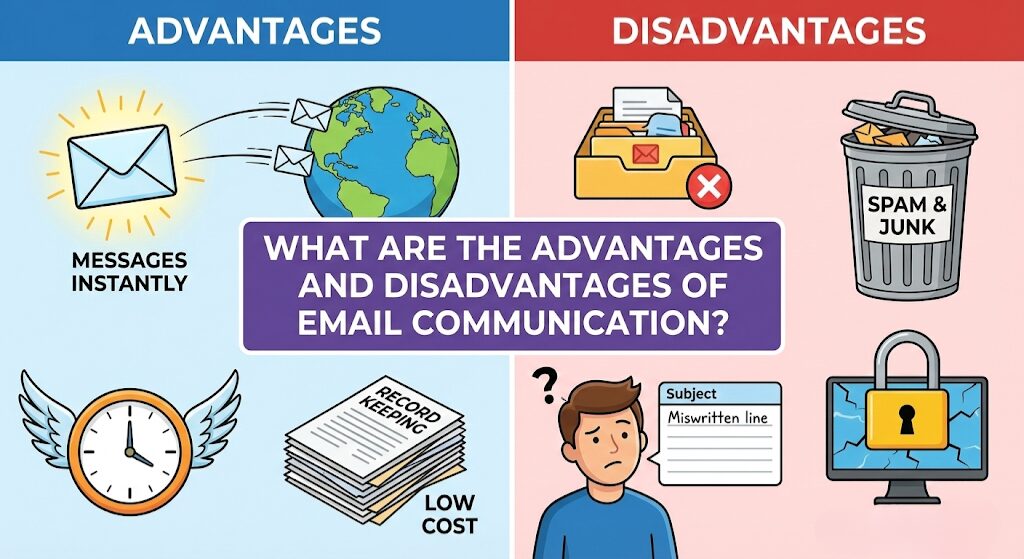
Email communication represents a classic double-edged sword in business—a tool of remarkable power that simultaneously enables and undermines professional effectiveness. Its advantages of universal accessibility, cost-effectiveness, documentation capability, and asynchronous flexibility explain its enduring dominance despite numerous competitors. Its disadvantages of overload, misinterpretation risk, security vulnerability, and productivity drain explain the constant search for alternatives and supplements. The strategic imperative isn't choosing between email's advantages and disadvantages but developing sophisticated approaches that maximize the former while systematically mitigating the latter.
The most effective professionals and organizations recognize that email excellence requires both technical mastery and cultural intelligence. Technical mastery encompasses writing clarity, security awareness, efficiency systems, and platform optimization. Cultural intelligence involves understanding communication norms, setting appropriate expectations, selecting channels strategically, and respecting recipients' time and cognitive resources. This dual competence transforms email from necessary evil to strategic asset—a tool that connects rather than isolates, clarifies rather than confuses, and enables rather than obstructs meaningful work.
As digital communication continues evolving, email's role will likely shift rather than disappear. Its function as universal connector between disparate systems and people remains uniquely valuable in fragmented technological landscapes. The organizations that thrive will be those that approach email not as default communication method but as deliberate choice within a portfolio of options—using email where its advantages shine while employing other channels where email's disadvantages would dominate. This strategic selectivity, combined with continuous improvement of email practices themselves, represents the path to communication excellence in an increasingly complex digital workplace.
Ultimately, email's advantages and disadvantages reflect broader truths about communication itself: that every channel involves trade-offs, that effectiveness depends more on skillful use than inherent properties, and that the most powerful tools require the most thoughtful application. By understanding email's complete landscape—strengths and weaknesses, opportunities and threats—professionals can wield this ubiquitous tool with precision rather than frustration, creating connections that drive business success while preserving the focus and wellbeing necessary for sustained performance.