📖 Table of Contents ▼
- Introduction
- Who Was Abraham Maslow?
- Origins of the Theory
- The Pyramid Visualized
- Level 1 — Physiological Needs
- Level 2 — Safety Needs
- Level 3 — Love & Belonging
- Level 4 — Esteem Needs
- Level 5 — Self-Actualization
- D-Needs vs. B-Needs
- Characteristics of Self-Actualized People
- Extended Hierarchy (8 Levels)
- Application in Management
- Application in Education
- Academic Criticisms
- Related Motivation Theories
- Modern Relevance
- FAQs
- Conclusion
Maslow’s Hierarchy of Needs Theory: A Complete Academic and Applied Guide
First proposed in a 1943 paper that set out to understand what fundamentally drives human behavior, Abraham Maslow’s Hierarchy of Needs has become arguably the most recognized framework in the history of motivational psychology. It reshaped how psychologists, educators, managers, and policymakers think about human development — and its five-tiered structure remains as generative a starting point for understanding motivation as it was eighty years ago.
The theory’s staying power is not accidental. Maslow identified something that rang true to human experience in a way that the two dominant psychological paradigms of his era — psychoanalysis and behaviorism — largely missed: that human beings are not merely creatures responding to past wounds or external stimuli, but beings oriented toward growth, meaning, and the realization of their own highest possibilities. This positive, forward-looking orientation was radical in its time and remains resonant in ours.
This guide examines the Hierarchy of Needs with the depth the subject demands. We move through Maslow’s biography and intellectual context, the theoretical architecture of the framework from base to apex, its distinction between deficiency and growth needs, the characteristics he identified in self-actualized individuals, his lesser-known expanded eight-level model, the framework’s applications in management and education, its substantive academic criticisms, and its continuing relevance in a world Maslow could not have imagined.
Who Was Abraham Maslow?
Abraham Harold Maslow was born on April 1, 1908, in Brooklyn, New York, to first-generation Russian-Jewish immigrant parents. His early life was, by his own account, marked by significant social isolation and academic refuge — a difficult childhood that may have sharpened his sensitivity to the conditions required for psychological health and authentic human flourishing. He pursued education with intensity, eventually earning his BA, MA, and PhD in psychology from the University of Wisconsin, where he worked under the behaviorist psychologist Harry Harlow, studying primate dominance and sexuality.
Maslow’s intellectual journey took a decisive turn in the early 1940s, when encounters with the cultural anthropologist Ruth Benedict and the Gestalt psychologist Max Wertheimer profoundly changed how he thought about psychological health. Rather than studying pathology — the dominant orientation of clinical psychology — he became fascinated by what made these remarkable individuals thrive. His notes from observing them became the seed from which his theory of self-actualization would eventually grow.
“What a man can be, he must be. This need we may call self-actualization.” — Abraham Maslow, A Theory of Human Motivation, 1943
Maslow spent most of his academic career at Brandeis University (1951–1969), where he developed his full theoretical framework and became one of the founding figures of humanistic psychology — the so-called “third force” in psychology after psychoanalysis and behaviorism. He served as president of the American Psychological Association in 1967–1968, reflecting his standing in the discipline at the height of his influence. He died of a heart attack on June 8, 1970, leaving behind a body of work that would shape psychology, management theory, education, and social policy for generations.
Maslow’s Intellectual Environment
Understanding Maslow’s contribution requires appreciating what he was responding to. Psychoanalysis, dominated by Freud and his successors, understood human behavior primarily through the lens of unconscious conflict, childhood trauma, and the management of instinctual drives. Behaviorism, championed by Watson and Skinner, studied behavior as a function of stimulus-response conditioning, largely setting aside questions of inner experience and motivation. Both schools, Maslow believed, were systematically biased toward the pathological and the mechanical, producing a picture of human nature that was fundamentally impoverished.
Humanistic psychology, which Maslow helped found alongside Carl Rogers, Viktor Frankl, and others, insisted on studying the full range of human experience — including health, creativity, love, and the striving for meaning. The Hierarchy of Needs was Maslow’s most systematic theoretical contribution to this project: a framework that integrated the full spectrum of human motivation, from the biological imperatives shared with all animals to the uniquely human capacity for self-transcendence.
Origins and Theoretical Foundations of the Framework
The Hierarchy of Needs was formally introduced in Maslow’s 1943 paper “A Theory of Human Motivation,” published in the journal Psychological Review. The paper was a direct intervention in the theoretical debates of its moment — a challenge to both the purely biological drive theories associated with behaviorism and the pathology-centered framework of psychoanalysis.
Maslow grounded his framework in several intellectual sources. From the biological sciences, he drew on the concept of homeostasis — the body’s tendency to maintain equilibrium — extending it from physiological regulation to psychological need satisfaction. From the Gestalt tradition, he took the idea that human experience is organized around wholes rather than isolated stimulus-response units. From his direct observation of colleagues he considered psychologically healthy and self-actualized, he drew the empirical starting point for his highest-level constructs.
The Central Propositions of the Theory
The Hierarchy of Needs rests on several interconnected theoretical propositions. First, that human needs can be meaningfully arranged in a hierarchy of relative prepotency — meaning some needs take motivational priority over others when unmet. Second, that this hierarchy generally moves from the most fundamental biological requirements at the base to the most distinctively human psychological capacities at the apex. Third, that needs lower in the hierarchy must be substantially (though not necessarily completely) satisfied before the next level’s needs become the primary motivational focus. And fourth, that growth — the movement up the hierarchy toward self-actualization — is the fundamental trajectory of psychologically healthy human development.
Maslow’s framework was also notable for what it explicitly rejected. He rejected the idea that motivation could be adequately explained by a single drive or a small set of fixed instincts. He rejected the assumption that higher-order motivations are simply disguised versions of lower biological ones. And he rejected the implicit assumption of much psychological research that the behavior of disturbed or deprived populations could serve as the adequate basis for a general theory of human nature — the equivalent, he memorably suggested, of trying to understand what humans are capable of by studying only the sick.
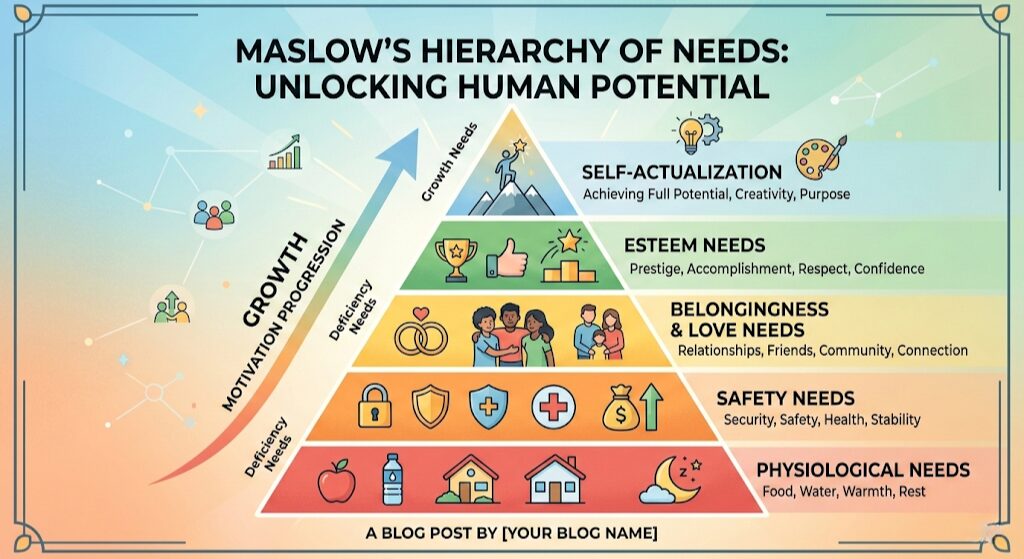
The Hierarchy Visualized
While the pyramid shape is a post-Maslow pedagogical tool rather than his own creation, it has become so central to how the theory is taught and understood that it warrants direct examination. The visual encodes several ideas: that needs are arranged in levels; that the base is broader (representing more universal, widely shared needs) and the apex narrower (representing a smaller proportion of people operating consistently at this level); and that upward movement is the direction of growth.
Reading the pyramid from base to apex traces the journey Maslow theorized as the path of healthy human development — from meeting survival requirements through creating security and social connection, building self-esteem through achievement and recognition, and ultimately arriving at the ongoing, never-fully-completed project of becoming the fullest possible version of oneself. Each level represents a qualitatively different category of human concern, not merely a quantitative variation in the intensity of the same drive.
Level 1 — Physiological Needs: The Biological Foundation
Physiological Needs — The Body’s Requirements for Survival
- Food and water — the fundamental metabolic requirements without which life cannot continue
- Shelter — protection from environmental exposure and extremes of temperature
- Sleep and rest — the biological imperative for cognitive and physical restoration
- Warmth — thermal regulation as a basic comfort requirement
- Air — continuous access to breathable atmosphere
- Clothing — protection and, in cold climates, survival necessity
- Homeostasis — the body’s regulation of internal stability across temperature, acidity, electrolyte balance
- Reproductive drive — the biological impulse toward species continuation
Physiological needs occupy the base of the hierarchy because they are the most prepotent of all needs — the most urgently motivating when unmet, and the most completely overriding of other motivational concerns. A person who is acutely hungry does not, Maslow argued, organize their life around the pursuit of safety, love, esteem, or self-actualization. The hungry organism is dominated by hunger. It perceives the world through the lens of hunger. Its future is pictured in terms of food. Its capacities are mobilized in the service of getting food.
This seemingly obvious observation carries a non-obvious implication: that the classic liberal conception of the human being as a rational agent making free choices among competing values assumes conditions — adequate satisfaction of physiological and safety needs — that are far from universal. Much human behavior that appears irrational or self-defeating from a higher-order perspective makes complete sense as the rational response of a person whose basic survival needs are uncertain or unmet.
Maslow noted that once physiological needs are met, they cease to be active motivators — a person who is adequately nourished and sheltered is no longer driven by hunger and cold. This is precisely why economic rewards above a comfortable sufficiency threshold have declining motivational leverage: they continue to address needs that are already substantially satisfied, while the genuinely active motivational needs have moved to higher levels of the hierarchy.
Level 2 — Safety Needs: Order, Security, and Stability
Safety Needs — The Requirement for a Predictable, Secure World
- Personal security — freedom from physical threat and violence
- Financial security — stable income, savings, and protection from economic catastrophe
- Employment security — reliable work that provides consistent income
- Health and wellbeing — access to healthcare and freedom from chronic illness or injury
- Order and law — living within a predictable social and legal framework
- Freedom from fear — psychological security that does not require constant vigilance
- Stability — a reliable, consistent environment rather than a chaotic, unpredictable one
Once physiological needs are reasonably met, the organism turns its primary motivational attention to safety — the need for a predictable, ordered, and secure environment. Maslow observed that this need is most clearly visible in children, who require consistent, orderly routines and become anxious in environments of unpredictability, inconsistency, or perceived threat. Adults manage safety needs with greater cognitive sophistication — through insurance, savings, career choices, legal structures, and the careful selection of relationships and environments — but the underlying motivational concern is the same.
The economic dimension of safety needs is particularly relevant to organizational behavior. For employees in precarious employment situations — zero-hours contracts, threatened layoffs, volatile commission structures — the dominant motivational concern is safety, not belonging or esteem. Motivational programs that address higher-order needs while safety needs remain chronically unresolved will produce minimal engagement. This insight connects directly to broader discussions of production and the fundamental factors that drive economic output — including the human factor, whose productivity is inextricably tied to the security conditions under which people work.
Level 3 — Love and Belonging Needs: Connection and Community
Love and Belonging Needs — The Social Dimension of Motivation
- Friendship — genuine, reciprocal personal relationships that provide emotional support
- Intimacy — deep relational connection, including romantic partnership
- Family — bonds of biological and chosen kinship that provide belonging and identity
- Sense of belonging — membership in groups, communities, and collectives that affirm one’s place
- Trust and acceptance — relationships characterized by psychological safety and mutual regard
- Giving and receiving affection — the emotional exchange that sustains relational bonds
- Community — participation in shared purpose and collective life larger than the individual
When physiological and safety needs are reasonably secured, human beings become primarily motivated by the need for love, affection, and belonging — the desire for warm, affectionate relationships and a felt sense of place within a community. Maslow was careful to distinguish this need from purely sexual desire, which he categorized as physiological. The belonging need is relational and social: the need to give and receive love, to feel that one matters to others, to be part of something larger than oneself.
The power of this motivational level is evident in the extraordinary lengths people will go to satisfy it: relocating cities to be near family, accepting lower wages to work in a close-knit team, conforming to social norms that conflict with individual preferences to maintain group membership, and suffering significant physical and financial costs to preserve intimate relationships. Loneliness and social exclusion — the thwarting of belonging needs — are among the most psychologically damaging human experiences, associated with outcomes across physical health, mental health, and cognitive function that rival or exceed the effects of many recognized public health threats.
In the organizational context, belonging needs find expression in team cohesion, organizational culture, inclusion, collegial relationships, and the experience of working toward shared goals with people who genuinely care about each other’s success. Organizations that provide technical competence and fair compensation but fail to create genuine community and belonging are meeting physiological and safety needs while leaving a powerful motivational level entirely unaddressed — with predictable consequences for engagement, discretionary effort, and talent retention.

“Motivation and Personality” — Abraham Maslow (3rd Edition)
Maslow’s own full development of his motivational framework, moving from the original 1943 paper through the mature articulation of the hierarchy and its implications for psychology, education, management, and human development. The definitive primary source.
View on Amazon →Level 4 — Esteem Needs: Recognition, Achievement, and Self-Respect
Esteem Needs — The Drive for Competence and Recognition
- Self-esteem — internal sense of worth, dignity, and confidence in one’s capacities
- Achievement — the satisfaction of accomplishing meaningful goals through genuine effort
- Mastery — developing competence and skill to the point of genuine expertise
- Independence — the capacity to be self-directing and self-reliant
- Status — recognition of one’s position and standing within a social group
- Prestige — external regard and reputation in one’s community or field
- Respect from others — being valued, taken seriously, and regarded with genuine esteem
- Recognition — having one’s contributions and qualities acknowledged by others
Maslow divided esteem needs into two distinct but related categories. The first is self-esteem — the internal experience of one’s own competence, strength, achievement, adequacy, and independence. This is the subjective confidence that one is capable of handling one’s life and making meaningful contributions. The second is the esteem of others — recognition, appreciation, respect, status, and reputation in the eyes of one’s community. Both are genuine and important needs; neither is simply reducible to the other.
The thwarting of esteem needs produces, Maslow argued, feelings of inferiority, weakness, and helplessness — and, in more extreme cases, the compensatory behaviors that psychologists associate with narcissistic injury: excessive status-seeking, aggressive competitiveness, and the defensive disparagement of others’ achievements. Understanding esteem need thwarting as a motivational explanation — rather than a character defect — opens more productive avenues for understanding organizational behavior, social conflict, and political dynamics than purely moral or dispositional interpretations.
The workplace manifestations of esteem needs are familiar and important. Meaningful work that provides opportunities for genuine mastery, recognition of genuine contributions, promotions and titles that reflect actual competence rather than just tenure, and leadership that treats people as capable and valuable rather than as interchangeable inputs — all of these address esteem needs. Their absence, even in organizations that adequately meet physiological, safety, and belonging needs, produces systematic under-engagement and the loss of the discretionary performance that distinguishes outstanding from merely adequate organizations.
Understanding how esteem needs relate to the broader structure of organizational management connects to the definition and scope of management as a discipline — particularly the leading and directing functions, which are fundamentally concerned with channeling human motivation toward organizational objectives. When managers understand that esteem needs are active motivational forces, not vanity, the design of recognition systems, career development structures, and feedback practices becomes a strategic management concern rather than a nice-to-have HR program.
Level 5 — Self-Actualization: Becoming What One Is Capable of Becoming
Self-Actualization — The Realization of Human Potential
- Realizing personal potential — the drive to become everything one is capable of becoming
- Creative expression — the need to create, invent, compose, or build something uniquely one’s own
- Peak experiences — moments of intense joy, insight, and unity that feel profoundly meaningful
- Problem-centered focus — absorption in meaningful problems that transcend personal concern
- Authenticity — living and acting in accordance with one’s genuine values and capabilities
- Autonomy — the freedom to pursue one’s own development without excessive external constraint
- Continued growth — the ongoing process of becoming rather than a fixed achievement state
- Acceptance of mystery — comfort with ambiguity and the unknown, without the need to resolve it prematurely
Self-actualization is the apex of Maslow’s original five-level hierarchy and its most distinctively human element. It refers not to the satisfaction of a deficiency — there is no “self-actualization deprivation” equivalent to hunger or loneliness — but to the expression of a positive growth tendency: the drive toward developing and actualizing one’s own full human capacities. A musician who keeps improving their musicianship, a scientist whose curiosity drives them toward ever-more-fundamental questions, an entrepreneur who builds not primarily for profit but to realize a vision — all exemplify the self-actualization drive in different domains.
Maslow was careful to note that self-actualization takes as many different forms as there are human beings. The specific content of one person’s self-actualization — what they need to become to fulfill their unique potentialities — is not universally specifiable. What is universal is the structure of the need: the drive toward realizing what one is uniquely capable of, in whatever domain or form that takes for the individual in question.
“Musicians must make music, artists must paint, poets must write if they are to be ultimately at peace with themselves. What human beings can be, they must be.” — Abraham Maslow, Motivation and Personality, 1954
Peak Experiences as Self-Actualization Markers
One of Maslow’s most distinctive contributions to the psychology of self-actualization was his concept of “peak experiences” — moments of intense joy, insight, beauty, or unitive consciousness that he observed self-actualized individuals describing with unusual frequency. These are the moments when a person feels fully alive, fully present, and fully connected to something larger than themselves — when the music takes over, when the solution appears with blinding clarity, when the relationship feels completely right, when the mountain summit is reached.
Maslow did not argue that peak experiences are exclusive to self-actualized people — he believed most people had them occasionally. But he observed that self-actualized individuals seemed to access them more frequently and more reliably, and that they organized their lives partly around creating conditions for these experiences. This places peak experience not in the category of random good fortune but in the category of achievable outcomes — consequences of living in alignment with one’s genuine capacities and values.

“The Farther Reaches of Human Nature” — Abraham Maslow
Maslow’s final and most expansive work, published posthumously in 1971. Extends the hierarchy to eight levels, develops the concept of peak experiences and transcendence, and represents the fullest expression of his humanistic vision of human possibility.
View on Amazon →Deficiency Needs vs. Growth Needs: A Foundational Distinction
One of the most theoretically important — and least frequently taught — aspects of Maslow’s framework is his distinction between two fundamentally different categories of need: deficiency needs (D-needs) and growth needs (being needs or B-needs). This distinction does not simply separate the lower four levels from the apex. It represents a qualitative shift in the nature of motivation itself.
- Physiological, safety, love/belonging, esteem
- Arise from deprivation — unmet needs create tension that motivates action toward satisfaction
- Satisfaction reduces the motivation — hunger satiated by eating eliminates hunger motivation
- Focus is on filling a gap or restoring equilibrium
- Motivation is fundamentally reactive — a response to felt absence
- Shared with other animals to varying degrees
- Can be fully satisfied, at least temporarily
- Self-actualization (and transcendence in later model)
- Arise not from deprivation but from the positive drive toward growth
- Satisfaction intensifies the motivation — the more one grows, the stronger the drive to grow further
- Focus is on expansion and becoming rather than filling a gap
- Motivation is fundamentally proactive — a response to the pull of unrealized potential
- Distinctively human in their highest expressions
- Cannot be fully or permanently satisfied — always more potential to actualize
This distinction is theoretically radical. For deficiency needs, the organism is in a state of wanting until the need is satisfied, after which the motivation dissipates. For growth needs, the situation is structurally opposite: satisfaction increases engagement rather than diminishing it. The more fully a musician develops their art, the more powerfully they are drawn to the next level of musical mastery. The more deeply a scientist engages with fundamental questions, the more compelling the unexplored territory becomes. Growth needs, unlike deficiency needs, are not extinguished by their satisfaction — they intensify.
This has profound implications for how organizations think about motivation. If you are trying to motivate through salary increases, the D-need logic applies: there is an effective amount, beyond which additional increments produce diminishing motivational returns. But if you can engage self-actualization motivations — giving people work that genuinely challenges them, develops them, and allows them to contribute meaningfully to problems they care about — the motivational dynamic is self-amplifying. The satisfied growth-need worker is more motivated, not less.
Characteristics of Self-Actualized People
Maslow did not define self-actualization abstractly and leave it at that. In one of the most distinctive and enduring elements of his research, he identified and studied a sample of individuals whom he considered to exemplify self-actualization — a method he acknowledged was subjective and exploratory but justified by the genuine explanatory richness it produced. His sample included historical figures (Abraham Lincoln, Thomas Jefferson, Albert Einstein, Eleanor Roosevelt, Frederick Douglass, William James, Spinoza) and personal acquaintances he considered unusually psychologically healthy.
From this observational research, he identified a remarkably consistent set of psychological characteristics that distinguished these individuals from the general population:
The Extended Eight-Level Hierarchy
The famous five-level model represents Maslow’s most widely known framework, but it does not represent his final thinking. In his later work — particularly in The Farther Reaches of Human Nature (1971), published posthumously — Maslow extended the hierarchy to include three additional levels that he had come to regard as theoretically essential but initially underemphasized.
| Level | Need Category | Core Drive | Position in Hierarchy |
|---|---|---|---|
| 8 | Transcendence | Helping others achieve self-actualization; spiritual experiences beyond the self | Apex (beyond self) |
| 7 | Self-Actualization | Realizing personal potential; creative expression; peak experiences | Individual apex |
| 6 | Aesthetic Needs | Appreciation of beauty, order, harmony, and form | Upper growth needs |
| 5 | Cognitive Needs | Knowledge, understanding, curiosity, meaning-making | Lower growth needs |
| 4 | Esteem Needs | Self-respect, achievement, recognition, status | Upper deficiency needs |
| 3 | Love & Belonging | Friendship, intimacy, community, connection | Middle deficiency needs |
| 2 | Safety Needs | Security, order, stability, freedom from threat | Lower deficiency needs |
| 1 | Physiological Needs | Food, water, shelter, sleep, warmth | Base (biological) |
The two most significant additions in the expanded model are cognitive needs and transcendence. Cognitive needs — the drive for knowledge, understanding, and meaning — represent the intellectual dimension of growth that the original five-level model subsumed into self-actualization but that Maslow came to see as a distinct motivational category. The hunger for understanding, the compulsion to make sense of experience, the restlessness of the curious mind in the presence of unexplained phenomena — these are recognizable as distinct from the drive for achievement, recognition, or creative self-expression that characterizes self-actualization proper.
Transcendence — the highest level in the extended model — represents Maslow’s late and profound engagement with the dimension of human motivation that points beyond the individual self entirely: the drive to help others achieve their potential, the experience of spiritual and mystical unity that he had been exploring through his study of peak experiences, and the sense of connection to something larger — a tradition, a cause, a sacred dimension of existence — that the most psychologically developed individuals he studied seemed to cultivate. This addition reflects Maslow’s acknowledgment that the individualistic framing of the original five-level model, with its apex of personal self-actualization, was incomplete as an account of human motivational life at its most developed.
Application of the Hierarchy in Management and Organizational Behavior
The application of Maslow’s hierarchy to management practice has been profound, persistent, and sometimes oversimplified. The framework’s influence on the behavioral turn in management theory — particularly on McGregor’s Theory X and Theory Y, Herzberg’s Two-Factor Theory, and McClelland’s Acquired Needs Theory — represents one of the most direct channels through which a psychological theory has reshaped organizational practice in the 20th century.
The basic management implication is straightforward: to motivate employees effectively, managers must first identify which level of the hierarchy represents their primary active need, and then create conditions that address that level. Motivational programs pitched at the wrong level — offering team-building experiences (belonging) to employees whose safety needs are threatened by impending layoffs, or adding salary bonuses (physiological/safety) to employees whose primary need is for meaningful challenge and autonomy (self-actualization) — will produce minimal motivational return.
Maslow’s Hierarchy Mapped to Organizational Practices
| Need Level | Organizational Expression | Management Response | Common Failure Mode |
|---|---|---|---|
| Physiological | Adequate wages; working conditions; breaks | Fair compensation; ergonomic environment; reasonable hours | Subminimum wages; unsafe conditions; excessive hours |
| Safety | Job security; safe environment; benefits | Stable employment; clear rules; health coverage; pension | Arbitrary termination; workplace hazards; benefit erosion |
| Belonging | Team cohesion; organizational culture; inclusion | Team-building; inclusive practices; mentorship; community | Siloed culture; exclusion; anonymous large-org alienation |
| Esteem | Recognition; meaningful responsibilities; career growth | Performance recognition; promotions; stretch assignments | Micromanagement; no recognition; career ceiling |
| Self-Actualization | Challenging work; autonomy; creative contribution | Meaningful work design; learning opportunities; autonomy | Routine work; no growth opportunities; disempowerment |
The hierarchy also illuminates why certain management interventions produce paradoxical results. Performance management systems that rank and rate employees against each other — creating winners and losers within the same team — directly threaten safety and belonging needs for the majority of employees, undermining the very higher-order motivational engagement they are designed to stimulate. Understanding the financial implications of these motivational dynamics connects to broader frameworks of organizational performance, including the principles that govern the financial and non-financial benefits of strategic planning — benefits that are only achievable in organizations where the human motivation conditions for strategic execution actually exist.
The hierarchy’s application extends to communication design within organizations. How managers communicate — the degree of consideration, clarity, and genuine respect embedded in organizational communications — directly affects the satisfaction of esteem and belonging needs. Understanding the principle of consideration in communication — adapting messages to the receiver’s perspective, needs, and context — reflects precisely the kind of management behavior that addresses higher-order needs rather than treating employees as interchangeable message recipients.

“Organizational Behavior” — Robbins & Judge (18th Edition)
The world’s most widely adopted organizational behavior textbook, with comprehensive coverage of motivation theories including Maslow, McGregor, Herzberg, and their modern successors. Essential for any serious student of management science.
View on Amazon →Application in Education and Human Development
Education is perhaps the domain outside of psychology and management where Maslow’s hierarchy has had its most extensive applied influence. The framework’s most direct educational implication is also its most practically important: students cannot engage effectively with higher-order learning — critical thinking, creative problem-solving, deep conceptual engagement — when lower-order needs are unmet.
A student who is hungry, cold, or frightened is not primarily a student — they are a person in physiological or safety distress. Their cognitive resources are substantially consumed by the management of that distress. Educational interventions that address only the academic dimension of student experience while ignoring the need conditions under which learning is possible are, from a Maslovian perspective, structurally doomed to limited effectiveness for a significant portion of their student population.
The Hierarchy of Needs in Classroom Practice
The most effective educators, whether or not they have explicitly studied Maslow, tend to operate with a functional intuition about the conditions required for learning. They create safe classroom environments where making mistakes is not cause for shame (safety and belonging). They build genuine relationships with students and create class communities where students feel they belong (belonging). They provide frequent, genuine recognition of real achievement and growth (esteem). And they design learning experiences that engage genuine curiosity and allow students to create, discover, and develop real competence (self-actualization).
The policy implications extend well beyond individual classroom practice. School breakfast and lunch programs, counseling services, stable and predictable school environments, anti-bullying initiatives, and differentiated learning approaches that allow students to develop genuine competence at their own pace — all of these are, in Maslovian terms, need-satisfaction interventions that create the psychological conditions within which higher-order learning becomes possible.
Academic Criticisms and Limitations of the Framework
The intellectual longevity of Maslow’s Hierarchy of Needs is remarkable, but it should not be mistaken for empirical validation. The theory faces substantive academic criticisms that any serious student must engage with honestly. These criticisms do not necessarily undermine the framework’s usefulness as a heuristic or pedagogical tool, but they do constrain its claims to scientific precision.
1. Limited Empirical Support for the Hierarchical Ordering
The most fundamental empirical challenge to the framework is the limited evidence for the strict hierarchical ordering Maslow proposed. Numerous studies have found that people frequently prioritize higher-order needs even when lower-order needs are substantially unmet, and that the specific ordering varies significantly across individuals, cultures, and situations. A person may pursue love and belonging with fierce urgency even under conditions of significant safety threat. An artist may sacrifice physiological comfort for creative expression. These are not exotic edge cases — they are common human experiences that challenge the theory’s core progression claim.
2. Cultural and Individualistic Bias
Perhaps the most searching academic criticism of the framework concerns its cultural specificity. The hierarchy, and particularly its apex of individual self-actualization, reflects values that are characteristic of individualistic Western cultures — the primacy of the individual, the valorization of personal potential, and the emphasis on autonomous self-expression. In collectivist cultures — which account for the majority of the world’s population — the highest human fulfillment is typically conceived in relational, communal, or spiritual terms rather than individual terms. Maslow’s pyramid, from this perspective, is not a universal theory of human motivation but a culturally specific framework dressed in universal language.
3. Methodological Limitations
The research method underlying Maslow’s identification of self-actualized characteristics — selecting individuals he personally judged to exemplify psychological health and then describing their common characteristics — is methodologically weak by contemporary standards. The sample was small, historically and culturally homogeneous (predominantly white, American or European, historically significant figures), selected by subjective criteria, and studied through observation and biography rather than controlled empirical investigation. The characteristics Maslow identified may reflect the values of his particular time, place, and social circle as much as universal features of psychological peak functioning.
4. The Pyramid Was Not Maslow’s
As noted earlier, the iconic pyramid visualization was created by management educators after Maslow’s publication, not by Maslow himself. His own writing described needs as overlapping, fluid, and dynamically interacting rather than as discrete, rigid tiers with clear transitions between them. The pyramid’s visual logic — with sharp separations between levels and a clear bottom-to-top progression — encodes a rigidity that Maslow explicitly rejected. Much of the criticism directed at the “hierarchy” model targets the pyramid visualization rather than the more nuanced theory Maslow actually articulated.
5. Underspecification of Self-Actualization
The concept of self-actualization is theoretically rich but empirically underspecified. What exactly counts as realizing one’s full potential? How would we measure it? What distinguishes genuine self-actualization from the rationalization of privileged circumstances? The concept’s resistance to precise operationalization has made it difficult to study rigorously, which partly explains why more operational frameworks — such as Deci and Ryan’s Self-Determination Theory, which specifies the needs for autonomy, competence, and relatedness as distinct, measurable constructs — have supplanted it in the empirical research literature while Maslow’s more evocative framework continues to dominate applied and educational settings.
Modern Relevance: The Hierarchy in a Changed World
Maslow developed his framework in the context of mid-20th-century America — a period of rapid economic growth, expanding middle-class prosperity, and increasing industrial employment that was beginning to give way to a more knowledge-intensive economy. The world of 2026 differs from that context in ways that are both challenging and illuminating for the hierarchy’s continued relevance.
The Gig Economy and Safety Need Regression
The expansion of precarious employment — zero-hours contracts, gig economy work, short-term contracting, and portfolio careers — has, in Maslovian terms, re-activated safety need concerns for large segments of the workforce in developed economies that had previously largely resolved them. Workers whose employment security is fundamentally unstable are not available for higher-order motivational engagement in the ways that Maslow and his management successors assumed. This is not a character failing — it is the entirely rational motivational consequence of a safety need that is genuinely threatened.
The financial dimensions of this dynamic connect to concepts like the understanding of working capital management at the organizational level — just as businesses need adequate working capital to function without constant crisis management, employees need adequate safety need satisfaction to invest cognitive and motivational resources in anything beyond immediate survival. Both individuals and organizations perform most effectively when they are not consumed by managing deficiency crises.
Digital Technology and Belonging Needs
The digitization of social life has created new and complex dynamics around belonging needs. Social media platforms, at their best, can extend community, maintain relationships across geographic distances, and provide belonging experiences for people who might otherwise be isolated. At their worst, they create pseudo-belonging — the simulation of connection without the substance — while simultaneously activating social comparison dynamics that undermine esteem and belonging by making the gap between one’s actual social position and idealized alternatives maximally visible and constantly present.
This tension is one of the most significant psychological challenges of the current era, and Maslow’s framework provides a useful diagnostic lens for analyzing it. The question is not whether digital social connection is “real” connection, but whether it actually satisfies the belonging need in ways that reduce the motivational drive toward connection — or whether it substitutes a less nutritious surrogate that maintains the drive while mimicking its satisfaction.
Self-Actualization in the Knowledge Economy
The broad structural shift toward knowledge-intensive work has made the self-actualization level of the hierarchy increasingly relevant as an organizational design concern. In industrial work, the value created by a worker was largely independent of their motivational engagement — a correctly specified process, correctly performed, produced the correct output whether the worker was deeply engaged or merely compliant. In knowledge work, this independence does not hold. The quality of a software engineer’s code, a designer’s creative solution, a consultant’s strategic insight, or a researcher’s hypothesis depends intimately on their level of genuine cognitive engagement — and genuine cognitive engagement in demanding, creative work requires motivational conditions that Maslow articulated with unusual clarity.
The implications for organizational strategy are direct. Businesses competing on the quality of knowledge work outputs — which increasingly means all businesses — need to create conditions for self-actualization motivation, not merely for physiological and safety need satisfaction. Understanding the principles that the financial manager applies when evaluating human capital investments in this context requires recognizing that the return on investment in motivation-enabling conditions — autonomy, meaningful work, development opportunity, creative latitude — may be the highest available ROI in the knowledge economy.
Transcendence and Purpose-Driven Organizations
Maslow’s later addition of transcendence to the hierarchy — the need to help others achieve their potential and to connect with something larger than the individual self — anticipates the growing evidence that purpose-driven organizations, where employees feel connected to a meaningful mission beyond profit maximization, systematically outperform those that do not. The research on organizational purpose has advanced considerably since Maslow’s time, but his theoretical framing identifies the motivational mechanism: transcendence needs are real, they activate powerfully when conditions allow, and organizations that connect employees to a genuinely meaningful purpose are harnessing a motivational force that purely instrumental, transactional organizations leave entirely untapped.
Frequently Asked Questions
What is Maslow’s Hierarchy of Needs?
What are the five levels of Maslow’s Hierarchy?
Who was Abraham Maslow?
What is self-actualization according to Maslow?
What is the difference between deficiency needs and growth needs?
How does Maslow’s theory apply to management and the workplace?
What are the main criticisms of Maslow’s Hierarchy of Needs?
Is the pyramid shape original to Maslow?
How does Maslow’s theory relate to McGregor’s Theory Y?
What is Maslow’s extended hierarchy beyond the original five levels?
Conclusion: What Maslow’s Hierarchy Continues to Teach Us
Maslow’s Hierarchy of Needs is imperfect as a scientific theory, and the academic literature has documented its limitations with appropriate rigor. The hierarchical ordering is not as universal or as rigid as the pyramid visualization suggests. The individualistic framing of self-actualization at the apex does not adequately represent the full cultural diversity of human motivational experience. The methodological foundations of the original research are weak by contemporary standards. These are real limitations that students and practitioners should understand and hold.
And yet, the framework endures — not through inertia or ignorance, but because it captures something genuinely true about human motivational life that more empirically precise frameworks often fail to convey with equivalent force. The intuition that a person cannot engage their highest human capacities when their most basic human needs are threatened is experientially recognizable. The observation that satisfied deficiency needs lose motivational power while growth needs intensify with satisfaction is an insight of real practical importance for anyone responsible for designing motivating conditions — in organizations, schools, families, or policy systems.
Perhaps most importantly, Maslow’s framework insists that humans are not merely problem-minimizing organisms managing deficiencies, but growth-oriented beings with a genuine developmental trajectory toward their fullest possible selves. In an intellectual environment still partly dominated by the metaphors of mechanism and optimization, this insistence on the positive, forward-looking, potentially self-transcending dimension of human motivation has not lost its radical edge.
The hierarchy connects to the full ecosystem of management, financial, and communication principles that shape how organizations actually function. From the golden rules of accounting that ensure financial transparency — enabling the safety-need-satisfying clarity about organizational stability — to the communication principles that directly address esteem and belonging needs in every organizational interaction, Maslow’s framework provides a motivational lens that enriches rather than competes with the technical disciplines of management science.
As a starting point for thinking about what human beings need to thrive — in organizations, in classrooms, in communities, and in their own private development — the Hierarchy of Needs remains as generative and as practically valuable as it was in 1943. What has changed is not its essential insight but our ability to extend, qualify, and build upon it with the accumulated empirical knowledge of eight subsequent decades of research. That is precisely what good foundational theory enables.
Continue Exploring Foundational Theories
From management principles and motivation theory to financial frameworks and communication science — Edmics offers comprehensive academic guides for serious students of business and social science.
Browse All Academic Guides →