📋 Table of Contents ▼
- Introduction
- 1. Map & Streamline Processes
- 2. Leverage Automation
- 3. Master Financial Management
- 4. Sharpen Communication
- 5. Strategic Planning
- 6. Invest in Employee Training
- 7. Use Data & Analytics
- 8. Delegate & Empower
- 9. Manage Time Ruthlessly
- 10. Review & Audit Regularly
- Efficiency Comparison Table
- FAQs
- Conclusion
Ten Tips to Improve Business Efficiency: The Complete Operational Playbook
Every business has a ceiling — not because of market limits, but because of internal inefficiencies quietly consuming resources, momentum, and morale. This guide breaks down ten proven, actionable strategies that eliminate waste and build organizations that perform at their true potential.
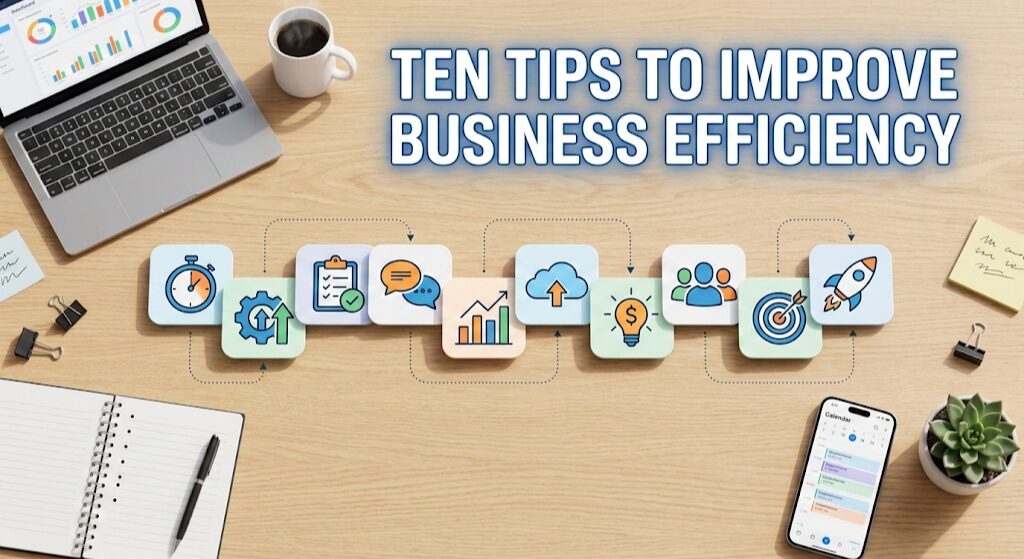
Strategic efficiency is the engine behind sustainable business growth.
Business efficiency is not a trendy buzzword reserved for Silicon Valley giants or Fortune 500 boardrooms. It is the fundamental difference between a company that strains and struggles and one that grows with confidence. Whether you are running a five-person startup, a regional retail chain, or a mid-sized manufacturing firm, operational inefficiency is costing you more than you realize — in wasted hours, missed opportunities, overstretched teams, and eroding margins.
The ten tips outlined in this guide are drawn from the disciplines of management science, financial strategy, organizational behavior, and operational research. They are not vague platitudes. Each one is a concrete lever you can pull to generate measurable improvement. Work through them methodically, apply them contextually, and you will create a business that runs sharper, faster, and more profitably than before.
01 Map, Analyze, and Streamline Your Core Processes
Before you can improve anything, you must understand exactly how it works. Process mapping — the systematic documentation of every step in a workflow — is the foundational act of efficiency improvement. Without it, you are making changes in the dark, hoping something sticks.
Most businesses accumulate processes organically. A task gets done a certain way because one person did it that way years ago, then it became habit, then it became “the way we do things.” Nobody questions it. Nobody measures it. Yet buried inside these unreflected routines are redundant steps, unnecessary handoffs, and bottlenecks that sap hours every single week.
How to Map a Business Process
Start by identifying your five to ten most critical operational workflows — the ones with the most volume, the most revenue impact, or the most visible pain points. For each, create a visual flowchart documenting every step from trigger to completion. Note who is responsible at each stage, how long each step takes, what inputs are required, and what can go wrong.
Tools like Lucidchart, Miro, or even a whiteboard session will do the job. The goal is not a perfect document — it is clarity. Once you can see the process laid out in front of you, inefficiencies become obvious: duplicated reviews, unnecessary approval chains, manual data transfers that could be automated, and steps that add cost but not value.
The Lean Methodology Connection
Lean management — originally developed in Toyota’s production system — provides a powerful framework for this work. The core principle is the elimination of “muda,” the Japanese term for waste. Lean identifies eight categories of waste that plague most businesses: overproduction, waiting, unnecessary transportation, over-processing, excess inventory, unnecessary motion, defects, and unused talent.
Once you have mapped and analyzed your processes, the next step is standardization. Documented standard operating procedures (SOPs) eliminate the guesswork, reduce training time, and ensure consistent quality across team members. A business where output quality depends entirely on who is working that day has a dangerous efficiency vulnerability.
Continuous Process Improvement
Process mapping is not a one-time exercise. Build it into a quarterly cycle. As your business evolves, as team sizes change, and as technology advances, your processes need to evolve too. The businesses that dominate their industries are the ones that institutionalize improvement — making the review and refinement of workflows a normal part of how they operate, not an emergency response to crisis.
✅ Benefits
- Reveals hidden bottlenecks instantly
- Creates a foundation for automation
- Reduces training time for new hires
- Enables consistent quality at scale
- Identifies cost-saving opportunities
⚠️ Challenges
- Time-intensive to document properly
- Can face resistance from long-tenured staff
- Requires ongoing maintenance
- Initial investment in mapping tools

Recommended: “Lean Thinking” by Womack & Jones
The definitive guide to eliminating waste from your business processes. A must-read for any efficiency-focused leader.
View on Amazon →02 Leverage Automation to Eliminate Repetitive Work
If process mapping reveals what needs to change, automation executes the most impactful changes at scale. We are living through the most accessible era of business automation in history. Technologies that once required enterprise-level budgets and dedicated IT departments are now available as affordable, user-friendly software-as-a-service (SaaS) tools that any business can deploy.
The core principle is simple: any task that is rule-based, repetitive, and high-volume is a candidate for automation. Data entry, invoice processing, email follow-up sequences, social media scheduling, inventory reordering, report generation, customer onboarding flows — all of these consume enormous amounts of human time and attention. Automated systems can handle them faster, with fewer errors, and at any hour of the day.
Categories of Business Automation
Think of automation as operating across three levels. At the task level, tools like Zapier and Make (formerly Integromat) connect your existing apps and automate data flows between them — for example, automatically logging a new customer inquiry from a contact form into your CRM, sending a confirmation email, and creating a task in your project management system simultaneously. This type of automation can be set up in hours with no coding required.
At the workflow level, platforms like HubSpot, Salesforce, and ActiveCampaign automate entire business processes — lead nurturing sequences, sales pipeline movements, customer onboarding journeys, and renewal reminders. These systems ensure that no lead goes cold, no follow-up is forgotten, and no customer feels neglected simply because your team was too busy.
At the intelligence level, artificial intelligence tools are increasingly capable of handling complex tasks: drafting first versions of content, analyzing customer sentiment, predicting demand fluctuations, processing documents, and generating financial summaries. The businesses investing in AI-assisted workflows today are building compounding efficiency advantages that will be very difficult to close in five years.
What Not to Automate
Automation is not appropriate for everything. Relationship-sensitive communications, complex negotiations, creative strategy development, and situations requiring empathetic human judgment should remain in human hands. Automating a response to a distressed customer complaint, for example, can create far more damage than it saves in efficiency. The art is in identifying the right activities to automate — freeing human attention for the work that genuinely benefits from it.
The ROI of Automation
The financial case for automation is compelling. A single employee who spends two hours per day on data entry at a fully-loaded cost of $50,000 per year is spending roughly $12,500 annually on a task that a $30/month software tool can perform. Across a team of ten, twenty, or fifty people, these numbers become transformative. Beyond the cost savings, automation also reduces error rates — and the cost of errors (rework, customer churn, regulatory risk) is often far greater than the cost of the task itself.
Recommended: Business Automation & Productivity Tools Guide
A comprehensive look at modern business automation platforms, with setup guides and ROI frameworks for each category.
View on Amazon →03 Master Financial Management and Resource Allocation
Operational efficiency and financial efficiency are deeply intertwined. A business can have excellent processes and talented people, yet still bleed profitability through poor financial discipline — misallocated budgets, untracked expenses, inefficient cash flow management, and a failure to understand the true cost drivers of the business.
Sound financial management starts with visibility. You cannot manage what you cannot see. This means maintaining accurate, up-to-date financial records, understanding your key financial statements, and reviewing your numbers with enough regularity to catch problems early. Businesses that look at their financial data monthly — at minimum — are far better positioned to make intelligent resource decisions than those that only review finances at year-end.
Understanding Your Financial Statements
Three core documents tell the financial story of your business. The income statement (profit and loss) shows revenue, costs, and net profit over a period. The balance sheet provides a snapshot of assets, liabilities, and equity at a given point in time. The cash flow statement tracks the movement of actual cash in and out of the business. Together, these three documents reveal where money is being made, where it is being lost, and whether the business is operationally sound or running on borrowed time.
Many business owners focus exclusively on revenue and ignore the structural signals hidden in the balance sheet and cash flow statement. A profitable business on paper can be in serious trouble if it has poor cash flow timing, excessive debt, or an asset base that is deteriorating. Developing financial literacy — or ensuring a financially literate person is actively involved in business decisions — is not optional for an efficient organization.
The Role of Auditing in Efficiency
Regular financial audits — whether internal or external — are powerful efficiency tools. Understanding the purposes and advantages of audit goes far beyond compliance. Audits expose redundant expenditures, identify departments that are consuming resources disproportionate to their output, and surface financial irregularities before they become catastrophic. Think of an audit as a health check for your business’s financial metabolism.
Smart Budgeting and Cost Control
Zero-based budgeting — where every expense must be justified from scratch each cycle rather than simply carried over from the previous period — forces conscious decision-making about resource allocation. It challenges the “we’ve always spent this on that” mindset and redirects money toward activities with the highest strategic and operational return.
Working Capital Management
The difference between gross working capital and net working capital is more than an accounting technicality. Understanding the distinction between gross and net working capital helps business leaders make smarter decisions about liquidity, receivables management, inventory levels, and payables strategy. Efficient working capital management can unlock significant cash that is currently trapped in the operating cycle — cash that can be reinvested, used to pay down debt, or held as a buffer against uncertainty.

Recommended: “Financial Intelligence for Entrepreneurs”
An accessible, practical guide to understanding the numbers that drive your business, written for non-finance professionals.
View on Amazon →04 Sharpen Internal and External Communication
Communication failure is one of the most expensive and underestimated sources of inefficiency in business. Misunderstood instructions, unclear project briefs, unanswered emails, poorly run meetings, and organizational silos — these are not minor annoyances. They generate rework, frustration, delayed decisions, and employee disengagement that cumulatively cost businesses thousands of hours and millions of dollars every year.
The first principle of efficient communication is clarity. A message that requires three follow-up clarifications to understand is not a communication — it is a liability. Whether you are writing an email, leading a meeting, or delivering feedback, investing thirty seconds more in clarity at the start saves minutes or hours of confusion later.
The Written Word as a Business Asset
In business, written communication is disproportionately important. Emails, reports, proposals, SOPs, and internal documentation form the connective tissue of an organization. The five Cs of effective writing — clear, concise, complete, correct, and courteous — provide a practical standard for all business writing. Organizations that train their teams in effective writing produce documents that are acted upon, not re-read and re-interpreted endlessly.
Choosing the Right Communication Channel
Not every communication belongs in every channel. Email is excellent for documented decisions, project updates, and stakeholder communications but terrible for rapid collaboration or urgent issues. Instant messaging platforms like Slack or Microsoft Teams excel at quick questions and team-level coordination but create distraction and context-switching if used as a substitute for focused work. Video calls add richness and relationship depth but carry a high time cost that makes them inappropriate for routine operational updates.
Developing explicit communication norms — what types of messages go where, what response time expectations exist, when to meet versus when to message — reduces the constant overhead of workers trying to figure out how to reach each other and what to expect in return. Understanding the advantages and disadvantages of email communication helps teams make smarter channel choices and set appropriate expectations around responsiveness.
Meeting Hygiene
Meetings are the single largest consumer of skilled time in most businesses — and the most consistently mismanaged. A one-hour meeting with eight people does not cost one hour; it costs eight hours of collective productive capacity. Every meeting should have a clear purpose, a written agenda distributed in advance, designated outcomes, and an end time. Meetings without these elements should not happen. Regular audits of your meeting calendar typically reveal 30–50% of recurring meetings that can be eliminated, shortened, or converted to asynchronous updates.
Cross-Departmental Communication
Siloed communication is an efficiency killer at the organizational level. When sales, marketing, operations, and finance operate in information isolation, duplicate work proliferates, conflicts emerge at handoff points, and strategic decisions get made with incomplete pictures. Building structured cross-functional communication — shared dashboards, regular inter-department touchpoints, and clear escalation paths — creates the information flow that allows the whole organization to operate as a coherent unit rather than a collection of competing departments.

Recommended: “Made to Stick” by Chip & Dan Heath
Master the art of clear, compelling communication that drives action across your entire organization.
View on Amazon →05 Anchor Everything in Strategic Planning
A business without a clear strategy is a business that wastes resources on activities that do not matter. Strategy is the filter through which every investment of time, money, and talent should pass. Without it, teams pursue conflicting priorities, managers make locally rational but globally destructive decisions, and the organization’s energy dissipates in a hundred directions rather than concentrating where it creates maximum value.
Strategic planning is the process of defining where your business wants to go, why that destination is the right one, and how you intend to get there — with concrete objectives, allocated resources, and measurable milestones. The financial and non-financial benefits of strategic planning are extensive: sharper resource allocation, better team alignment, faster decision-making, and a stronger capacity to anticipate and respond to market changes.
From Vision to Execution
Effective strategic planning operates across three timeframes simultaneously. Long-range planning (three to five years) establishes the destination — the markets you want to compete in, the capabilities you need to build, and the competitive position you are trying to achieve. Medium-range planning (one to two years) translates the strategic direction into specific initiatives and resource commitments. Operational planning (quarterly and monthly) converts those initiatives into concrete projects, tasks, and performance targets.
The bridge between strategy and execution is often the weakest link in business efficiency. Many organizations produce excellent strategic plans that then sit in a drawer while daily operational pressures dominate everyone’s attention. Building execution infrastructure — regular strategy reviews, clear ownership of strategic initiatives, and visible progress tracking — is what separates organizations that plan strategically from those that actually become strategic.
OKRs as an Efficiency Framework
Objectives and Key Results (OKRs), popularized by Google and Intel, provide a practical framework for connecting strategic intent to daily work. Each objective defines a qualitative goal that matters. Each key result defines two to five measurable outcomes that indicate the objective is being achieved. When every team and individual can articulate how their work connects to the company’s strategic objectives, resources naturally concentrate where they are most needed, and activity that does not contribute to strategic goals becomes conspicuous and actionable.

Recommended: “Good Strategy / Bad Strategy” by Richard Rumelt
The clearest, most insightful book on what real strategy looks like — and how to avoid the strategic-plan theater that plagues most organizations.
View on Amazon →06 Invest Aggressively in Employee Training and Development
People are the most important operational variable in any business — and they are also the most consistently undertrained. Organizations that treat employee development as a luxury rather than a strategic investment end up with teams that are slower, less capable, more error-prone, and more likely to leave. The compounding cost of underinvestment in people is staggering.
Consider the full picture. An undertrained employee makes more mistakes — and each mistake has a cost in materials, time, customer trust, or regulatory exposure. They work more slowly as they figure things out, seek more supervision (consuming a manager’s most valuable resource — attention), and are less able to handle complexity or change. When they inevitably leave to find better opportunities, you absorb the full cost of recruiting and onboarding a replacement — typically 50–200% of the departing employee’s annual salary.
Training as a Productivity Multiplier
Well-trained employees work faster, make better decisions, require less supervision, generate better ideas, and stay longer. A one-time training investment of $2,000 per employee that increases productivity by just 10% — and reduces annual turnover by one employee — typically delivers a 5–10x return within the first year. These are not theoretical numbers; they are consistent with what businesses that measure training ROI actually find.
Effective training programs combine several elements: formal instruction (courses, workshops, certifications), on-the-job structured learning (mentorship, job rotation, stretch assignments), and self-directed development (book allowances, conference attendance, online learning subscriptions). The mix depends on the role and the individual, but the commitment to development needs to be consistent and visible from leadership.
Cross-Training for Operational Resilience
Single points of failure are efficiency time bombs. When only one person knows how to perform a critical function — manage a key account relationship, operate a piece of equipment, run a particular software system — the entire operation becomes vulnerable to that person’s absence. Cross-training employees to cover each other’s critical functions eliminates these vulnerabilities and creates a more agile, adaptable workforce.

Recommended: “The First 90 Days” by Michael Watkins
The definitive guide to accelerating the productivity of new and transitioning employees — a critical efficiency resource for growing teams.
View on Amazon →07 Build a Culture of Data-Driven Decision Making
Intuition has a place in business — but it is a distant second to evidence when it comes to operational decisions. Businesses that make resource allocation, process improvement, hiring, and strategic decisions based on accurate data consistently outperform those that rely primarily on gut feel and hierarchy. The efficiency advantage is real: data-driven companies are 23 times more likely to acquire customers and 19 times more likely to be profitable, according to McKinsey research.
The foundation of data-driven operation is having the right metrics — not too many, not too few. An excess of metrics creates analysis paralysis and distraction. A deficit leaves you flying blind. Most businesses benefit from a focused dashboard of ten to twenty key performance indicators (KPIs) that cover the critical dimensions of their operation: revenue and profitability metrics, operational efficiency metrics (cycle time, error rates, throughput), customer metrics (satisfaction, retention, lifetime value), and people metrics (engagement, turnover, productivity).
Building Your Data Infrastructure
Data is only useful if it is timely, accurate, and accessible. Businesses still relying on manual spreadsheet reporting — where data is compiled by one person, validated laboriously, and distributed weekly or monthly — are operating with a significant informational lag. Modern business intelligence tools (Google Looker Studio, Power BI, Tableau, or even a well-structured CRM dashboard) can deliver real-time operational visibility at very low cost.
The critical discipline is ensuring your underlying data sources are clean and reliable. Garbage in, garbage out applies with brutal consistency in business analytics. If your CRM data is incomplete, your sales dashboards are misleading. If your time-tracking data is unreliable, your project cost analysis is fiction. Building data quality into your operational routines — making it part of how work gets done rather than a separate audit exercise — is the infrastructure investment that makes all downstream analytics trustworthy.
From Data to Action
Data’s value is entirely realized in action, not in dashboards. A business that produces beautiful weekly reports but makes no operational changes in response to what the data reveals has achieved nothing except a convincing-looking performance theater. Build decision loops into your data review processes: who reviews which metrics, on what cadence, with what authority to make changes, and with what accountability for outcomes. Data without decision authority is noise.
Recommended: “Competing on Analytics” by Davenport & Harris
A landmark study of how data-driven companies build sustainable competitive advantage — with practical frameworks for building analytical capability.
View on Amazon →08 Delegate Effectively and Build Empowered Teams
One of the most common and costly efficiency failures in growing businesses is the reluctance of founders and managers to genuinely delegate. The pattern is familiar: the business grows, more decisions need to be made, but the founder or leader holds on to decision-making authority long past the point where it serves the business well. The result is a bottleneck at the top — approvals stall, opportunities are missed, talented people disengage because their judgment is never trusted, and the leader burns out trying to supervise everything.
Understanding the function of a financial manager — and more broadly, the principles of clear role delineation in management — illuminates why proper delegation is not a management style preference but an operational necessity. When people have clear ownership of clearly defined responsibilities, with the authority to make decisions within those responsibilities and accountability for the outcomes, organizations become dramatically more responsive and efficient.
The Art of Effective Delegation
Effective delegation is not simply assigning tasks — it is transferring ownership. The person receiving a delegated responsibility should understand the outcome they are expected to achieve, have access to the resources and information they need to achieve it, have the authority to make the decisions required along the way, and be held accountable for the result. Missing any one of these elements turns delegation into a recipe for frustration on both sides.
Managers who struggle to delegate typically fall into one of three traps. The perfectionism trap: believing only they can do the task to the required standard. The speed trap: believing it is faster to do it themselves than to explain and transfer. The control trap: using involvement in decisions as a source of status and relevance. None of these traps serve the organization. All three are learned behaviors that can be changed — with intention, coaching, and systems that make delegation safer and more visible.
Building a Culture of Ownership
The goal of effective delegation is not just task completion — it is building a culture where every person at every level of the organization operates with the mindset of an owner. This means caring about outcomes, not just activities; looking for improvements proactively rather than waiting to be told; making decisions confidently within one’s scope; and feeling genuinely accountable for the results of one’s work. Organizations with this culture are exponentially more efficient than those where people wait to be told what to do and consider their responsibility fulfilled when the task is completed regardless of the outcome.

Recommended: “Multipliers” by Liz Wiseman
How the best leaders unlock and amplify the intelligence of the people around them — the definitive book on empowerment and delegation in leadership.
View on Amazon →09 Manage Time as Your Most Finite Resource
Every other resource in a business — capital, technology, talent — can be acquired, replaced, or scaled. Time cannot. Every hour consumed by low-value activity is an hour unavailable for high-value work. At the organizational level, the cumulative impact of poor time management — unnecessary meetings, unstructured work habits, reactive task-switching, and low-priority work crowding out strategic activity — is devastating to efficiency and output quality.
The first step to organizational time management is honest prioritization. Not all activities are equal. A small number of activities — the ones that drive revenue, serve customers, build capability, or create strategic advantage — deliver the vast majority of value. The rest are maintenance at best and distraction at worst. Leaders who ruthlessly prioritize these high-leverage activities, and systematically eliminate or delegate the rest, consistently outperform those who try to do everything.
The Eisenhower Matrix Applied to Business
The Eisenhower Matrix — organizing tasks by urgency and importance into four quadrants — is a simple but powerful prioritization tool. Quadrant 1 tasks are urgent and important: crises, deadlines, and genuine emergencies that demand immediate attention. Quadrant 2 is important but not urgent: strategic planning, relationship building, process improvement, training, and innovation — the activities that create long-term efficiency and competitive advantage. Quadrant 3 is urgent but not important: most meetings, most email interruptions, and most “can you quickly…” requests. Quadrant 4 is neither urgent nor important: time wasters that should simply be eliminated.
Most business leaders spend the majority of their time in Quadrants 1 and 3 — fighting fires and responding to urgency — while Quadrant 2 activities are perpetually deferred. This is the organizational efficiency trap: the urgent always beats the important, even when the important activities are precisely what would reduce future urgency. Breaking this pattern requires structural intervention: blocking protected time for Quadrant 2 work, creating norms that limit Quadrant 3 interruptions, and building organizational capacity that reduces Quadrant 1 crises through better prevention.
Deep Work and Focused Productivity
Cal Newport’s concept of “deep work” — cognitively demanding work performed in a state of distraction-free concentration — is directly relevant to business efficiency. The most valuable work most knowledge workers do — analysis, writing, strategy, complex problem-solving, creative development — requires sustained focus that is impossible in a fragmented attention environment. Organizations that create structural space for deep work — through meeting-free mornings, focus hours, or remote work policies that enable concentration — produce higher quality outputs per hour invested than those that allow constant interruption as the default operating mode.
Recommended: “Deep Work” by Cal Newport
The most persuasive case for protecting focused work time in a distracted world — and a practical guide to rebuilding the organizational conditions for it.
View on Amazon →10 Build Regular Review and Audit Cycles Into Your Operations
The most efficient businesses are not those that found the perfect operational formula once and preserved it forever. They are the ones that institutionalized the practice of honest self-assessment and continuous improvement. Without structured review cycles, organizations drift: good practices erode, bad habits accumulate, and the gap between actual performance and potential performance widens gradually until a crisis forces a reckoning.
Regular operational reviews — structured, honest assessments of how the business is performing against its goals — are the organizational equivalent of preventive maintenance. They catch problems while they are still small, surface improvement opportunities before competitors exploit them, and create a culture of accountability and learning rather than blame and defensiveness.
Designing an Effective Review Structure
Most businesses benefit from a layered review structure that operates across multiple timeframes. At the daily or weekly level, brief operational stand-ups (10–15 minutes) keep teams aligned on current priorities and surface immediate blockers. At the monthly level, department reviews assess performance against targets, review key metrics, and identify operational issues requiring action. Quarterly business reviews assess strategic progress, review financial performance, and make resource allocation adjustments for the next quarter. Annual reviews examine the health of the entire business model: market positioning, competitive dynamics, organizational capability, and strategic direction.
Understanding the scope and definition of management in a modern business context helps leaders design review structures that are genuinely useful rather than performative. The principles of management — planning, organizing, leading, and controlling — provide a natural scaffold for review conversations that connect operational details to strategic outcomes.
Financial Auditing as Efficiency Practice
Beyond operational reviews, regular financial auditing is an essential efficiency discipline. Many organizations limit audits to compliance requirements, missing the far more valuable opportunity to use the audit process as a systematic search for financial inefficiency. A thorough audit examines not just whether accounts are accurate, but whether spending patterns make operational sense, whether pricing reflects true costs, whether contracts and vendor relationships are competitive, and whether the organization’s asset base is being deployed productively.
The golden rules of accounting provide the foundational framework for maintaining financial records that support meaningful auditing. Businesses that observe rigorous accounting discipline — maintaining clear separation between transaction types, ensuring every entry is supported by documentation, and following consistent accounting policies — produce financial records that are genuinely informative rather than merely technically compliant.
Creating a Culture of Continuous Improvement
The ultimate goal of regular reviews is not just to identify what needs fixing in the current period — it is to build organizational muscles that make improvement a continuous, embedded practice rather than a periodic project. This means creating psychological safety for honest assessment (people who fear punishment for reporting bad news will stop reporting it), rewarding the identification of problems as well as their resolution, and building improvement experiments into normal operational rhythm rather than treating them as exceptional change management initiatives.

Recommended: “The Goal” by Eliyahu Goldratt
A business novel that revolutionized operations management — and remains the most engaging introduction to systematic constraint identification and elimination ever written.
View on Amazon →Efficiency Strategy Comparison: Implementation Effort vs. Impact
Not all efficiency improvements are equal in terms of the effort required to implement them versus the impact they generate. Use this reference table to prioritize your efficiency improvement roadmap based on your current business situation and resource constraints.
| Strategy | Implementation Effort | Time to Results | Impact Level | Suitable For | Cost |
|---|---|---|---|---|---|
| Process Mapping | Medium | 2–4 weeks | ⭐⭐⭐⭐⭐ | All businesses | Low |
| Automation | Medium–High | 1–3 months | ⭐⭐⭐⭐⭐ | High-volume operations | Low–Medium |
| Financial Management | Medium | 1–6 months | ⭐⭐⭐⭐⭐ | All businesses | Low |
| Communication Improvement | Low–Medium | Immediate–4 weeks | ⭐⭐⭐⭐ | Teams of 5+ | Very Low |
| Strategic Planning | Medium–High | 3–12 months | ⭐⭐⭐⭐⭐ | Growth-stage businesses | Low |
| Employee Training | Medium | 1–6 months | ⭐⭐⭐⭐ | All businesses | Medium |
| Data & Analytics | Medium–High | 2–6 months | ⭐⭐⭐⭐ | Data-rich operations | Low–Medium |
| Delegation & Empowerment | Medium | 1–3 months | ⭐⭐⭐⭐ | Founder-led businesses | Very Low |
| Time Management | Low | Immediate | ⭐⭐⭐⭐ | All businesses | Very Low |
| Review & Audit Cycles | Low–Medium | 1–4 months | ⭐⭐⭐⭐⭐ | All businesses | Low |
Efficiency Improvement Prioritization Matrix
Given the range of options, a thoughtful sequencing strategy matters. Businesses just beginning their efficiency journey typically benefit most from starting with process mapping (it enables everything else), time management improvements (quick wins, low cost), and communication standardization (immediately reduces friction and rework). These three investments create the clarity and capacity needed to pursue more complex initiatives like automation, data infrastructure, and strategic planning with greater likelihood of success.
| Phase | Focus Area | Expected Outcome | Duration |
|---|---|---|---|
| Phase 1: Foundations | Process mapping, communication norms, time management | Clarity, visibility, reduced daily friction | Month 1–2 |
| Phase 2: Systems | Automation, financial management, data infrastructure | Reduced manual work, better financial visibility, data-driven decisions | Month 2–6 |
| Phase 3: Culture | Training, delegation, strategic planning, review cycles | Self-improving organization, aligned teams, sustainable advantage | Month 6–18 |
The Financial Architecture of Efficient Businesses
Truly efficient businesses are built on sound financial architecture — the combination of accounting systems, financial controls, capital structure, and financial reporting that gives leaders the information and stability they need to make confident operational decisions. Without this architecture, efficiency improvements in operations can be undermined by financial mismanagement that erodes the gains.
The accounting equation — Assets = Liabilities + Equity — is not just an accounting formula. It is a fundamental statement about the financial health and structural integrity of any business. Understanding what drives changes in each of these components, and how they interact, enables business leaders to make resource allocation decisions that strengthen the business’s financial foundation rather than weakening it in pursuit of short-term operational metrics.
The Double-Entry System as an Efficiency Tool
The discipline of double-entry bookkeeping — where every financial transaction is recorded in at least two accounts — is not merely an accounting convention. It is a built-in error-detection mechanism that maintains the integrity of financial records and enables the kind of accurate financial reporting that efficient decision-making requires. Businesses that maintain rigorous double-entry records have better financial visibility, fewer accounting errors, and cleaner audit trails than those that operate on single-entry or informal systems.
Capital Efficiency and Return on Investment
Capital efficiency — generating the maximum possible return from the capital deployed in the business — is one of the most important dimensions of overall business efficiency. This means evaluating every significant investment not just on its absolute cost but on its expected return, understanding the time value of money, and being disciplined about allocating capital to its highest-return uses rather than its most visible or politically comfortable ones.
The concept of compounding applies not only to financial investments but to operational efficiency improvements. An organization that achieves a 5% efficiency gain in Year 1, builds on it with another 5% in Year 2, and continues this pattern creates a cumulative advantage that is dramatically larger than the sum of its parts. This is the organizational dividend of earning interest on interest — the reason that companies committed to continuous improvement don’t just maintain their competitive position; they extend it.
Aligning Management Principles with Efficiency Goals
The principles of management — as articulated from Fayol’s classical framework to modern management science — provide a structural foundation for organizational efficiency. Division of labor, authority and responsibility, discipline, unity of command, unity of direction, subordination of individual interests to organizational goals, remuneration, centralization vs. decentralization, scalar chain, order, equity, stability, initiative, and esprit de corps: each of these principles, properly applied, contributes to an organization that operates cohesively and efficiently rather than in fragmented, conflicting, or wasteful patterns.
The key is not mechanical application of management principles but thoughtful adaptation to context. A startup of five people and a corporation of fifty thousand have very different optimal applications of centralization, for example. Understanding the principle deeply — why it exists, what problem it solves — enables context-appropriate implementation rather than dogmatic adherence to rules that may not fit the situation.
Frequently Asked Questions About Business Efficiency
What is business efficiency?
Why is improving business efficiency important?
What is the fastest way to improve operational efficiency?
How does communication affect business efficiency?
What role does financial management play in efficiency?
How can small businesses improve efficiency with limited budgets?
What is strategic planning and how does it help efficiency?
How often should a business review its efficiency strategies?
What is the difference between efficiency and effectiveness in business?
Can improving employee training really boost business efficiency?
Conclusion: Efficiency Is Not a Project, It Is a Practice
The ten strategies in this guide are not a checklist to be completed and filed away. They are disciplines — habits of thinking and operating that, practiced consistently, transform the performance ceiling of any business. Process mapping, automation, financial discipline, communication clarity, strategic alignment, employee development, data-driven decisions, effective delegation, time mastery, and continuous review: each is powerful in isolation, but their compounding interaction is where the real transformation happens.
The businesses that struggle are not struggling because of market forces beyond their control. In most cases, they are struggling because of accumulated inefficiencies — processes never examined, communications never improved, strategies never made explicit, data never collected, people never fully developed. These inefficiencies do not announce themselves with dramatic crises. They drain organizations slowly, consistently, and quietly — until one day the business discovers that competitors who appeared equal a few years ago have pulled decisively ahead.
The businesses that lead their industries are not necessarily the ones with the best products or the most advantaged market positions. They are consistently the ones that learned to operate most efficiently — extracting maximum value from their people, their processes, their capital, and their time. That advantage is available to any business willing to invest the focused attention and disciplined execution that efficiency improvement requires.
The right moment to begin is not when the business is in crisis. It is now, when you still have the runway to implement changes thoughtfully, measure their impact honestly, and build the organizational habits that make efficiency self-sustaining over time. Start with one strategy, execute it completely, measure the results, and build from there. Momentum accumulates faster than most leaders expect — and the compounding returns of consistent efficiency improvement are among the most powerful forces available in business.
Ready to Unlock Your Business’s Full Potential?
Explore more strategic business guides on Edmics — from financial management fundamentals to advanced management principles that help you build a truly efficient organization.
Explore More Business Guides →