📖 Table of Contents ▼
Theory X and Theory Y: McGregor’s Foundational Framework on Human Motivation and Management
In 1960, a single book quietly reordered the intellectual foundations of management science. Douglas McGregor’s The Human Side of Enterprise argued that the assumptions managers hold about human nature — not their tools, their strategies, or their structures — are the most powerful determinant of organizational performance. Theory X and Theory Y were born from that argument, and six decades later, they remain the most widely taught, debated, and applied framework in management education worldwide.
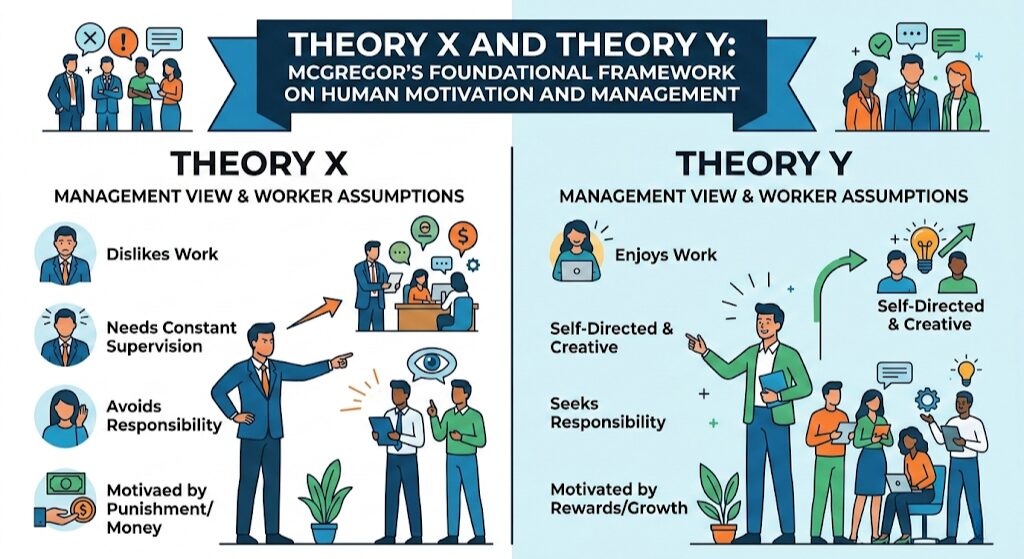
Few academic frameworks have demonstrated the durability of McGregor’s binary model. It has survived the behavioral revolution, the rise of human resources management, the knowledge economy, and the digital transformation of work. Not because it is perfect — McGregor himself acknowledged its limitations — but because the fundamental question it asks has never lost its relevance: What do you actually believe about the people who work for you?
The answer to that question, whether conscious or not, ripples through every hiring decision, performance review, organizational structure, and leadership behavior in the business. This guide explores Theory X and Theory Y with the depth and rigor the topic deserves — examining their philosophical roots, their empirical standing, their real-world manifestations, and their enduring relevance in a world of remote work, knowledge workers, and organizational complexity that McGregor could not have imagined.
Douglas McGregor: The Man Behind the Theory
Douglas Murray McGregor (1906–1964) was a social psychologist and professor at the MIT Sloan School of Management. Before entering academia, he worked in various management roles, giving him direct experience of the organizational dynamics he would later theorize about. His background bridged the empirical rigor of academic psychology with the practical realities of organizational life — a combination that gave his work unusual credibility in both worlds.
McGregor was deeply influenced by the humanistic psychology movement emerging in the mid-twentieth century, particularly the work of Abraham Maslow, whose hierarchy of needs provided the psychological architecture on which Theory Y would rest. He was also responding directly to the dominant management paradigm of his era: the legacy of Frederick Winslow Taylor’s Scientific Management and Henri Fayol’s classical administrative theory, both of which he considered theoretically flawed and organizationally damaging.
“The conventional conception of management’s task in harnessing human energy to organizational requirements can be stated broadly in terms of three propositions… I have called this set of propositions Theory X.” — Douglas McGregor, The Human Side of Enterprise, 1960
The Intellectual Context: What McGregor Was Responding To
To understand why Theory X and Theory Y were so intellectually significant in 1960, it helps to understand what management thought looked like before them. The dominant framework was essentially mechanistic: organizations were production systems, workers were inputs, and the manager’s job was to maximize efficiency through clear task specification, close supervision, and incentive-coercion structures. This worldview was not merely theoretical — it was embedded in the design of factories, the structure of hierarchies, the content of management training programs, and the performance measurement systems of virtually every large organization in the industrialized world.
McGregor did not attack this framework as immoral (though he had ethical concerns about it). He attacked it as empirically wrong — as a set of assumptions about human nature that were demonstrably inaccurate and that produced predictably poor organizational outcomes when acted upon. This made his argument genuinely subversive: it did not ask managers to be kinder; it told them their current assumptions were making their organizations less productive.
Theory X: The Authoritarian Framework
Theory X represents what McGregor considered the prevailing implicit assumption in most conventional management practice of his era — and, to a considerable degree, of management practice today. It is not a caricature of bad management; it is a coherent, internally consistent set of beliefs about human motivation that, if true, would actually justify many of the control-oriented management practices it generates.
Understanding Theory X deeply requires resisting the temptation to dismiss it as simply wrong or old-fashioned. Many managers who operate from Theory X assumptions are not cynical or cruel — they are acting rationally according to beliefs they hold sincerely, beliefs often reinforced by real experiences of employees behaving in ways consistent with Theory X predictions. (McGregor’s insight was that this confirmation often reflects the self-fulfilling nature of the theory itself.)
The Core Assumptions of Theory X
McGregor identified two versions of Theory X management that flow from these assumptions, which he labeled “hard” and “soft.” Hard Theory X management uses coercion, tight controls, close supervision, threats, and punishment to drive performance. Soft Theory X management attempts to avoid conflict by being permissive and offering satisfactions in exchange for compliance — essentially buying acquiescence rather than compelling it. McGregor argued that both variants fail for the same reason: neither creates genuine commitment or engagement, because neither addresses the actual motivational needs of people once basic security is assured.
Management Style Under Theory X
Organizations built on Theory X assumptions produce characteristic structures and behaviors. Hierarchies are tall and heavily layered, because control requires supervisory density. Decision-making is centralized, because the assumption that workers lack judgment and initiative makes decentralization seem risky. Rules and procedures proliferate, because behavior must be specified in advance to prevent the deviation that workers are assumed to seek. Performance management is primarily punitive — focused on catching and correcting failures rather than developing and enabling capability.
The physical and procedural manifestations of Theory X are visible across many workplaces even today: time-clocking systems, activity monitoring software, multi-level approval chains, rigid attendance policies, and compensation structures that assume workers will not work without financial incentive and will steal without surveillance. None of these structures are necessarily irrational given Theory X premises. They are the logical operational expression of a particular belief system about human nature.
Academic Critique and Limitations of Theory X
From a behavioral science perspective, Theory X’s assumptions about motivation are inconsistent with substantial empirical evidence. The idea that work is inherently aversive is contradicted by research demonstrating that humans derive intrinsic satisfaction from mastery, creation, social contribution, and problem-solving — in other words, from activities that resemble work at its most meaningful. The assumption that people avoid responsibility contradicts studies showing that autonomy and responsibility are among the most powerful drivers of engagement and performance in knowledge work contexts.
Perhaps Theory X’s most damaging theoretical flaw, as McGregor argued, is its failure to distinguish between the deprivation of higher-order needs and the nature of those needs themselves. When people appear lazy, disengaged, or irresponsible in organizations, it is most commonly because the organization has structured their work and relationships in ways that prevent the satisfaction of their genuine motivational needs — not because those needs do not exist. The Theory X manager observes the symptoms of motivational deprivation and concludes that the patient simply lacks motivation, missing entirely that the treatment is producing the symptoms.

“The Human Side of Enterprise” — Douglas McGregor (Annotated Edition)
The original source. McGregor’s landmark 1960 text, now available in an annotated edition with contemporary commentary by Joel Cutcher-Gershenfeld. Essential reading for anyone studying management theory at any level.
View on Amazon →Theory Y: The Humanistic Framework
Theory Y is not simply Theory X with optimism layered on top. It represents a fundamentally different ontological position about the nature of human motivation — one grounded in the humanistic psychology of Maslow, Herzberg, and their colleagues, and supported by research evidence that McGregor marshaled from across the behavioral sciences. Where Theory X assumes deficiency, Theory Y assumes capacity. Where Theory X treats motivation as extrinsic, Theory Y recognizes intrinsic motivation as a powerful and largely untapped organizational resource.
McGregor was careful to note that Theory Y was not a utopian prescription. He was not claiming all workers are always motivated or that management becomes unnecessary. He was claiming that the conditions under which most people work — the structures, the reward systems, the relationships, the degree of autonomy — systematically prevent the expression of motivational capacities that genuinely exist and that could be harnessed for both organizational and individual benefit.
The Core Assumptions of Theory Y
“The essential task of management is to arrange organizational conditions and methods of operation so that people can achieve their own goals best by directing their own efforts toward organizational objectives.” — Douglas McGregor, The Human Side of Enterprise, 1960
Management Style Under Theory Y
Theory Y management is characterized not by permissiveness or the absence of structure, but by a fundamentally different relationship between the manager and the managed. The manager’s role shifts from controller to enabler — creating the conditions, the clarity, and the resources that allow motivated, capable adults to direct their energy toward meaningful goals. This is a more demanding form of management than the command-and-control model, not less, because it requires sophisticated understanding of human motivation, genuine skill in collaborative goal-setting, and the intellectual honesty to trust people with real autonomy.
In structural terms, Theory Y organizations tend to have flatter hierarchies, more distributed decision-making authority, richer feedback systems, greater investment in employee development, and performance management systems that focus on growth and enablement rather than punishment and compliance. The physical environment often reflects the underlying philosophy: open collaboration spaces, flexible working arrangements, access to information that was formerly restricted, and visible channels for upward communication and influence.
Academic Critique and Limitations of Theory Y
Despite its more solid psychological grounding, Theory Y is not without genuine academic criticisms. The most substantive concern is its implicit assumption of universality. Not all workers, in all contexts, with all types of work, are equally ready or able to respond to Theory Y conditions. Research on situational leadership — particularly Hersey and Blanchard’s work — suggests that the appropriate management style should match the developmental readiness of the specific employee for the specific task. A highly capable, experienced professional and a newly hired entry-level employee genuinely require different management approaches, and applying Theory Y uniformly to both may serve neither well.
A second critique concerns the role of organizational context. Theory Y may describe the ideal under conditions of relative stability and role clarity, but organizations facing genuine crises — financial emergencies, safety-critical failures, rapid market disruption — may legitimately need to adopt more directive, Theory X-adjacent responses in the short term. The framework’s value lies in describing the appropriate default operating mode for healthy organizations, not a rigid absolute that must be maintained regardless of circumstances.
A third, more philosophical critique points to the paternalism latent in Theory Y’s framing. Even in McGregor’s most generous interpretation, management is still creating the conditions for employee self-actualization — still deciding what kind of autonomy to grant, what the organizational objectives are, and what rewards constitute adequate motivation. The agency this creates is real but bounded. Critical management theorists have argued that this represents a sophisticated form of control rather than its genuine absence.

“Drive: The Surprising Truth About What Motivates Us” — Daniel H. Pink
The most compelling modern update to McGregor’s Theory Y thesis, drawing on decades of behavioral science research to argue that autonomy, mastery, and purpose — not carrots and sticks — are the true drivers of human performance in the knowledge economy.
View on Amazon →Theory X vs. Theory Y: A Systematic Comparison
The contrast between Theory X and Theory Y is most illuminating when examined not as an abstract philosophical debate but as a concrete set of diverging organizational choices — choices about how to structure work, how to design reward systems, how to build relationships between managers and employees, and how to define the purpose of management itself.
- Humans are inherently work-averse
- External control is necessary for performance
- People prefer to be directed
- Motivation is primarily extrinsic
- Creativity is rare; concentrated at the top
- Security is the dominant motivational need
- Management = control and oversight
- Trust must be earned through compliance
- Work is as natural as play when conditions are right
- Self-direction emerges from genuine commitment
- People seek and accept responsibility
- Motivation includes powerful intrinsic dimensions
- Creativity is widely distributed across the workforce
- Self-actualization is a genuine motivational force
- Management = enabling and aligning conditions
- Trust is the foundation, not the reward
Comprehensive Comparative Analysis
| Dimension | Theory X | Theory Y |
|---|---|---|
| View of Human Nature | Passive, resistant, self-interested | Active, growth-oriented, capable of self-direction |
| Motivation Source | Extrinsic: money, fear, coercion | Both extrinsic and intrinsic: growth, mastery, purpose |
| Attitude Toward Responsibility | Workers avoid it; must be assigned top-down | Workers seek it when conditions enable it |
| Creativity & Innovation | Rare; concentrated in management | Widely distributed; largely underutilized |
| Decision-Making | Centralized; top-down | Participative; distributed where appropriate |
| Organizational Structure | Tall hierarchy; narrow span of control | Flatter hierarchy; broader autonomy |
| Communication Flow | Primarily downward directives | Multi-directional; upward feedback valued |
| Performance Management | Punishment-focused; deficiency-oriented | Development-focused; strength-oriented |
| Training Investment | Minimal; compliance-focused | Substantial; growth and mastery-focused |
| Trust Baseline | Low; must be earned through demonstrated compliance | High; extended as the default, adjusted by experience |
| Employee Experience | Typically: compliance, disengagement, alienation | Typically: engagement, ownership, satisfaction |
| Suitable Contexts | Repetitive, safety-critical, crisis situations | Knowledge work, creative roles, strategic functions |
| Risk | Talent attrition; innovation stagnation; disengagement | Misapplication to contexts requiring structure; naïve trust |
The Maslow Connection: Motivational Foundations of Theory Y
McGregor’s debt to Abraham Maslow is explicit and substantial. The psychological credibility of Theory Y rests almost entirely on the validity of Maslow’s motivational framework, and understanding that connection illuminates both the power and the limitations of McGregor’s argument.
Maslow’s hierarchy proposes five levels of human need, organized in a rough progression from the most basic to the most distinctively human. At the base are physiological needs: food, shelter, warmth, rest. Next come safety needs: security, order, freedom from fear. Above these are social/belonging needs: relationships, group membership, love. Then esteem needs: self-respect, achievement, recognition, status. At the apex sits self-actualization: the realization of one’s full human potential through creative, meaningful work.
Maslow’s critical observation — the one McGregor built upon — is that a satisfied need is no longer a motivator. Once physiological needs are reasonably met, more food does not drive behavior; safety needs take over. Once safety is assured, social needs drive behavior. And so on up the hierarchy. This has profound implications for management in an affluent, industrialized society: the physiological and safety needs that economic rewards directly address are already substantially met for most workers in developed economies. Offering more money to a worker whose physiological and safety needs are already satisfied has declining motivational leverage — while the higher-order needs for belonging, esteem, and self-actualization remain chronically unaddressed by conventional management practice.
The connection between McGregor’s framework and broader principles of management is also relevant here. Understanding how motivation theory integrates with the principles of management — particularly concepts of authority, responsibility, and the directing function — reveals how Theory X and Theory Y are not merely philosophical positions but practical prescriptions for how the management process should unfold. The directing function of management, in a Theory Y organization, looks radically different from its Theory X counterpart: it is oriented toward goal alignment and conditions creation rather than behavioral specification and compliance monitoring.
Theory Z: William Ouchi’s Extension
McGregor’s framework was extended in 1981 when William Ouchi, a professor at UCLA, published Theory Z: How American Business Can Meet the Japanese Challenge. Inspired by the remarkable productivity and organizational cohesion of Japanese corporations during Japan’s post-war economic miracle, Ouchi proposed a third management philosophy that he argued combined the humanistic impulses of Theory Y with distinctively Japanese organizational values.
Theory Z shares Theory Y’s fundamental respect for employee capacity and motivation, but adds dimensions that McGregor’s framework did not emphasize: the importance of long-term relationships, collective decision-making, holistic concern for the employee as a whole person rather than merely a productive agent, and strong organizational culture as a mechanism of coordination and commitment.
| Theory X | Theory Y | Theory Z |
|---|---|---|
| Short-term focus; transactional employment | Individual autonomy; outcome orientation | Long-term employment; lifetime career development |
| Centralized, top-down decisions | Participative decision-making | Collective, consensus-based (Ringi) decision-making |
| Narrow task focus | Holistic role orientation | Non-specialized, broad career paths with job rotation |
| Individual accountability | Individual ownership with shared context | Collective responsibility; group accountability |
| Explicit, formal control systems | Implicit trust with formal accountability | Implicit, informal control with explicit measures |
| Segmented concern for employee at work | Professional concern for employee at work | Holistic concern for employee and family life |
Theory Z was influential in the 1980s, particularly as American businesses grappled with the competitive challenge posed by Japanese manufacturers. Its emphasis on culture, loyalty, and long-term human capital investment anticipated many of the themes that would dominate management thinking in subsequent decades — from the emphasis on culture in Tom Peters and Robert Waterman’s In Search of Excellence to the contemporary focus on employee experience as a competitive differentiator.
Academic reception of Theory Z has been more ambivalent. Critics note that its prescriptions are deeply culturally specific — the collective decision-making and lifetime employment norms that Ouchi admired were embedded in Japanese cultural values of group harmony and institutional loyalty that do not translate straightforwardly into individualistic Western organizational contexts. The subsequent decades of Japanese economic stagnation, and the internal contradictions that lifetime employment systems created in the face of rapid technological and market change, have qualified the theory’s prescriptive appeal without fully undermining its descriptive insights.
Real-World Applications and Organizational Case Studies
The value of Theory X and Theory Y as academic frameworks is not merely historical or philosophical. Their most important function is as diagnostic lenses — tools for identifying the implicit assumptions driving current management behavior and evaluating whether those assumptions are producing the organizational outcomes they theoretically should.
Theory X Organizations: Case Characteristics
Organizations operating primarily from Theory X assumptions are identifiable by their structural and cultural characteristics. They typically feature multiple management layers between frontline workers and executive leadership, explicit authorization requirements for decisions that employees could make independently, monitoring systems that track activity rather than outcomes, and a general atmosphere of compliance rather than engagement.
The financial services industry has historically exhibited many Theory X characteristics: stringent activity monitoring, script-based customer interactions, multi-level approval chains, and performance management systems oriented primarily around compliance metrics. The result is often exactly what McGregor’s framework predicts: adequate compliance, minimal discretionary effort, high turnover, and chronic under-utilization of employee judgment and creativity.
It would be intellectually dishonest, however, to suggest that Theory X approaches produce no value in any context. Aviation maintenance, nuclear power plant operations, surgical teams, and pharmaceutical manufacturing all operate in environments where deviations from specified procedures carry life-or-death consequences. In these contexts, the structured oversight and explicit behavioral specification that Theory X produces are genuine safety assets, not merely expressions of management distrust. The critical academic insight is that Theory X management is contextually appropriate in some situations — the error is applying it universally.
Theory Y Organizations: Case Characteristics
The most celebrated Theory Y organizations of the past half-century include examples like 3M, whose famous “15% time” policy — allowing engineers to spend 15% of their working time on self-directed projects — produced innovations including Post-it Notes and masking tape. Google’s similar “20% time” policy, at least during its early years, generated products including Gmail and Google News. These examples illustrate Theory Y’s central claim: that human creativity and motivation, given appropriate conditions and genuine autonomy, generate value that directive management could never command into existence.
For deeper context on why the role of a financial manager in a Theory Y environment looks fundamentally different than in a Theory X organization, consider exploring the function of the financial manager — particularly how strategic planning and resource allocation decisions shift when the underlying management philosophy changes from control to enablement.
The technology sector broadly, and software development specifically, represents one of the most extensively documented environments for Theory Y management. The Agile methodology that now dominates software development is essentially an operationalization of Theory Y principles: cross-functional self-organizing teams, continuous feedback and adaptation, distributed decision-making close to the work, emphasis on individual interactions over processes and tools, and trust in team judgment over hierarchical oversight. The methodological shift from waterfall (Theory X) to Agile (Theory Y) software development has been associated with substantial improvements in delivery speed, software quality, and developer engagement.
Hybrid Approaches in Practice
Most sophisticated organizations today operate with contextually differentiated management approaches rather than committing entirely to either theory. A pharmaceutical company might apply Theory X rigor to manufacturing processes and regulatory compliance while applying Theory Y principles to its research and development function. A retail organization might use Theory Y approaches to develop store managers while maintaining more structured operational protocols for frontline service delivery to ensure consistent customer experience.
The key discipline is conscious choice. Organizations that apply Theory X by default — because it is familiar, because it feels safe, because nobody questioned it — and organizations that apply Theory Y naively — because it sounds more humane, without assessing whether the conditions for it actually exist — both produce suboptimal outcomes. The academic and practical value of McGregor’s framework is precisely that it surfaces these choices and demands that they be made deliberately.

“An Everyone Culture” — Robert Kegan & Lisa Laskow Lahey
A rigorous academic and practical study of “deliberately developmental organizations” — companies that operationalize Theory Y at the deepest level, building entire cultures around the growth of every employee. A natural successor text to McGregor’s original work.
View on Amazon →Modern Relevance: Theory X and Y in the 21st-Century Workplace
McGregor published his framework sixty-five years ago, in an era of industrial manufacturing, lifetime employment contracts, and deeply hierarchical organizations. The workplace of 2026 — with its remote workers, knowledge-intensive roles, gig economy participants, algorithmic management systems, and AI-augmented workflows — looks dramatically different. Yet the theoretical tension McGregor identified has not diminished; in many ways, it has intensified.
Remote Work as the Ultimate Theory X/Y Test
The COVID-19 pandemic conducted an inadvertent global experiment in management assumptions. When physical presence became impossible as a proxy for performance, organizations were forced to reveal — and sometimes confront for the first time — what they actually believed about their employees’ self-discipline and motivation.
Organizations with Theory X cultures found remote work profoundly threatening. Unable to monitor presence and activity through physical proximity, many defaulted to technological surveillance: keystroke monitoring, random screenshot capture, webcam activity tracking, and aggressive check-in schedules designed to maintain the appearance of oversight. The research on these interventions is largely negative: they signal distrust, damage morale, drive away talented employees who have options, and produce compliance-theater rather than genuine performance.
Organizations with Theory Y cultures found remote work far less disruptive. When you manage for outcomes rather than activities, trust employees to self-organize, and build accountability through clear goal-setting and regular outcome-focused conversations rather than through physical presence, the removal of the office changes the logistics of work but not its fundamental operating model.
The Knowledge Economy and Theory Y Imperatives
The structural shift from industrial to knowledge-intensive work has made Theory Y not merely preferable but increasingly necessary. The outputs of a knowledge worker — analysis, creative problem-solving, complex judgment, relationship management, innovation — cannot be commanded into existence through directive management. They are intrinsically dependent on engagement, discretionary effort, and the application of cognitive and creative capacities that employees can withhold entirely while technically complying with every behavioral requirement their employer specifies.
In this context, the scope of management as an academic discipline has necessarily expanded to encompass not just planning, organizing, leading, and controlling — but also creating conditions for intrinsic motivation, building psychological safety, developing human capital, and aligning individual development with organizational objectives in ways that produce genuine commitment rather than mere compliance.
Theory Y and Organizational Strategy
The relationship between management philosophy and strategic capability is profound. Organizations that operate from Theory X assumptions systematically under-invest in human capital, suppress the bottom-up information flows that would enable adaptive strategy, and create cultures where failure is punished rather than learned from — all of which impair strategic agility. The financial and operational case for Theory Y management aligns with the broader case for strategic planning: the financial and non-financial benefits of strategic planning are only fully realizable in organizations where the human conditions for strategy execution — engagement, commitment, discretionary effort, innovation — are actually present.
AI and the New Theory X Risk
The emergence of sophisticated AI-powered management tools introduces new vectors for Theory X management that McGregor could not have anticipated. Algorithmic scheduling systems that assign workers maximum-stress shift patterns to minimize labor costs, delivery management systems that optimize route efficiency with no accommodation for human judgment, customer service AI that scripts and measures every interaction — these represent Theory X in its most mechanistic form, made possible by technology that removes even the human discomfort of supervising people in dehumanizing ways.
The academic and ethical dimensions of this development are active areas of management research. The question of whether algorithmically managed workers retain any meaningful autonomy — whether Theory Y conditions can be created within fundamentally Theory X algorithmic structures — is one of the most significant management questions of the current decade.
Theory X and Y Within the Broader Management Framework
McGregor’s framework does not exist in theoretical isolation. It sits within a rich intellectual tradition of management science that includes the classical, behavioral, systems, and contingency schools of thought. Understanding how Theory X and Theory Y relate to the broader landscape of management principles deepens both the academic appreciation of the framework and its practical applicability.
Classical Management Theory vs. Behavioral Management Theory
Theory X is philosophically continuous with classical management theory — the tradition associated with Taylor, Fayol, and Weber. Classical theory prioritizes efficiency, formalization, hierarchy, and rational system design. It views organizations as machines and workers as components of those machines. The management challenge, in this view, is engineering: designing the optimal system and ensuring its components function as specified.
Theory Y belongs to the behavioral management tradition — the school of thought that began with the Hawthorne studies and developed through the work of Mayo, Lewin, Maslow, Herzberg, McGregor, and Argyris. Behavioral management theory recognizes that organizations are human systems, that workers are not interchangeable components but complex social and psychological actors, and that the management challenge is fundamentally one of motivation, development, and relational intelligence rather than engineering design.
The contingency school — which emerged in the 1960s and 1970s through the work of Lawrence and Lorsch, Burns and Stalker, and others — represents a synthesis: rejecting the universal prescriptions of both classical and behavioral theory in favor of contextually sensitive analysis. From a contingency perspective, both Theory X and Theory Y can be appropriate, depending on the nature of the work, the environmental conditions, the characteristics of the workforce, and the strategic requirements of the organization. This is the intellectual position that most contemporary management scholars would occupy when asked to evaluate McGregor’s framework.
Communication as an Organizational Efficiency Variable
The management philosophy embedded in Theory X or Theory Y shapes communication patterns in profound ways. In Theory X organizations, communication is primarily directive and downward — instructions flow from management to workers, and upward communication is limited to performance reports and compliance confirmations. In Theory Y organizations, communication is multi-directional, genuinely informative, and expected to flow upward as readily as downward.
The importance of communication quality as a dimension of organizational efficiency connects McGregor’s framework to practical communication research. For instance, understanding the role of consideration in communication — the idea that effective communication requires genuine attention to the receiver’s perspective, needs, and capacity to understand — is far more consistent with Theory Y’s relational foundations than with Theory X’s directive communication norms.
Financial Accountability in Theory X and Y Organizations
The approach to financial accountability — including how accounting principles are applied and how financial information is shared — differs systematically between Theory X and Theory Y organizations. Theory X organizations typically restrict financial information to management levels, treating transparency about costs, revenues, and financial performance as a management prerogative rather than an organizational resource. Theory Y organizations, recognizing that informed employees make better decisions, tend toward greater financial transparency — sharing performance data broadly, connecting individual and team contributions to financial outcomes, and treating financial literacy as an organizational investment.
The golden rules of accounting provide the technical foundation for financial record-keeping that, in a Theory Y organization, becomes a shared organizational resource rather than a management control mechanism. When employees understand the financial dimensions of their work — when they can see the connection between their decisions and the organization’s financial outcomes — they make more commercially intelligent choices, which is precisely the kind of discretionary judgment that Theory Y predicts motivated, informed employees will exercise.
Frequently Asked Questions
What is Theory X and Theory Y?
Who developed Theory X and Theory Y?
What are the core assumptions of Theory X?
What are the core assumptions of Theory Y?
Which theory is better — Theory X or Theory Y?
How does Theory X relate to Scientific Management?
What is the relationship between Theory Y and Maslow’s Hierarchy?
What is Theory Z and how does it relate to Theory X and Y?
Can Theory X and Theory Y coexist in the same organization?
How does Theory X and Theory Y apply to modern remote work?
Conclusion: What McGregor’s Framework Still Demands of Us
Douglas McGregor did not invent the idea that how you treat people affects how they behave. But he gave that idea precise theoretical form, connected it to the best psychological research of his era, and placed it squarely in the center of management education — where it has remained ever since, and with good reason.
The enduring power of Theory X and Theory Y is that they function as a mirror. They do not primarily describe types of workers; they describe types of managers. More precisely, they describe types of assumptions — about human nature, about motivation, about the relationship between organizational objectives and individual needs — that shape every policy, every structure, every relationship, and every decision in the organizations that hold them. The question McGregor forces us to ask is not “what kind of workers do I have?” but “what do I actually believe about the people I lead, and is that belief accurate?”
The academic evidence accumulated since 1960 has broadly — if not uniformly — supported Theory Y’s more generous view of human motivational capacity, particularly for knowledge-intensive and creative work. The contingency research has added necessary nuance: context matters, development level matters, work design matters, and the binary simplicity of McGregor’s original framework needs refinement when applied to the full complexity of modern organizational life.
But the core insight survives every refinement: organizations that create the conditions for genuine human motivation — autonomy, mastery, purpose, connection, growth — consistently outperform those that rely on compliance structures rooted in a fundamentally pessimistic view of human nature. Not because optimism is morally superior to pessimism, but because Theory Y more accurately describes what motivates the people who build, serve, and lead the organizations that shape our world.
Whether you approach this framework as a student encountering it for the first time, a manager reflecting on the assumptions embedded in your daily decisions, or a scholar exploring its place in the evolution of management thought — the questions it raises remain as sharp and as necessary as they were in 1960. What you believe about people is, ultimately, the most consequential management decision you will ever make.
Continue Your Journey into Management Theory
Explore more foundational academic guides across management, economics, finance, and organizational behavior on Edmics — built for serious students and curious professionals.
Explore All Guides on Edmics →