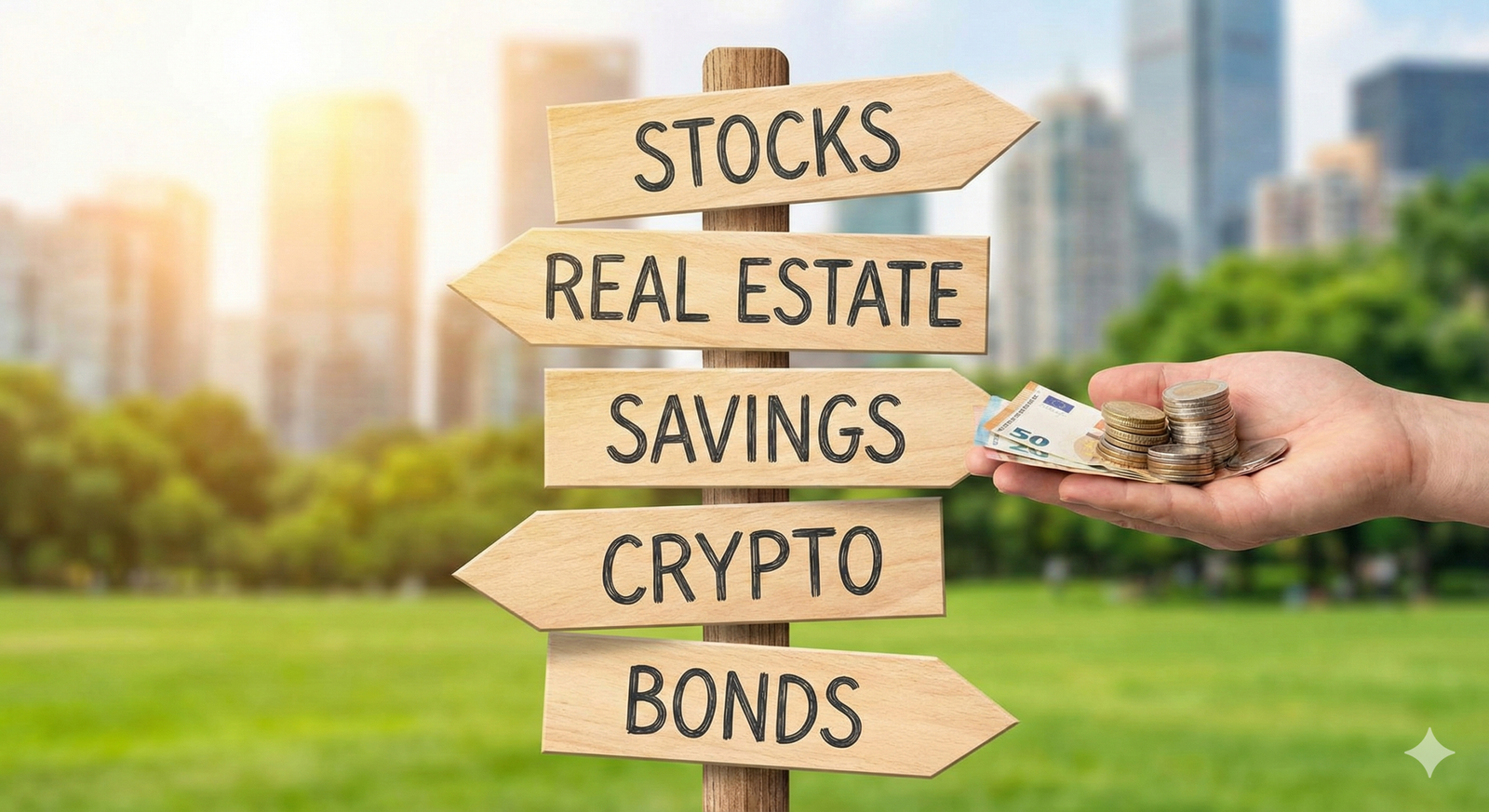
Where to Invest Money: The Complete Roadmap for Building Wealth
Start Here: The “Where” Depends on the “When”
“Where should I put my money?” is the most common question in finance, but the answer depends entirely on when you need it back.
If you need the money in 6 months for a wedding, putting it in the stock market is gambling. If you need it in 30 years for retirement, keeping it in a savings account is losing money to inflation.
This guide breaks down the investment landscape into actionable tiers, helping you match your money to the right vehicle. For a forward-looking perspective on specific assets performing well this year, check our guide on best investments for 2026.
The Financial Hierarchy of Needs
Before you buy your first stock or crypto coin, you must secure your foundation. Investing without a safety net is financial suicide.
Step 1: The Emergency Fund
Goal: 3–6 months of living expenses.
Where to put it: High-Yield Savings Account (HYSA).
Why: This money is insurance, not an investment. Do not risk it.
Step 2: High-Interest Debt
Goal: $0 Balance.
Strategy: Pay off any credit card debt with interest rates above 7%. Guaranteed 20% return (by saving on interest) beats the stock market every time.
The Missing Piece: Tax-Advantaged Retirement Accounts
Before you even think about which specific stock or fund to buy, you need to decide which container that investment lives in. This is one of the most overlooked parts of building wealth. Two people can buy the exact same S&P 500 index fund and end up with wildly different amounts of spendable money in retirement simply because one used a tax-advantaged account and the other didn’t.
Think of a retirement account like a wrapper around your investments. The wrapper itself doesn’t generate returns — the stocks and funds inside it do that — but the wrapper determines how much of those returns the government lets you keep.
The 401(k): Your Employer’s Offer
A 401(k) is a workplace retirement plan that lets you contribute pre-tax dollars directly from your paycheck. Because the contribution comes out before income tax is calculated, your taxable income for the year drops, which lowers your tax bill today. The money then grows tax-deferred, meaning you don’t pay any tax on dividends, interest, or capital gains while it sits in the account. You only pay ordinary income tax when you withdraw funds in retirement.
The single most important rule with a 401(k) is this: always capture the full employer match before investing anywhere else. If your employer matches 50% of contributions up to 6% of your salary, that match is an immediate, guaranteed 50% return on your money — something no stock, bond, or crypto asset can reliably promise. Walking away from a match is walking away from free money.
Traditional IRA vs. Roth IRA
An Individual Retirement Account (IRA) is similar to a 401(k) but opened independently through a brokerage rather than an employer. There are two primary flavors, and the difference between them comes down to when you want to pay taxes.
| Feature | Traditional IRA | Roth IRA |
|---|---|---|
| Tax treatment on contribution | Pre-tax (may lower this year’s taxable income) | After-tax (no deduction today) |
| Tax treatment on withdrawal | Taxed as ordinary income | Completely tax-free (if rules are met) |
| Best for | Investors who expect to be in a lower tax bracket in retirement | Investors who expect to be in a higher tax bracket later, or younger investors with decades of growth ahead |
| Required withdrawals | Yes, starting at a set age | No required withdrawals during the original owner’s lifetime |
A helpful mental model: with a Traditional account, you’re deferring the tax bill to a future version of yourself. With a Roth, you’re paying the tax bill now, at today’s known rate, so every dollar of future growth is yours to keep, untouched by the IRS. For young investors with many decades of compounding ahead, that tax-free growth can be enormously valuable, since the account balance — and therefore the value of that future tax exemption — has the most time to expand.
HSAs: The Secret Triple-Tax-Advantaged Account
If you have a high-deductible health insurance plan, you likely qualify for a Health Savings Account (HSA). Most people treat this as a place to stash money for doctor visits, but savvy investors treat it as a stealth retirement account, because it offers a benefit no other account can match: contributions are tax-deductible, growth is tax-free, and withdrawals for qualified medical expenses are also tax-free. That’s three tax advantages stacked on top of each other.
The strategy many long-term investors use is to pay for current medical expenses out of pocket when possible, let the HSA balance invest and grow untouched for years, and then reimburse themselves later (or simply use the funds for medical costs in retirement, when they’re guaranteed to have some). After age 65, HSA funds can also be withdrawn for non-medical reasons without penalty, taxed just like a Traditional IRA, which makes the account flexible even if you stay healthy.
529 Plans: Investing for a Child’s Education
If your goal isn’t retirement but rather funding a child’s future education, a 529 plan offers similar tax-deferred growth, with tax-free withdrawals when the money is used for qualified education expenses like tuition, books, and room and board. Contribution limits are generous, and many states offer an additional state tax deduction for contributions, making this one of the most efficient ways to save for a child’s college years.
Choosing the Right Brokerage Account
Once you understand the tax-advantaged wrappers above, the next decision is where to actually house your day-to-day investing. Most people end up using a combination of account types depending on their goals.
Taxable Brokerage Accounts
A standard taxable brokerage account has no contribution limits and no restrictions on when you can withdraw funds, which makes it the most flexible option. The tradeoff is that you’ll owe capital gains tax when you sell investments for a profit, and you’ll owe tax on any dividends received each year, regardless of whether you withdraw the cash. This account type is ideal for money you want invested for the long term but might need access to before traditional retirement age, such as funds earmarked for an early retirement or a major purchase a decade out.
Employer-Sponsored Plans
Beyond the standard 401(k), some employers offer a 403(b) for nonprofit and government workers, or a 457(b) for certain public sector employees. These function similarly to a 401(k) in terms of tax treatment, though the specific rules around early withdrawals and catch-up contributions can differ. If you’re self-employed, a Solo 401(k) or a SEP IRA allows you to contribute a much larger percentage of your income compared to a standard IRA, since you’re effectively acting as both the employer and the employee.
What to Look for in a Broker
When choosing where to actually open these accounts, prioritize a broker with zero commission on stock and ETF trades, no account minimums, a wide selection of low-cost index funds, and a clean, reliable mobile app. Nearly every major broker today offers commission-free trading, so differentiation usually comes down to research tools, customer service quality, and the breadth of available account types (does the broker support 529 plans, custodial accounts for kids, or self-directed IRAs, for example).
1. The Growth Engine: Stock Market Funds
For most people, the stock market is the primary vehicle for long-term wealth. It has historically returned about 10% per year on average over the last century.
Index Funds & ETFs
Instead of trying to pick the next Apple or Tesla, buy the whole basket. An S&P 500 ETF (like VOO or SPY) gives you ownership in the 500 largest companies in America. It is low cost, diversified, and beats 90% of professional traders over time. For more specific sector picks, see our stocks investing guide.
Individual Stocks
If you have a higher risk tolerance and want to try to beat the market, allocate a small portion (5-10%) of your portfolio to individual companies. Look for businesses with strong “moats” (competitive advantages) and healthy cash flow.

J.L. Collins wrote this book as a guide for his daughter. It simplifies the complex world of investing into a straightforward strategy that anyone can follow. Stop overthinking and start building.
Check Price on Amazon2. The Inflation Hedge: Real Estate
Real estate is a favorite among wealthy investors because it offers leverage (you can buy a $500k asset with $100k down) and tax advantages. It also serves as a powerful hedge against inflation.
| Type | Effort | Liquidity |
|---|---|---|
| Physical Rental | High (Landlord) | Low (Hard to sell fast) |
| REITs (Stocks) | Zero (Passive) | High (Sell instantly) |
| Crowdfunding | Low | Medium (Lock-up periods) |
If you don’t want to fix toilets at 2 AM, consider REITs (Real Estate Investment Trusts). These are companies that own office buildings, apartments, or data centers, and they are required by law to pay out 90% of their taxable income as dividends to you. Learn more in our real estate section.
3. The Moonshot: Crypto & Alternatives
This category is for the “speculative” portion of your portfolio—money you can afford to lose but has the potential for explosive 10x+ growth.
Cryptocurrency
Bitcoin has emerged as “digital gold,” a decentralized store of value. Ethereum powers the new internet of contracts. While volatile, a 1-5% allocation here can significantly boost portfolio returns. Read more about risk management in our crypto investing guide.
Commodities
Gold, silver, and oil do not produce cash flow, but they protect purchasing power when currencies weaken. They are essential portfolio diversifiers.

If you invest in crypto, you need self-custody. “Not your keys, not your coins.” The Ledger Nano X keeps your investments safe from exchange hacks.
Check Price on Amazon4. The Safety Net: Bonds & HYSAs
As you get closer to retirement, capital preservation becomes more important than growth. This is where fixed-income assets shine.
- Treasury Bills (T-Bills): Loans to the US government. Considered “risk-free.”
- Corporate Bonds: Loans to companies. Higher risk than Treasuries, but higher yield.
- CDs (Certificates of Deposit): You lock your money away for 1-5 years in exchange for a guaranteed interest rate.
Balancing these safe assets with growth stocks is the core of a solid retirement strategy.
5. Mutual Funds vs. ETFs vs. Index Funds
Once you decide to invest in “the stock market” rather than picking individual companies, you still have to choose a vehicle. The terms mutual fund, ETF, and index fund get thrown around interchangeably, but they are not the same thing, and the differences matter for your returns, your tax bill, and how easily you can buy and sell.
What an Index Fund Actually Is
An index fund is not a separate legal structure — it’s a strategy. It simply means the fund is built to mirror a specific market benchmark, such as the S&P 500 or the total U.S. stock market, rather than having a human manager pick winners. Because there’s no expensive research team trying to beat the market, index funds carry very low expense ratios, often a fraction of a percent per year. An index fund can be packaged either as a traditional mutual fund or as an ETF.
Mutual Funds: The Older Structure
Mutual funds pool money from thousands of investors and are priced once per day, after the market closes. When you place an order, you don’t know your exact execution price in advance — you get whatever the fund’s net asset value settles at that evening. Many mutual funds also carry minimum investment requirements, sometimes $1,000 or more, and some (though a shrinking number) still charge a “load,” or sales commission, on top of the annual expense ratio.
ETFs: The Modern Alternative
Exchange-Traded Funds trade throughout the day just like a stock, meaning you can buy or sell at any point the market is open and see your exact price in real time. Most ETFs have no minimum investment beyond the price of a single share, and thanks to fractional shares at most modern brokers, you can often start with just a few dollars. ETFs are also generally more tax-efficient than mutual funds in a taxable account, because of how shares are created and redeemed behind the scenes, which tends to minimize taxable capital gains distributions passed on to shareholders.
| Feature | Mutual Fund | ETF |
|---|---|---|
| Trading | Once daily, after market close | Continuously during market hours |
| Minimum investment | Often $500–$3,000 | Price of one share (or less with fractional shares) |
| Typical tax efficiency | Lower in taxable accounts | Higher in taxable accounts |
| Management style | Actively or passively managed | Mostly passively managed (though active ETFs exist) |
For most long-term investors building wealth in a standard taxable account, a low-cost, broadly diversified ETF tracking a total market or S&P 500 index checks every box: low fees, intraday liquidity, and tax efficiency. Inside a 401(k), where tax efficiency matters less because the account is already tax-advantaged, an equivalent low-cost index mutual fund works just as well if that’s what your plan offers.
Active vs. Passive Management
Actively managed funds employ a professional manager (or team) who tries to select investments that will outperform a benchmark, charging a higher fee in exchange for that expertise. Passive funds simply track a benchmark and make no attempt to beat it, which keeps costs dramatically lower. The uncomfortable truth for the active management industry is that the majority of actively managed funds fail to outperform their benchmark index over long time horizons, especially once fees are factored in, which is why passive index investing has become the default recommendation for most retail investors.
Understanding Expense Ratios
Every fund, whether active or passive, charges an expense ratio — an annual fee expressed as a percentage of your investment, deducted automatically from the fund’s returns rather than billed to you directly. The difference between a 0.03% expense ratio and a 1.03% expense ratio might look trivial on paper, but compounded over several decades on a growing balance, that extra 1% can consume a substantial portion of your total ending wealth. This is one of the few variables in investing that is entirely within your control, which is why cost-conscious investors treat low fees as a genuine edge rather than an afterthought.
Sector and Thematic Funds
Beyond broad market index funds, there are also sector-specific ETFs that concentrate on a single industry — technology, healthcare, energy, or financials, for example — as well as thematic funds built around trends like clean energy or robotics. These can be a reasonable way to add a targeted tilt to a portfolio that’s already broadly diversified, but because they concentrate risk in a single industry, they generally work best as a small satellite position rather than the core of a portfolio.
Bond Funds
Just as stock index funds bundle hundreds of companies together, bond funds bundle together many individual bonds — government, municipal, or corporate — into a single diversified holding. This solves a practical problem with buying individual bonds directly, which often requires larger minimum purchase amounts and more specialized knowledge of credit ratings and maturities. A total bond market index fund gives broad exposure to investment-grade debt in a single low-cost purchase, and is commonly used as the “safer” counterweight to stock funds within a diversified portfolio.
How Many Funds Do You Actually Need?
It’s tempting to accumulate a large collection of niche funds over time, but for most investors a portfolio built from just three or four broad, low-cost funds — a total U.S. stock fund, a total international stock fund, a total bond fund, and perhaps a REIT fund — captures the vast majority of the diversification benefit available. Adding more funds beyond that point often just increases overlap and complexity without meaningfully changing your actual risk or return profile.
6. Dividend Investing: Getting Paid to Wait
Some companies return a portion of their profits directly to shareholders in the form of cash payments called dividends, typically distributed quarterly. Dividend investing is the strategy of building a portfolio around companies with a history of paying — and steadily raising — these payouts.
Why Investors Chase Dividends
Dividends provide a stream of cash you can either spend or reinvest, and mature, profitable companies tend to be the ones paying them, which can make a dividend-focused portfolio feel steadier during volatile markets. Reinvesting dividends automatically, through a Dividend Reinvestment Plan (DRIP), also accelerates compounding, since each payout buys a few more shares that then generate their own future payouts.
Dividend Yield vs. Dividend Growth
A high dividend yield can be tempting, but an unusually high yield is often a warning sign rather than a gift — it frequently means the stock price has fallen sharply because the market expects the company to cut its payout. Many long-term investors instead favor “Dividend Aristocrats” or “Dividend Kings” — companies that have raised their dividend every single year for 25 or even 50-plus consecutive years — since a long streak of increases signals durable, disciplined profitability rather than a temporarily inflated yield.
Dividends and Taxes
Qualified dividends — those paid by most U.S. companies and held for a minimum period — are taxed at the more favorable long-term capital gains rates rather than as ordinary income, which makes dividend-paying stocks reasonably tax-efficient to hold in a taxable brokerage account. Non-qualified dividends, more common with REITs and some foreign stocks, are taxed as ordinary income, which is one reason many investors prefer to hold REITs inside a tax-advantaged account like an IRA rather than a taxable one.
Dividend Funds vs. Picking Individual Dividend Stocks
Rather than researching and selecting individual dividend-paying companies, most investors get simpler, more diversified exposure through a dividend-focused ETF, which bundles together dozens or hundreds of qualifying companies into a single purchase. This spreads out the risk that any single company cuts its payout and removes the need to monitor individual balance sheets, while still delivering the steady income stream that attracts investors to the strategy in the first place.
Dividends as Part of Total Return
It’s worth remembering that dividends are only one piece of an investment’s total return; the other piece is price appreciation. A company that pays no dividend at all, reinvesting every dollar of profit back into growing the business instead, can still be an excellent long-term investment if that reinvestment fuels faster growth. Judging a stock purely by its dividend yield while ignoring its total return, including price changes, is a common and costly mistake.
Building a Dividend-Funded Income Stream
For investors nearing or in retirement, a dividend-focused strategy can supplement withdrawals by providing a recurring cash stream that doesn’t require selling shares outright. This can feel psychologically easier than periodically selling off portions of a portfolio, even though financially the two approaches can end up fairly similar once taxes and total return are accounted for. The key is not to over-concentrate in high-yield sectors chasing income at the expense of overall diversification.
7. International & Emerging Markets
It’s tempting to invest only in companies you recognize from your own country, a bias researchers call “home country bias.” But the U.S. is only one part of the global economy, and adding international exposure can smooth out returns over time since different regions tend to lead and lag the market cycle at different points.
Developed vs. Emerging Markets
Developed international markets — think Japan, the United Kingdom, Germany, and Canada — tend to behave somewhat similarly to the U.S. market: mature economies, established regulatory systems, and relatively stable currencies. Emerging markets — countries like India, Brazil, Vietnam, and Indonesia — offer higher long-term growth potential because their economies and middle classes are expanding faster, but that potential comes with higher volatility, currency risk, and less predictable regulation.
How Much International Exposure Makes Sense
There’s no single right answer, but many target-date and balanced funds allocate somewhere between 20% and 40% of their stock portion to international markets, roughly mirroring the fact that U.S. companies make up a little less than two-thirds of total global stock market value. The simplest way to get this exposure is through a single low-cost “total international” index ETF, which bundles developed and emerging markets into one purchase rather than requiring you to pick individual countries.
A Simple Global Starting Point
A commonly cited “three-fund portfolio” pairs a U.S. total stock market fund, a total international stock fund, and a total bond market fund. It’s not the only reasonable approach, but it illustrates how a globally diversified portfolio can be built with just three purchases.
Currency Risk
When you invest internationally, you’re exposed to two variables instead of one: the performance of the underlying companies, and the movement of foreign currencies relative to your own. A great year for a foreign stock market can still translate into a mediocre return once converted back to your home currency if that currency weakened significantly during the same period, and the reverse is also true. Most broad international index funds don’t hedge this currency exposure, which adds a layer of diversification in its own right, since currency movements don’t always move in the same direction as the underlying stock markets.
Why Not Just Stay 100% U.S.?
Because no single country’s stock market leads every cycle indefinitely. Different regions have taken turns leading global returns across different decades, and no one has reliably predicted in advance which region will lead next. Holding a globally diversified portfolio isn’t a bet that international markets will outperform — it’s an acknowledgment that nobody knows for certain which region will win over any given stretch, so it makes sense to own a slice of all of them.
8. Asset Allocation by Age
“Asset allocation” simply means how your money is divided between stocks, bonds, and other assets. It is one of the biggest drivers of your long-term returns and your portfolio’s volatility, generally mattering more than which specific fund you pick within each category.
The Classic Rule of Thumb
A traditional starting formula subtracts your age from 110 or 120 to estimate your stock allocation percentage, with the rest in bonds. A 30-year-old, for example, might land around 80–90% stocks. This isn’t a rigid rule — it’s a rough anchor that assumes younger investors have more time to recover from downturns, while older investors nearing retirement need to protect what they’ve already built.
| Age Range | Illustrative Stock Allocation | Illustrative Bond/Cash Allocation |
|---|---|---|
| 20s–30s | 85–100% | 0–15% |
| 40s | 75–85% | 15–25% |
| 50s | 60–75% | 25–40% |
| 60s and retired | 40–55% | 45–60% |
These figures are illustrative, not prescriptive — your actual mix should reflect your personal risk tolerance, other income sources like a pension or Social Security, and how soon you’ll actually need to draw down the money. If simplifying this decision appeals to you, a target-date fund automatically shifts its allocation along a glide path like this one as the target year approaches, without requiring you to rebalance it manually.
Target-Date Funds Explained
A target-date fund is named for the approximate year you plan to retire, such as “2055,” and it automatically becomes more conservative as that year approaches, shifting from a stock-heavy mix in your 20s and 30s toward a more bond-heavy mix as retirement nears. This makes it one of the simplest possible “set it and forget it” options, especially popular as the default investment inside many workplace 401(k) plans, since it removes the need to manually rebalance or adjust your allocation over the following decades.
Risk Tolerance Isn’t Just About Age
Two 40-year-olds with identical incomes can reasonably choose very different allocations if one has a stable government pension waiting for them and the other doesn’t, or if one has a higher tolerance for watching their balance swing during a downturn without losing sleep. Age is a useful starting anchor, but it should be adjusted based on your job stability, other assets, upcoming large expenses, and your honest emotional reaction to seeing your portfolio drop 20% in a bad month.
9. Robo-Advisors vs. DIY Investing
Once you understand the building blocks — accounts, funds, and allocation — you have to decide who actually assembles the portfolio: you, or an automated service.
What a Robo-Advisor Does
A robo-advisor asks you a short questionnaire about your goals, timeline, and risk tolerance, then automatically builds and maintains a diversified portfolio of low-cost ETFs on your behalf. Most robo-advisors also handle rebalancing automatically and offer built-in tax-loss harvesting, all for an annual advisory fee that’s typically a fraction of a percent of your account balance — far less than a traditional human advisor charges.
What DIY Investing Requires
Managing your own portfolio costs nothing beyond the underlying fund fees, and it gives you full control over exactly which funds you hold and when you rebalance. The tradeoff is that it requires more time, more discipline, and a willingness to avoid tinkering with your allocation every time the market gets volatile — the single biggest risk to a DIY investor is usually behavioral, not technical.
| Factor | Robo-Advisor | DIY (Self-Managed) |
|---|---|---|
| Time required | Minutes to set up, mostly hands-off after | Ongoing research and periodic rebalancing |
| Typical cost | Small advisory fee plus fund fees | Fund fees only |
| Best for | Hands-off investors who want automation | Investors comfortable managing their own allocation |
Neither approach is objectively superior — plenty of successful long-term investors use a hybrid, keeping retirement accounts on autopilot with a robo-advisor or target-date fund while managing a smaller taxable account themselves.
When a Human Advisor Still Makes Sense
Robo-advisors excel at the mechanical parts of investing — building a diversified portfolio, rebalancing it, and harvesting losses — but they generally can’t help with more complex financial planning questions, such as structuring a small business sale, coordinating estate planning across multiple accounts, or navigating a complicated multi-state tax situation. For those scenarios, a fee-only fiduciary advisor, who is legally obligated to act in your best interest, can be worth the added cost even if you continue managing routine investing on your own.
Questions to Ask Before Choosing a Platform
Before settling on either a robo-advisor or a self-directed brokerage, check what the underlying fund fees are in addition to any advisory fee, whether tax-loss harvesting is included or an added-cost feature, whether the platform supports the specific account types you need (Roth IRA, taxable, 529), and how easily you could transfer your holdings elsewhere in the future if you change your mind.
10. Dollar-Cost Averaging
Dollar-cost averaging (DCA) means investing a fixed amount of money on a regular schedule — say, $500 every payday — regardless of whether the market is up or down that day, rather than trying to time a single “perfect” entry point.
Why It Works Psychologically and Mathematically
Because your fixed dollar amount buys more shares when prices are low and fewer shares when prices are high, DCA automatically smooths out your average purchase price over time and removes the emotionally difficult decision of guessing when to invest a lump sum. For most people contributing from a regular paycheck, DCA isn’t really a choice — it’s simply what happens naturally every time a portion of income lands in a 401(k) or brokerage account.
DCA vs. Investing a Lump Sum
If you come into a large sum of money at once, such as an inheritance or a bonus, research generally shows that investing it all immediately tends to outperform spreading it out over several months, simply because markets rise more often than they fall over long periods. That said, DCA-ing a lump sum in over three to twelve months remains a reasonable choice for investors who would otherwise feel too anxious to invest the entire amount in one day — the psychological comfort can be worth a small amount of theoretical performance.
Automating the Process
The easiest way to actually stick with dollar-cost averaging is to remove the decision entirely by setting up automatic, recurring transfers from your bank account into your brokerage or retirement account on payday. Most brokers let you schedule automatic purchases of specific funds so the money is invested without requiring you to log in and manually place an order every time, which also reduces the temptation to skip a contribution during a scary market headline.
DCA Doesn’t Guarantee Profit
It’s worth being clear-eyed that dollar-cost averaging is a discipline and risk-management technique, not a guarantee against loss — if the market declines over your entire investing period, DCA won’t prevent a loss, it will simply average your purchase price along the way down. Its real value lies in removing emotion and guesswork from the timing decision, not in predicting or controlling market direction.
11. Rebalancing Your Portfolio
Over time, different assets grow at different rates, which means your carefully chosen allocation drifts. If stocks have a great year, your target 80/20 stock-to-bond split might quietly become 88/12, exposing you to more risk than you originally intended.
Two Common Rebalancing Approaches
Calendar-based rebalancing means checking your allocation on a set schedule, such as once a year, and selling down whatever has grown too large while buying more of what’s underweight. Threshold-based rebalancing instead triggers a rebalance whenever any asset class drifts a set distance from its target, such as five percentage points, regardless of the calendar date. Either method works; what matters most is picking one and sticking to it rather than rebalancing impulsively based on headlines.
Rebalancing Without Triggering Taxes
In a tax-advantaged account like a 401(k) or IRA, you can rebalance freely with no tax consequences. In a taxable account, selling appreciated assets to rebalance can trigger capital gains tax, so many investors instead rebalance by directing new contributions toward whichever asset class has fallen behind, gradually nudging the portfolio back into balance without selling anything at all.
A Simple Annual Rebalancing Checklist
1. Pick one date each year (a birthday works well).
2. Compare your current allocation to your target.
3. If any category has drifted more than 5%, adjust — buying underweight assets first with new cash where possible.
4. Resist the urge to check or adjust again until next year.
Rebalancing Across Multiple Accounts
If you hold a 401(k), an IRA, and a taxable brokerage account, it’s often easier to think of all three as one combined portfolio rather than rebalancing each account in isolation. This lets you make most of your rebalancing adjustments inside tax-advantaged accounts, where trades don’t trigger a taxable event, while leaving your taxable account largely undisturbed and tax-efficient.
12. Tax Efficiency & Tax-Loss Harvesting
Where you hold an investment can matter almost as much as which investment you hold. Placing the right asset in the right account type — a concept often called “asset location” — can meaningfully increase your after-tax returns without changing your underlying risk at all.
Asset Location Basics
Assets that generate a lot of taxable income each year, such as bonds, REITs, and actively managed funds with frequent turnover, are generally better held inside tax-advantaged accounts like a 401(k) or IRA, where that income isn’t taxed annually. Tax-efficient assets, such as broad index ETFs that rarely distribute taxable capital gains, are reasonable to hold in a taxable brokerage account, since you control when you trigger a taxable event by choosing when to sell.
Tax-Loss Harvesting
Tax-loss harvesting means intentionally selling an investment that has dropped below what you paid for it, locking in a capital loss that can offset capital gains elsewhere in your portfolio — and up to a set amount of ordinary income each year if losses exceed gains. Any unused losses beyond that limit can typically be carried forward to offset gains in future years. To avoid running afoul of the “wash sale rule,” which disallows the tax loss if you buy a substantially identical investment within 30 days before or after the sale, many investors swap into a similar-but-not-identical fund rather than sitting in cash or buying the exact same fund back immediately.
Short-Term vs. Long-Term Capital Gains
Assets held for one year or less before being sold are subject to short-term capital gains tax, taxed at the same rate as ordinary income, which is typically much higher than the long-term rate. Assets held for longer than a year qualify for long-term capital gains treatment, which comes with meaningfully lower tax rates. This single distinction is one of the strongest arguments for a buy-and-hold approach: frequent short-term trading not only makes market timing harder, it also pushes gains into the more expensive tax bracket.
Tax-Efficient Fund Placement Example
As a simplified illustration, an investor might hold their bond funds inside a 401(k) or IRA where the annual interest payments aren’t taxed each year, while holding their broad U.S. stock index fund in a taxable account where it rarely generates taxable distributions and benefits from long-term capital gains rates when eventually sold. This isn’t a universal rule for every investor, but it demonstrates the underlying logic of matching tax-inefficient assets with tax-sheltered accounts.
13. Investor Psychology & Common Mistakes
The biggest threat to most portfolios isn’t a bad fund choice — it’s the investor’s own behavior during periods of stress or euphoria. Understanding a few common psychological traps can save you more money than almost any technical strategy.
Panic Selling During Downturns
When markets fall, the instinct to “stop the bleeding” by selling everything feels protective, but it locks in a real loss and turns a temporary paper decline into a permanent one. Investors who stayed invested through past market crashes and simply kept contributing generally recovered and grew their wealth, while those who sold near the bottom often missed the recovery entirely, since some of the market’s strongest days historically follow immediately after its worst ones.
Chasing Performance
It’s tempting to pile into whatever asset class or stock had the best returns last year, but yesterday’s winner has no obligation to keep winning, and chasing recent performance often means buying near a peak. A steadier approach is sticking to a predetermined allocation and rebalancing into whatever has underperformed, which is psychologically uncomfortable but historically effective.
Overconfidence and Excessive Trading
Frequent trading tends to correlate with lower returns, not higher ones, largely because it’s difficult to consistently time entries and exits correctly, and every trade in a taxable account can trigger a tax event. Multiple long-running studies of individual brokerage accounts have found that the most active traders tend to underperform buy-and-hold investors by a meaningful margin over time.
Lifestyle Creep
As income rises, spending often rises right alongside it, leaving the same small percentage — or nothing at all — left over to invest. Automating a fixed percentage of every raise directly into your investment accounts before it hits your checking account is one of the simplest ways to keep your savings rate climbing along with your income.
Confirmation Bias and Financial News
It’s easy to seek out news and commentary that confirms whatever you already believe about the market’s direction, while dismissing information that contradicts it. Constant exposure to financial media, much of which is designed to generate clicks through urgency and alarm, can push otherwise disciplined investors toward impulsive decisions. Checking your portfolio less frequently, and treating daily financial headlines as entertainment rather than actionable signals, tends to correlate with better long-term outcomes.
The Sunk Cost Fallacy
Holding onto a losing investment purely because you don’t want to “admit” the loss, rather than because you still believe in its future prospects, is a classic behavioral trap. The money already invested is gone regardless of what you decide next; the only relevant question going forward is whether you’d buy that same investment today at its current price, knowing what you now know.
14. The Power of Compound Interest
Compound interest is often called the eighth wonder of the financial world, and for good reason: it means your investment returns start generating their own returns, creating growth that accelerates the longer money stays invested.
A Simple Illustration
Consider two investors. The first invests $300 a month starting at age 25 and stops contributing entirely at 35, letting the balance simply grow untouched until 65. The second waits until 35 to start and contributes the same $300 a month every year until 65. Assuming the same average annual return, the investor who started ten years earlier and stopped after a decade typically ends up with a larger balance than the one who contributed for three times as long but started later — purely because of the extra decade of compounding.
Why Time Matters More Than Timing
This is the mathematical reason “start now” is repeated so often in personal finance: the earliest dollars invested have the most years to compound, making them disproportionately valuable compared to dollars invested later, even if the later dollars are larger in total. It’s also why minimizing fees matters so much — a 1% annual fee doesn’t just cost 1% once, it compounds against you every single year, quietly eating into decades of potential growth.
The Takeaway
You don’t need a large amount of money to start — you need time. Getting started with a small, consistent contribution today generally beats waiting to invest a larger amount later.
The Rule of 72
A handy mental shortcut for estimating how compounding works is the “Rule of 72”: divide 72 by your expected annual rate of return to estimate roughly how many years it will take your money to double. At an assumed 8% average annual return, for instance, that suggests a portfolio would roughly double approximately every nine years, which makes the long-term effect of extra decades in the market easier to visualize without needing a spreadsheet.
Compounding Works Against You Too
The same mathematical force that grows your investments can also grow debt you owe, particularly high-interest credit card balances. This is precisely why paying down high-interest debt is generally prioritized ahead of investing — the guaranteed “return” from eliminating a 20%+ interest rate is difficult for nearly any investment to reliably beat.
16. How Much of Your Income Should You Actually Invest?
A commonly cited guideline suggests directing somewhere around 15% to 20% of gross income toward long-term investing, including any employer 401(k) match, though this is a general benchmark rather than a strict rule that fits everyone equally.
Starting Smaller and Scaling Up
If 15–20% feels unreachable right now, starting at whatever percentage is realistic — even 3% or 5% — and increasing it by one percentage point every few months or with every raise is a far more sustainable path than aiming for a large number, feeling discouraged, and investing nothing at all. The habit of investing consistently matters more in the early years than the exact percentage.
Prioritizing Where the Money Goes First
A common order of operations many planners recommend is: contribute enough to your 401(k) to capture the full employer match first, then pay down any high-interest debt, then max out an HSA if you have access to one, then contribute to an IRA (Roth or Traditional depending on your tax situation), then go back and increase your 401(k) contributions further, and finally invest any remaining savings in a taxable brokerage account. This sequence generally captures the highest-value, most tax-advantaged dollars first before moving to more flexible but less tax-favored accounts.
17. Investing During Inflation and Recessions
Economic cycles are inevitable, and understanding how different assets tend to behave during inflationary periods or recessions can help you avoid panicking when the news cycle turns negative.
Assets That Historically Hold Up During Inflation
When prices across the economy rise broadly, cash sitting idle loses purchasing power every day it isn’t invested. Real assets — real estate, commodities, and stocks in companies with strong pricing power that can pass rising costs on to customers — have historically tended to hold up better than fixed-rate bonds or cash during inflationary stretches, since bond payments are fixed in nominal dollar terms and lose real value as prices rise around them. Treasury Inflation-Protected Securities (TIPS) are a specific type of government bond built specifically to adjust their principal value with inflation, offering a more direct hedge for investors concerned about rising prices.
What Tends to Happen During Recessions
Recessions are typically marked by falling corporate earnings, rising unemployment, and declining stock prices, often before the recession is officially confirmed by economic data, since markets tend to anticipate rather than react. Historically, stock markets have experienced meaningful declines during recessions but have also historically recovered and gone on to reach new highs afterward, which is precisely why long-term investors are generally advised to stay invested through the downturn rather than selling near the bottom out of fear.
Defensive Sectors
Certain sectors — utilities, consumer staples, and healthcare, for example — tend to be less sensitive to economic swings because demand for their products and services (electricity, groceries, medication) remains relatively stable regardless of whether the economy is expanding or contracting. Some investors tilt a portion of their portfolio toward these defensive sectors as a way to reduce volatility, though doing so typically also means giving up some upside during strong bull markets.
Cash Reserves as a Buffer, Not a Strategy
Maintaining a solid emergency fund, discussed earlier in this guide, becomes especially valuable heading into uncertain economic periods, since it reduces the chance you’ll be forced to sell investments at a depressed price to cover an unexpected expense or job loss. That said, holding excessive cash beyond your emergency fund as a long-term “just in case” strategy tends to be a losing approach across full market cycles, since cash reliably loses purchasing power to inflation over time while sitting on the sidelines.
15. Investing Glossary
- Asset Allocation: How your portfolio is divided among asset classes like stocks, bonds, and cash.
- Bear Market: A period when prices fall 20% or more from a recent high.
- Bull Market: A period of generally rising prices.
- Capital Gain: The profit earned when an investment is sold for more than its purchase price.
- Diversification: Spreading investments across different assets to reduce the impact of any single one performing poorly.
- Expense Ratio: The annual fee a fund charges, expressed as a percentage of your investment.
- Liquidity: How quickly and easily an asset can be converted to cash without a significant loss in value.
- Net Asset Value (NAV): The per-share value of a mutual fund, calculated once daily after markets close.
- Principal: The original amount of money invested, before any gains or losses.
- Volatility: The degree to which an investment’s price swings up and down over time.
- Yield: The income an investment generates, usually expressed as a percentage of its price.
- Asset Location: The practice of choosing which account type (taxable, tax-deferred, or tax-free) holds a particular investment to minimize taxes.
- Basis Point: One-hundredth of one percent, commonly used to describe small differences in fees or interest rates.
- Dollar-Cost Averaging: Investing a fixed amount at regular intervals regardless of price.
- Fiduciary: A financial professional legally required to act in the client’s best interest rather than their own.
- Rebalancing: Adjusting a portfolio back to its target allocation after market movements cause it to drift.
- Tax-Loss Harvesting: Selling an investment at a loss to offset taxable capital gains elsewhere in a portfolio.
- Wash Sale: Selling a security at a loss and buying a substantially identical one within 30 days, which disallows the tax deduction.
Frequently Asked Questions
You can start with as little as $1 or $5 thanks to “fractional shares” offered by most modern brokerage apps (like Robinhood, Fidelity, or Schwab). The key is starting early to let compound interest work.
A High-Yield Savings Account (HYSA) or Short-Term Treasury Bills. These offer competitive interest rates with virtually zero risk of losing your principal balance.
If your situation is simple (W2 income, standard 401k), you likely don’t need one. If you have a high net worth, own a business, or have complex estate planning needs, a fee-only fiduciary advisor is worth the cost.
Neither is “better”—they serve different purposes. Stocks are passive and liquid (easy to sell). Real estate is active (requires work) and illiquid, but offers tax breaks and leverage. Most wealthy people own both.