Index Funds vs. Mutual Funds: Everything You Need to Know Before You Invest
What Are Index Funds and Mutual Funds?
If you’ve spent more than five minutes researching investing, you’ve bumped into these two terms — often used interchangeably, often confused. Here’s the truth: every index fund is technically a type of mutual fund, but not every mutual fund is an index fund. They differ fundamentally in how they’re managed, not in their legal structure.
Mutual Funds: The Classic Approach
A mutual fund pools money from thousands (sometimes millions) of individual investors, then hands that combined capital to a professional portfolio manager or a team of analysts. These professionals actively research companies, read earnings reports, analyze economic data, and make constant buy-and-sell decisions in pursuit of one overriding goal: to beat the market.
Mutual funds have been around since the 1920s, and for decades they were practically the only vehicle ordinary investors had for professionally managed, diversified investing. The idea was compelling: let experts make decisions on your behalf, and pay them a fee for their expertise.
That fee is where complications arise — but we’ll get to that in the cost section.
Index Funds: The Challenger
Index funds arrived on the scene in 1976, when Vanguard founder John Bogle launched the first index fund available to individual investors, based on the S&P 500. The concept was radical at the time, and Bogle was widely mocked by the financial establishment. His idea? Don’t try to beat the market. Just be the market.
An index fund tracks a specific market benchmark — the S&P 500, the total U.S. stock market, global equities, bonds, real estate investment trusts, or any number of other indices. The fund holds (or closely mimics) all the securities in that index, in roughly the same proportion. When a company is added or removed from the index, the fund adjusts automatically. No manager is sitting in a corner office making daily bets.

This passive approach means dramatically lower operating costs, more predictable performance (relative to the benchmark), and far fewer taxable events — all of which tend to work strongly in the investor’s favor over time.
If you’re still exploring the broadest universe of where your money might go in 2026, it’s worth checking out our comprehensive guide on the best investments for 2026 before deciding between these two fund structures.

John Bogle’s seminal guide on why index funds beat almost everything else — a must-read for any investor building long-term wealth.
→ View on AmazonKey Differences at a Glance
Before we go deep, here’s the bird’s-eye view. This table covers the most critical dimensions investors care about when choosing between these two fund types.
| Factor | Index Funds | Actively Managed Mutual Funds |
|---|---|---|
| Management Style | Passive — tracks a benchmark | Active — manager picks securities |
| Expense Ratio | 0.01% – 0.20% | 0.50% – 1.50%+ |
| Long-Term Performance | Beats 80–90% of active funds | Most underperform benchmark |
| Tax Efficiency | High (low turnover) | Lower (frequent trading) |
| Transparency | Holdings published daily | Quarterly disclosures only |
| Minimum Investment | $0 – $3,000 (varies) | $500 – $5,000+ (varies) |
| Manager Risk | None | High (key-person risk) |
| Potential to Outperform | No (by design) | Yes (but rarely achieved) |
| Emotional Decision-Making | Eliminated | Manager bias possible |
| Best For | Long-term, cost-conscious investors | Specific strategies, niche exposure |
*Illustrative estimate assuming 1.4% annual fee difference on $100,000 growing at 7% annually over 30 years.
Cost Comparison: Fees, Expense Ratios & Hidden Costs
If there is one single factor that most clearly separates index funds from actively managed mutual funds, it’s cost — and the difference is not trivial. Over the lifetime of an investment, seemingly small expense ratio gaps compound into enormous dollar amounts.
Breaking Down the Expense Ratio
The expense ratio is an annual fee expressed as a percentage of your invested assets. It covers the fund’s management fees, administrative costs, marketing expenses, and other operational costs. This fee is deducted directly from the fund’s assets, meaning you never see it leave your account — but you absolutely feel it in your long-term returns.
If you invest $50,000 in a fund returning 7% annually before fees:
- At 0.05% expense ratio (index fund): after 30 years → approximately $367,000
- At 1.00% expense ratio (active fund): after 30 years → approximately $296,000
Difference: ~$71,000 — simply from the fee gap.
The average actively managed mutual fund carries an expense ratio between 0.50% and 1.50%, with some specialty or hedge-fund-like vehicles charging even more. Leading index funds from Vanguard, Fidelity, and Schwab now charge as little as 0.01%–0.04%, and Fidelity even offers several true zero-fee index funds.
Sales Loads: The Often-Overlooked Cost
Beyond the expense ratio, many mutual funds charge sales loads — commissions paid either when you buy (front-end load) or sell (back-end load) the fund. These typically range from 2% to 5.75%. A 5% front-end load on a $10,000 investment means you start with only $9,500 actually working for you from day one.
Index funds rarely carry sales loads. When you invest $10,000 in a no-load index fund, all $10,000 goes to work immediately.
Transaction Costs & Portfolio Turnover
Active mutual fund managers buy and sell securities constantly — sometimes turning over the entire portfolio multiple times per year. Every transaction generates brokerage commissions and market-impact costs. These costs don’t show up in the advertised expense ratio, but they are real and they drag on performance.
Index funds, by contrast, only trade when the underlying index changes — which happens infrequently. This “low-turnover” approach keeps internal trading costs minimal.
| Cost Type | Index Fund | Active Mutual Fund |
|---|---|---|
| Annual Expense Ratio | 0.01% – 0.20% | 0.50% – 1.50%+ |
| Front-End Sales Load | Rarely (0%) | 0% – 5.75% |
| Back-End (Redemption) Load | None | 0% – 2% |
| 12b-1 Marketing Fees | Rare or 0% | 0% – 1% |
| Portfolio Turnover Costs | Very Low (5%–15%/yr) | High (50%–150%+/yr) |
| Account Minimum | $0 – $3,000 | $500 – $5,000+ |
Performance: The Data Doesn’t Lie
The mutual fund industry has been built for decades on a premise: that skilled managers can identify mispriced securities and deliver returns that exceed what the market naturally provides. It’s an appealing idea. Unfortunately, the data has consistently undermined it.
What the SPIVA Report Reveals
S&P Dow Jones Indices publishes an annual SPIVA (S&P Indices Versus Active) scorecard that tracks how actively managed mutual funds perform relative to their benchmark indices. The findings have been remarkably consistent across all the years this report has been published:
- Over a 1-year period: ~50–60% of large-cap active funds underperform the S&P 500
- Over a 5-year period: ~75% of large-cap active funds underperform
- Over a 10-year period: ~85% of large-cap active funds underperform
- Over a 15-year period: ~88–92% of large-cap active funds underperform
The longer the horizon, the more dismal the picture for active management. This is not simply a U.S. phenomenon — the same pattern holds across international markets, small-cap funds, bond funds, and emerging market funds.
“Most of the mutual fund industry is supported by myth. The idea that any manager can consistently beat the market over long periods of time is not supported by evidence.” — Burton Malkiel, Princeton economist and author of A Random Walk Down Wall Street
Why Active Managers Struggle
This isn’t a criticism of individual managers’ intelligence or effort. The challenge is structural. Modern financial markets are extraordinarily efficient — millions of sophisticated investors, algorithms, and institutional traders are analyzing the same information simultaneously. The chance that any individual manager has a consistent, sustainable edge is small and shrinks over time as that edge gets competed away.
Add to this the drag from fees, and the math becomes stacked against active managers before they even make their first trade.
When Active Management Does Work
It would be dishonest to suggest active management never delivers results. Some situations where active funds have historically justified their fees include:
- Illiquid markets: Small-cap stocks, emerging markets, high-yield bonds — areas where information is less widely disseminated and skilled analysts can find genuine edge
- Fixed income: Some active bond managers have demonstrated skill in navigating credit risk and duration management
- Specific strategy exposures: Market-neutral, long-short equity, or absolute-return strategies that don’t fit neatly into index-tracking
- Short time horizons: In 1-year windows, some managers do outperform — but consistency across multi-year periods is what’s rare

Understanding long-term performance data is foundational, and it connects directly to how you think about wealth management strategies across your overall portfolio — not just which single fund type to choose.

Burton Malkiel’s landmark investing classic — updated for modern markets. The definitive case for passive investing backed by decades of data.
→ View on AmazonTax Efficiency: Index Funds’ Silent Superpower
One of the most underappreciated advantages of index funds has nothing to do with market performance — it’s what happens on your tax return. And in taxable (non-retirement) accounts, this difference can be genuinely enormous.
How Mutual Funds Create Taxable Events
When an active mutual fund manager sells a stock at a gain, that capital gain must be distributed to all shareholders of the fund — including shareholders who haven’t sold a single share. You might hold a mutual fund all year without making any transaction, and still receive a capital gains distribution that you owe taxes on at the end of December.
This can create a deeply counterintuitive scenario: you invest in a mutual fund, the fund underperforms the market, its NAV drops — and you still get a tax bill for capital gains distributions made earlier in the year. It’s the worst of both worlds.
During the 2020 market volatility, several actively managed mutual funds distributed large capital gains to shareholders even as the funds’ own values declined significantly. Index fund holders in the same market environment experienced far fewer (often zero) such distributions.
Index Fund Tax Advantages
Because index funds rarely sell securities (they only trade when the index rebalances), they generate very few capital gains distributions. Holdings appreciate over years or decades without triggering taxable events. You maintain control over when you realize gains — you pay capital gains tax only when you choose to sell your fund shares.
This gives index fund investors access to one of the most powerful concepts in tax planning: tax deferral. The money that would have gone to taxes stays invested, compounding in your favor.
| Tax Scenario | Index Fund | Active Mutual Fund |
|---|---|---|
| Annual Capital Gains Distributions | Rare/None | Common |
| Investor Control Over Gains | High (sell when you choose) | Low (manager triggers distributions) |
| Portfolio Turnover Rate | 5%–15% | 50%–150%+ |
| Dividend Income | Passes through normally | Passes through normally |
| Best Account Type | Taxable or tax-advantaged | Tax-advantaged (IRA, 401k) preferred |
If you hold both fund types, consider keeping actively managed funds inside tax-advantaged accounts (IRA, 401k, Roth IRA) where their distributions aren’t taxable annually. Place index funds in taxable accounts where their tax efficiency shines. This “asset location” strategy can significantly improve your after-tax returns.
Diversification and Risk: Understanding What You’re Buying
Both index funds and mutual funds offer diversification — that is, your money is spread across multiple securities rather than riding on the fate of a single company. But the degree and nature of that diversification can differ significantly.
Broad Market Exposure vs. Concentrated Bets
A total market index fund might hold 3,000–4,000 individual stocks. When you own one, you essentially own a tiny slice of the entire economy. If one company collapses, it barely registers in the fund’s performance.
Actively managed funds, however, can be highly concentrated. A manager who is highly confident in a particular sector, country, or investment thesis might hold 30–60 stocks, with heavy weighting toward their top picks. This concentration means the fund can significantly outperform — or underperform — the market. For investors, this adds a layer of uncertainty: you’re betting not just on the market, but on the manager’s judgment.
Types of Risk in Each Fund
| Risk Type | Index Funds | Active Mutual Funds |
|---|---|---|
| Market Risk (Systematic) | Yes — fully exposed to market moves | Yes — exposed to market moves |
| Concentration Risk | Low (broad holdings) | Can be high (top bets) |
| Manager Risk | Zero | Significant (manager leaves, strategy shifts) |
| Style Drift Risk | Minimal | Possible (manager changes approach) |
| Volatility vs. Benchmark | Tracks benchmark closely | Can be higher or lower |
When building a resilient investment strategy, understanding how funds fit alongside other assets — equities, bonds, real estate, gold — is crucial. If you’re interested in broader diversification beyond these fund structures, our in-depth coverage of real estate investing explores one of the most powerful alternative asset classes available to retail investors.
Flexibility, Liquidity, and Access
When most people think about the difference between funds, they focus on fees and performance. But the structural differences in how these funds operate day-to-day can matter just as much for your actual investing experience.
Traditional Mutual Fund Mechanics
Traditional mutual funds (both index-based and actively managed) price once per day — at the close of the market (4:00 PM EST). If you place a buy or sell order at noon, you won’t know your price until the end of the trading day. This end-of-day pricing applies regardless of when during the day you submit the order.
For long-term investors, this rarely matters. For traders or those managing cash flow in volatile periods, it can be a frustration.
ETF-Based Index Funds: The Best of Both Worlds
Many index funds are now available as ETFs (Exchange-Traded Funds), which trade on stock exchanges throughout the day just like individual stocks. Want to buy VTI (Vanguard Total Stock Market ETF) at 10:30 AM? You can get a real-time price. This intraday pricing adds flexibility for tactical investors.
That said, for buy-and-hold investors contributing regularly to a retirement account, the difference between intraday trading and end-of-day pricing is largely academic. What matters far more over decades is the expense ratio, not whether you can trade at 10:30 AM.
Minimum Investments and Accessibility
Historically, mutual funds required minimum investments of $500–$5,000 or more. Today, many brokers have dramatically reduced or eliminated minimums. Index funds from Fidelity’s ZERO series require no minimum investment at all. ETF-based index funds can be purchased for as little as the price of one share.
Some actively managed mutual funds still maintain meaningful minimums, and certain institutional share classes (which carry lower expense ratios) require investment minimums of $100,000 or more — largely inaccessible to retail investors unless accessed through a workplace 401(k) plan.
When Index Funds Are the Right Choice
Index funds don’t work for every situation or every investor personality — but for many people, they represent the single most rational and evidence-based investment decision available. Here’s a breakdown of when they excel.
✅ Pros of Index Funds
- Dramatically lower expense ratios
- Superior long-term performance vs. most active funds
- High tax efficiency in taxable accounts
- Full transparency — you know exactly what you own
- No manager risk or key-person dependency
- Simple, set-and-forget strategy
- Broad diversification by default
- Eliminates emotional management decisions
❌ Cons of Index Funds
- Cannot beat the market — designed to match it
- You hold losing companies alongside winners
- No downside protection in market crashes
- No ability to “rotate out” of overvalued sectors
- Benchmark concentration risk (S&P 500 is heavy in tech)
- May feel passive during volatile markets
Index Funds Are Ideal When You:
- Have a long time horizon (10+ years) and won’t need the money soon
- Are investing in a taxable brokerage account and want to minimize tax drag
- Don’t want to spend time researching individual funds or managers
- Are a beginner who wants to start building wealth without getting overwhelmed
- Want to maximize the portion of market returns that actually ends up in your pocket
- Are contributing regularly through dollar-cost averaging
In fact, index funds are the cornerstone of what financial planning experts call “the simple portfolio” — and for good reason. Their mathematical advantages are so consistent that even most professional investors fail to outperform them over meaningful periods.
If you’re thinking about building wealth systematically over decades, index funds often integrate naturally into a broader plan around personal financial planning — working alongside budgeting, debt management, and retirement savings strategies.
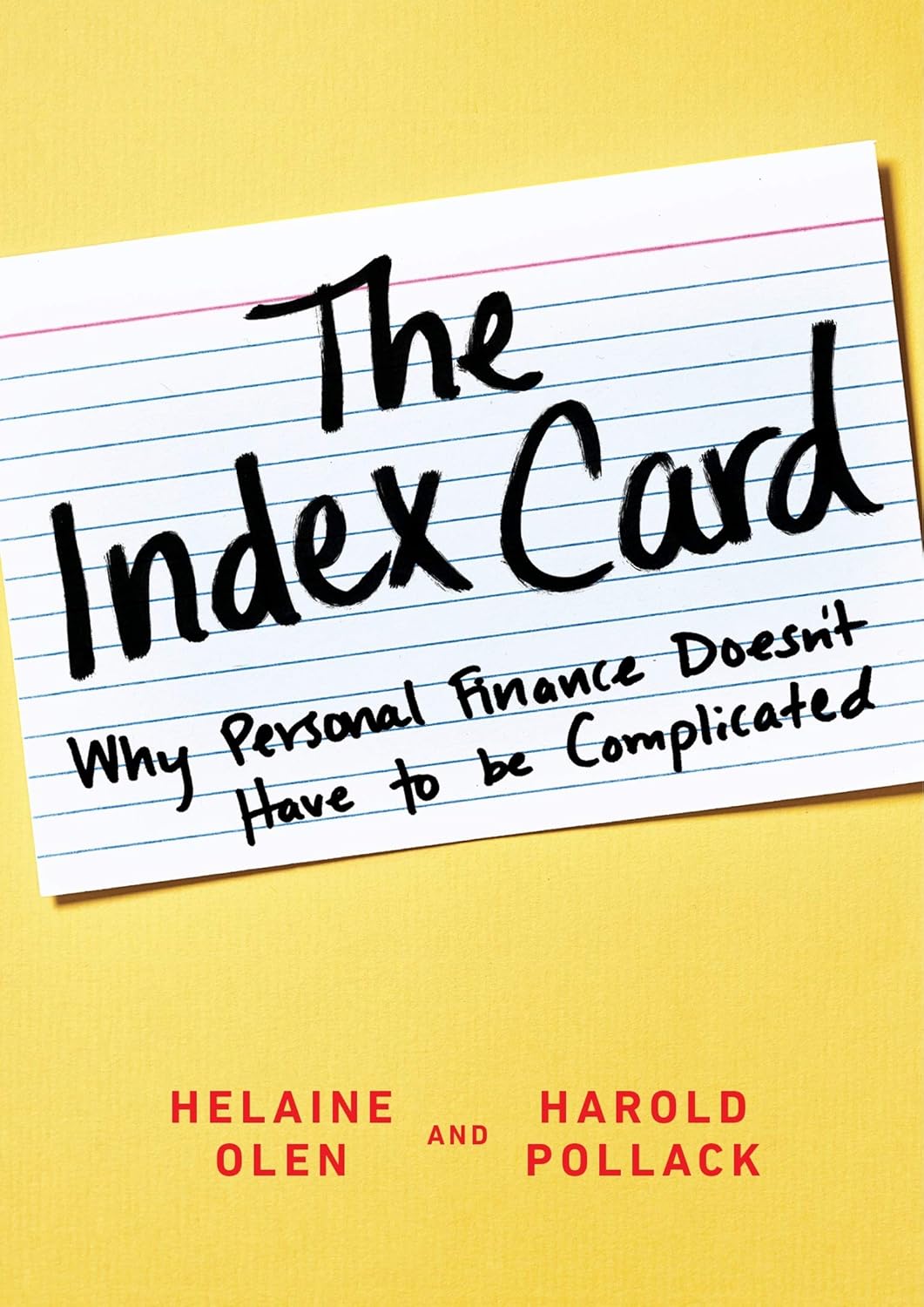
Everything you need to know about investing, saving, and retirement — distilled down to what actually matters. A perfect complement to building your index fund strategy.
→ View on AmazonWhen Actively Managed Mutual Funds Make Sense
Despite their structural disadvantages on cost and long-term performance, actively managed mutual funds aren’t obsolete. There are real scenarios where they add value and earn their higher fees — at least for portions of your portfolio.
✅ Pros of Active Mutual Funds
- Potential to outperform in inefficient markets
- Professional risk management during volatility
- Access to complex strategies (long/short, credit analysis)
- May add value in niche or emerging markets
- Can provide downside protection in bear markets
- Useful for specific investment mandates
❌ Cons of Active Mutual Funds
- High fees that compound against you over time
- Majority underperform their benchmark long-term
- Tax-inefficient in taxable accounts
- Manager turnover introduces uncertainty
- Style drift: strategy can change unexpectedly
- Less transparent than index funds
Active Funds Genuinely Add Value In These Contexts:
- Emerging market equities: Less efficient markets with information asymmetries that skilled analysts can exploit
- Small-cap stocks: Less analyst coverage means more potential for skilled managers to find mispriced opportunities
- Fixed income / bond funds: Interest rate forecasting and credit analysis are areas where some managers have demonstrated consistent skill
- Absolute return strategies: Funds designed to produce positive returns regardless of market direction (market-neutral, merger arbitrage)
- ESG / thematic investing: When you want specific sector or values-based exposure that available indices don’t cleanly capture
- Tax-advantaged accounts: Inside an IRA or 401(k), the tax-inefficiency problem largely disappears, making active funds more competitive
Many sophisticated investors and financial advisors use a “core and satellite” approach: the majority of the portfolio (70–85%) is in low-cost index funds for broad, efficient market exposure. A smaller “satellite” allocation (15–30%) goes into actively managed funds targeting specific opportunities the index approach can’t capture. This gives you the best of both worlds.
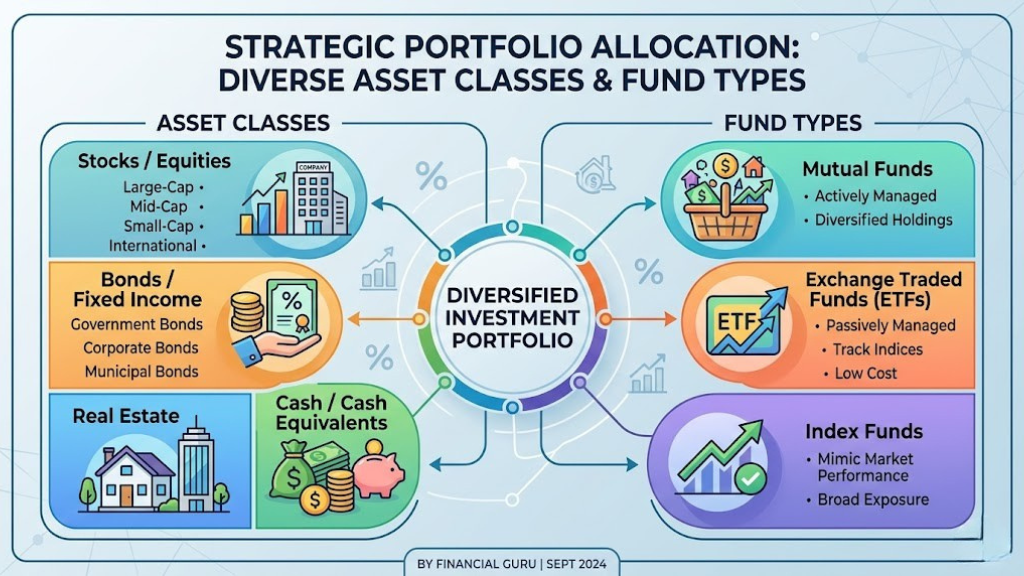
The Many Flavors: Types of Index Funds and Mutual Funds
Both categories contain multitudes. Understanding the sub-types within each category helps you match the right fund to your specific investment goals.
Types of Index Funds
| Index Fund Type | What It Tracks | Example Tickers |
|---|---|---|
| U.S. Total Market | All U.S. publicly traded stocks (~3,500–4,000 companies) | VTI, FSKAX, SWTSX |
| S&P 500 | 500 largest U.S. companies by market cap | VOO, IVV, FXAIX |
| International Developed | Stocks in Europe, Japan, Australia, Canada, etc. | VXUS, IXUS, SWISX |
| Emerging Markets | Stocks in developing economies (China, India, Brazil, etc.) | VWO, EEM, IEMG |
| Total Bond Market | U.S. investment-grade bonds of all durations | BND, FBND, AGG |
| Real Estate (REIT) | Real estate investment trusts listed on U.S. exchanges | VNQ, SCHH, USRT |
| Dividend Index | High-dividend-paying or dividend-growing companies | VYM, DGRO, SCHD |
| Factor/Smart Beta | Stocks screened for value, momentum, quality, low volatility | VLUE, MTUM, QUAL |
Types of Actively Managed Mutual Funds
| Fund Type | Strategy | Typical Expense Ratio |
|---|---|---|
| Large-Cap Growth | Focus on large companies with high growth potential | 0.60%–1.20% |
| Value Funds | Seek undervalued companies trading below intrinsic value | 0.50%–1.10% |
| Income / Dividend Funds | Prioritize stocks paying regular, growing dividends | 0.50%–1.00% |
| Sector Funds | Focus on specific industries (healthcare, tech, energy) | 0.80%–1.50% |
| International Funds | Foreign equities with active country/company selection | 0.80%–1.50% |
| Balanced/Allocation Funds | Mix of stocks and bonds, actively adjusted | 0.50%–1.20% |
| Bond Funds | Active selection of corporate, government, or municipal bonds | 0.40%–1.00% |
| Hedge-Fund Style | Long/short, market-neutral, absolute return strategies | 1.50%–2.50%+ |
How to Start Investing: A Practical Step-by-Step
Knowing the theory is one thing. Actually putting money to work is another. Here’s how to go from understanding the index-vs-active debate to building a real portfolio.
Step 1: Define Your Goal and Timeline
Before choosing any fund, clarity on your objective is essential. Are you investing for retirement 30 years away? Building a college fund for a child born last year? Saving for a home purchase in five years? Each goal demands a different risk profile and, consequently, a different fund mix.
For goals more than 10 years out, growth-oriented index funds (total market, S&P 500) have historically been highly appropriate. For shorter horizons, capital preservation matters more, and bond index funds or stable-value options become relevant. To model your long-term retirement savings in concrete terms, try our retirement savings calculator.
Step 2: Choose an Account Type
Where you invest is as important as what you invest in. The tax wrapper determines how much of your return you actually keep.
| Account Type | Tax Treatment | Best Fund Choice |
|---|---|---|
| 401(k) / 403(b) | Pre-tax contributions; taxed on withdrawal | Low-cost index funds (check plan options) |
| Roth IRA | After-tax contributions; withdrawals tax-free | Growth index funds for maximum compounding |
| Traditional IRA | Pre-tax deduction (if eligible); taxed on withdrawal | Index or active funds work — tax-deferred |
| Taxable Brokerage | No tax advantage; capital gains taxed each year | Index funds strongly preferred for tax efficiency |
| 529 College Savings | Tax-free growth for education expenses | Age-based index fund allocations |
Step 3: Select Your Brokerage
For index fund investing, the major no-fee brokerages — Fidelity, Schwab, and Vanguard — offer the widest range of low-cost options with no trading commissions. If you’re primarily investing through a workplace 401(k), your options are limited to what your plan provides, which makes it even more important to identify the lowest-cost index fund options available within that plan.
Step 4: Build a Simple Core Portfolio
You don’t need dozens of funds. A three-fund portfolio covers the entire investable universe with minimal complexity:
- U.S. Total Stock Market Index Fund — your core domestic equity exposure
- International Stock Market Index Fund — developed and emerging market exposure
- U.S. Bond Market Index Fund — fixed income for stability and income
Adjust the allocation between stocks and bonds based on your age, risk tolerance, and timeline. A common rule of thumb is to subtract your age from 110 and hold that percentage in stocks — though modern longevity has pushed many advisors to use 120 or even 130.
Step 5: Automate and Stay the Course
Set up automatic monthly contributions. Choose automatic dividend reinvestment. And then — this is the hard part — don’t check your balance during market downturns. The biggest enemy of long-term investing returns isn’t market crashes, it’s investor behavior: panic-selling at lows and chasing performance at highs.
Studies by Fidelity consistently find that the accounts with the best long-term performance are those where the investor “forgot” they had the account — or the account holders had died. The less you tinker, the more the mathematics of compounding work in your favor.
Index Funds vs. Mutual Funds in Your Retirement Strategy
Retirement is the investment horizon where the fund-type debate becomes most consequential. Across 20, 30, or 40 years of accumulation, every basis point of fees and every tax-inefficiency compounds in ways that fundamentally change your final balance.
The 401(k) Situation
Most workplace 401(k) plans offer a mix of index funds and actively managed mutual funds. The problem: many plans still include high-cost active funds prominently, and employees often default into whatever options appear first on the menu — which isn’t always the best choice.
A few things to know: you have the legal right to see your plan’s complete fund menu, including all expense ratios. Always prioritize index fund options with the lowest expense ratios. If your plan doesn’t offer good index funds, use whatever low-cost option is available — and advocate to your HR department for better options (ERISA law requires plan fiduciaries to offer prudent options).
Building Toward Financial Independence
For investors building toward early retirement or financial independence, the math on cost efficiency becomes even more critical. Each additional year of expenses you avoid paying to an active fund manager is an additional year your money can be working for you instead.
Knowing how much you need to save — and at what rate — is the foundation of any solid retirement plan. Resources on how much you should save for retirement can give you a concrete savings target to aim toward, which then informs how aggressively you need to invest and whether an index-only or blended approach makes sense for your timeline.
Target Date Funds: A Special Case
Target date funds deserve a mention here. These are often presented as mutual funds (and technically they are), but many leading ones (from Vanguard, Fidelity, and Schwab) are actually composed entirely of underlying index funds — giving you the automatic rebalancing of a managed fund with the low costs of index investing.
A target date 2055 fund, for example, might be 90% stocks and 10% bonds today, gradually shifting to 50/50 as 2055 approaches. These are excellent one-stop options for investors who don’t want to manage allocation themselves.

The classic study of how ordinary Americans build extraordinary wealth — through disciplined, low-cost investing and the patience to let compounding work. A timeless companion to any long-term fund strategy.
→ View on AmazonFrequently Asked Questions
What is the main difference between index funds and mutual funds? ▼
Index funds passively track a market benchmark (like the S&P 500) with minimal trading, while mutual funds are typically actively managed by professional portfolio managers who select individual securities. The key practical difference is cost: index funds carry expense ratios as low as 0.01%, while actively managed mutual funds typically charge 0.50%–1.50% or more annually. Over long investment horizons, this fee difference has an enormous effect on final returns.
Are index funds safer than mutual funds? ▼
Neither is inherently safer — both carry market risk. However, broad market index funds offer diversification across thousands of securities by design, which reduces concentration risk. Some actively managed mutual funds may take on more concentrated positions in pursuit of higher returns, potentially increasing volatility. Your actual risk exposure depends primarily on the underlying assets (stocks vs. bonds, domestic vs. international), not the fund structure itself.
Do index funds pay dividends? ▼
Yes. Most index funds pass through dividends from their underlying stocks or bonds to shareholders, typically on a quarterly basis. You can choose to receive these as cash or have them automatically reinvested in additional shares. Dividend reinvestment is one of the most powerful tools for long-term compounding and is supported by virtually all major brokerages.
Can you lose money in an index fund? ▼
Yes. Index funds track the market, so when the market falls, the fund falls with it. During the 2008 financial crisis, S&P 500 index funds lost roughly 50% of their value at the trough. During the 2020 COVID crash, they dropped approximately 34% within weeks. However, in both cases — and in every major historical decline — markets eventually recovered and reached new highs. The key is maintaining a long-term perspective and not panic-selling during downturns.
What is a good expense ratio for a mutual fund? ▼
For actively managed mutual funds, an expense ratio below 0.75% is generally considered competitive. For index funds, aim for below 0.20%, and many leading options from Vanguard, Fidelity, and Schwab are now under 0.05%. Every extra 0.1% in annual fees compounds into thousands of dollars of lost returns over decades. When evaluating any fund, always compare its expense ratio to similar options — a high-cost fund must outperform significantly just to break even with a low-cost alternative.
Are index funds better for beginners? ▼
For most beginners, yes — emphatically so. Index funds require no knowledge of individual stock or manager selection, carry lower costs, provide instant diversification, and historically outperform the majority of actively managed funds over long time horizons. A total market index fund is arguably the most beginner-friendly investment vehicle available: buy it, hold it, keep adding to it, and let the market do the rest. The simplicity is a feature, not a limitation.
Can you invest in both index funds and mutual funds? ▼
Absolutely — and many sophisticated investors do. A common approach is the “core-and-satellite” strategy: a large core (70–85% of the portfolio) in low-cost index funds for broad market exposure, supplemented by satellite positions (15–30%) in actively managed funds targeting specific niches where active management may add value, such as emerging markets, small-cap value, or specific fixed income strategies. This approach balances cost efficiency with tactical flexibility.
How are mutual funds taxed compared to index funds? ▼
Mutual funds distribute capital gains to shareholders whenever the manager sells securities within the fund. These distributions are taxable even if you didn’t sell any shares. Index funds trade far less frequently (only when the underlying index rebalances), generating far fewer taxable capital gains distributions. In taxable brokerage accounts, this difference can significantly impact your after-tax returns. In tax-advantaged accounts like IRAs and 401(k)s, this distinction matters much less since gains aren’t taxed until withdrawal.
Do mutual funds outperform index funds over time? ▼
Data consistently shows the opposite. According to the S&P SPIVA Scorecard, over 15-year periods, approximately 88–92% of actively managed large-cap mutual funds underperform the S&P 500 index. The longer the time period measured, the more dismal the active management results become. Exceptions exist, but identifying which funds will outperform in advance (rather than in hindsight) has proven extremely difficult. Even most professional institutional investors fail to consistently beat low-cost index benchmarks after fees.
Are ETFs the same as index funds? ▼
ETFs (Exchange-Traded Funds) and index funds are related but distinct concepts. An ETF is a structure that trades on a stock exchange throughout the day, while a mutual fund prices once daily after market close. Most ETFs track indices (making them index funds in ETF form), but there are also actively managed ETFs. Similarly, most index funds exist as traditional mutual funds. In practice, the terms overlap significantly — VTI (a Vanguard ETF) and VTSAX (a Vanguard mutual fund) both track the total U.S. stock market, with very similar performance and costs. The main practical differences are trading mechanics and minimum investment amounts.
What is the minimum investment for index funds in 2026? ▼
Minimums have dropped dramatically in recent years. Fidelity’s ZERO series index funds require no minimum investment. Schwab’s index funds start at $1. Vanguard mutual fund minimums typically begin at $1,000–$3,000, though their ETF equivalents can be purchased for the price of a single share (often under $100). Many brokerages now offer fractional shares, allowing you to invest any dollar amount in ETF-based index funds regardless of share price. There is essentially no financial barrier to starting with index fund investing today.
What are the best index funds to invest in right now? ▼
Some of the most consistently recommended index funds include: Vanguard Total Stock Market Index Fund (VTSAX/VTI), Fidelity ZERO Total Market Index Fund (FZROX), Schwab Total Stock Market Index (SWTSX/SCHB) for U.S. equity exposure; Vanguard Total International Stock Index (VTIAX/VXUS) for international exposure; and Vanguard Total Bond Market Index Fund (VBTLX/BND) for fixed income. The “best” fund depends on your brokerage, tax situation, time horizon, and overall portfolio goals. What matters more than which specific ticker you choose is that you start, keep costs low, and stay consistent.
Conclusion: Making the Right Choice for Your Situation
After weighing every dimension — fees, performance data, tax efficiency, risk profile, flexibility, and practical accessibility — the evidence broadly favors index funds for most investors in most situations. The mathematics are hard to argue with: lower costs compound into dramatically better outcomes over the kind of multi-decade horizons that define retirement investing.
But this isn’t an absolutist verdict. Actively managed mutual funds continue to serve real purposes: in inefficient markets, in tax-advantaged accounts where their weaknesses matter less, as satellite positions around a core of index holdings, and for investors who want specific strategies that don’t map to any available index.
The best portfolio isn’t necessarily the one that contains only index funds, or only actively managed funds. It’s the one you can build, understand, commit to through market volatility, and continue adding to over years and decades. Simplicity, consistency, and cost-consciousness are the real superpowers of long-term investing — and index funds make those qualities easier to maintain than almost any other vehicle available to ordinary investors today.
Whether you’re just starting your first account or reviewing a portfolio built over the past decade, the principles remain the same: keep costs low, diversify broadly, invest consistently, and resist the urge to chase performance or panic during downturns. The investor who does those four things — regardless of which specific funds they choose — will almost always end up in a dramatically better position than the one who doesn’t.
Ready to Put Your Money to Work?
Explore our complete guide to the best investment opportunities available in 2026 — from index funds and dividend stocks to real estate and alternative assets.
→ See the Best Investments for 2026