

1. Introduction: The Psychology of Money and Prioritization
For millions of people, the word “budget” triggers immediate feelings of anxiety, restriction, and financial claustrophobia. It feels like a diet for your wallet—a mechanism designed solely to prevent you from enjoying life. However, this perspective is entirely backward. A budget is not a cage; it is a blueprint for your freedom. As financial experts frequently say, a budget is simply telling your money where to go instead of wondering where it went.
The primary reason most people fail at budgeting isn’t a lack of math skills; it is a lack of prioritization. When faced with rent, credit card bills, a desire to invest, a broken car transmission, and the temptation of a weekend getaway, human psychology naturally defaults to panic or avoidance. Without a clear hierarchy of needs, money is squandered on immediate gratification while long-term security crumbles.
If you are wondering exactly what should be prioritized when creating a budget, you are in the right place. In this masterclass, we will construct a bulletproof financial hierarchy. By ordering your financial life through these specific, non-negotiable tiers, you will eliminate the anxiety of money management and pave a mathematical road to genuine wealth.
2. Step 1: Establishing the Baseline (Income vs. Expenses)
Before you can prioritize where your money is going, you must have an absolute, unvarnished understanding of reality. You cannot prioritize a budget based on guesses or “mental math.”
First, calculate your Total Net Income. This is your take-home pay—the exact amount of money that hits your bank account after taxes, health insurance premiums, and employer deductions are removed. If you have a variable income (freelance, commission-based), calculate your baseline using your lowest-earning month from the past year. This prevents you from over-projecting your resources.
Second, conduct a ruthless audit of your last three months of bank statements. Every single transaction must be categorized. This exercise almost always reveals shocking “money leaks”—hundreds of dollars bleeding out through forgotten subscriptions, excessive takeout, or impulse online shopping.

Take Immediate Control of Your Cash Flow
Writing down your expenses engages your brain differently than looking at a screen. Grab a premium physical Budget Planner to meticulously track your income, eliminate money leaks, and crush your financial goals.
Shop Budget Planners on Amazon3. Priority #1: The Four Walls (Survival)
The Absolute Necessities
When creating a budget—especially if your income is tight or you are facing a financial crisis—your absolute first priority is survival. Personal finance experts refer to this as protecting “The Four Walls.” Until these four categories are fully funded, not a single dollar should be directed anywhere else.

- 1. Food: This means basic groceries to keep you and your family fed. It absolutely does not include dining out, delivery apps, or expensive coffee shop runs.
- 2. Shelter: Your rent or mortgage payment. Keeping a roof over your head is non-negotiable.
- 3. Basic Utilities: Water, electricity, and heating/gas. (Note: A premium cable package or multiple streaming services do not count as basic utilities).
- 4. Essential Transportation: The fuel, basic maintenance, and public transit costs required to get you to and from your place of employment. If you cannot get to work, you cannot generate the income required to fund the budget.
If you are experiencing a severe financial hardship, you must pay for The Four Walls before you pay your credit card minimums, student loans, or medical bills. Protect your survival first.
4. Priority #2: The Emergency Fund (Your Financial Shield)
The Starter Emergency Fund
Once your Four Walls are secured, your immediate next priority is building a financial buffer between you and disaster. Life is wildly unpredictable. Tires blow out, HVAC systems fail, and medical emergencies happen. Without an emergency fund, these normal life events become debt-inducing catastrophes.
Your goal here is a Starter Emergency Fund of $1,000 to $2,000. This money should be kept in a highly liquid, easily accessible savings account. It is not an investment; it is insurance. By having this buffer, you ensure that when the alternator in your car breaks, you do not have to put the $800 repair on a credit card carrying a 24% interest rate.
Note: Once you complete Priority #3 (Debt Elimination), you will return to this tier to expand this starter fund into a fully-funded 3 to 6 months of living expenses.
5. Priority #3: High-Interest Debt Elimination (The Wealth Killer)
Stopping the Bleeding
If you have consumer debt, your budget is effectively leaking money. High-interest debt (like credit cards, personal loans, and payday loans) is mathematically designed to keep you broke. Your third budget priority is to attack this debt with terrifying intensity.
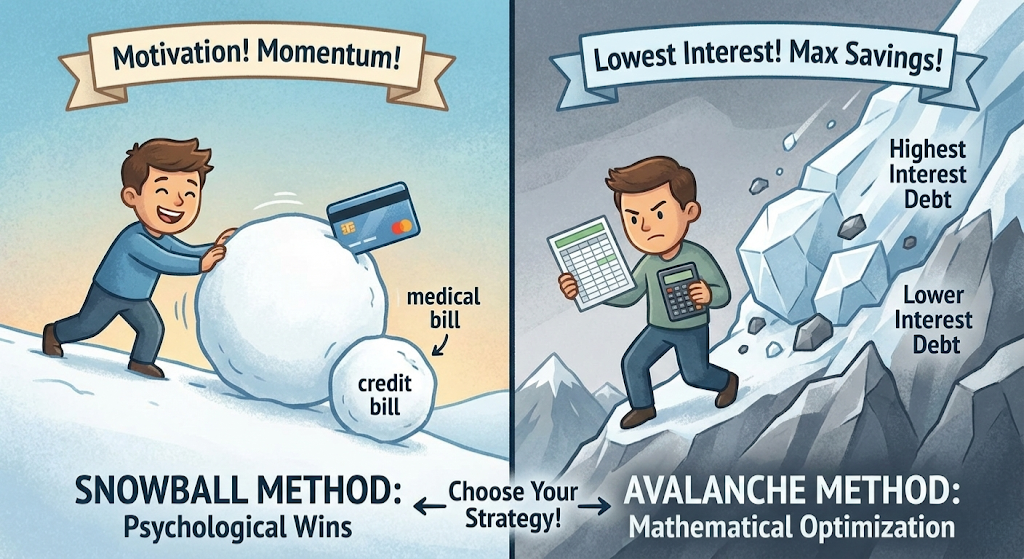
There are two primary psychological and mathematical frameworks for prioritizing debt payoff:
| Method | How It Works | Best For |
|---|---|---|
| The Debt Snowball | List debts from smallest balance to largest balance. Pay minimums on everything, but throw every extra dollar at the smallest balance until it is gone. Roll that payment into the next smallest. | People who need quick psychological “wins” to stay motivated. It changes behavior through momentum. |
| The Debt Avalanche | List debts from highest interest rate to lowest interest rate. Attack the highest interest rate first, regardless of the balance size. | People who are highly disciplined and want to mathematically pay the absolute least amount of interest over time. |
The 401(k) Match Exception
There is one massive exception to the “pay off all debt before investing” rule. If your employer offers a 401(k) match, you should prioritize contributing just enough to capture that match before attacking your debt. An employer match is a guaranteed 100% return on your investment. You will never beat a 100% return anywhere else.

Destroy Debt and Build Lasting Wealth
Need a proven roadmap? Discover the most highly-rated personal finance books that teach you the exact psychological and mathematical strategies needed to escape the paycheck-to-paycheck cycle forever.
Browse Top Finance Books6. Priority #4: Retirement and Long-Term Investing
Paying Your Future Self
With your Four Walls secured, your starter emergency fund in place, and your toxic high-interest consumer debt eliminated, your budget transitions from defense to offense. It is time to prioritize wealth generation.
The standard financial consensus is that you must prioritize saving 15% to 20% of your gross income for retirement. If you are wondering how much should I save for retirement, it depends entirely on your age and goals, but 15% is the universal baseline.
When directing this 15% through your budget, prioritize tax-advantaged accounts in this specific order:
- Max out the Employer Match: (If you haven’t already).
- Fund a Roth IRA: A Roth IRA allows your investments to grow completely tax-free, and you pay zero taxes when you withdraw the money in retirement.
- Max out a Health Savings Account (HSA): If you have a high-deductible health plan, an HSA offers a rare “triple-tax advantage” (tax-free contributions, tax-free growth, tax-free withdrawals for medical expenses).
- Return to the 401(k): If you still haven’t hit your 15% goal, funnel the remainder back into your traditional employer 401(k).
If you are looking to accelerate this phase, researching where to invest money outside of standard retirement accounts—such as broad-market index funds or real estate—is your next logical step.
7. Priority #5: Short-Term Savings Goals
Sinking Funds
Your budget must account for large expenses that you know are coming, but don’t happen every month. Prioritizing these goals prevents you from dipping into your emergency fund or going back into credit card debt.
You achieve this through “Sinking Funds.” You identify a future expense, determine when it is due, and divide the total cost by the number of months you have to save for it. This amount becomes a monthly priority in your budget.
- Examples of Sinking Funds: Annual property taxes, Christmas/holiday gifts, an upcoming family vacation, or a down payment for a replacement vehicle.
By treating your annual vacation like a monthly bill, the money is sitting in your account exactly when you need it.
8. Priority #6: Discretionary Spending (Guilt-Free Fun)
The Wants
Only after you have funded your survival, your emergency shield, your debt payoff, your future retirement, and your known upcoming expenses do you allocate money to your “Wants.”
This is where subscriptions, dining out, concert tickets, and new clothes live. Many people fail at budgeting because they place this tier at the top. They buy a new wardrobe, go out for drinks all weekend, and then try to invest whatever “is left over” at the end of the month. The harsh reality is that there is rarely anything left over.
By placing discretionary spending at the bottom of the priority list, you flip the script. You guarantee your financial security first. Then, whatever money drops down to this final tier can be spent 100% guilt-free, knowing your future is entirely secure.

Calculate Your Compound Growth
Ensure your retirement projections and debt payoff timelines are mathematically perfect. A professional financial calculator allows you to easily compute interest rates, amortization schedules, and future investment values.
View Financial Calculators9. The Hidden Priority: Insurance Protection
Most budgeting guides jump straight from “emergency fund” to “debt payoff” and completely skip a tier that quietly determines whether everything else in your plan survives contact with real life: insurance. An emergency fund protects you from a $500 surprise. Insurance protects you from a $500,000 surprise. If you build a beautiful budget hierarchy but skip proper coverage, one bad diagnosis, one lawsuit, or one house fire can wipe out years of disciplined saving in a single afternoon.
When you are deciding what should be prioritized when creating a budget, insurance premiums should be evaluated alongside — not after — your Four Walls. Here is the order in which most financial planners recommend reviewing coverage:
- Health Insurance: A single hospitalization without coverage can generate tens of thousands of dollars in debt. If your employer offers a plan, enrolling is almost always a budgeting priority, even if the premium feels expensive on a tight month.
- Auto and Renters/Homeowners Insurance: These are often legally required or mortgage-required, but many people carry the state minimum and call it done. Review your liability limits; being underinsured after an at-fault accident can bankrupt a household that otherwise had a perfect budget.
- Term Life Insurance: If anyone depends on your income — a spouse, children, aging parents — a term life policy is shockingly inexpensive for someone in their 20s or 30s and should be prioritized before extra investing. It exists purely to replace your income if you are gone.
- Disability Insurance: Statistically, you are far more likely to become disabled and unable to work than to die prematurely, yet almost nobody budgets for disability coverage. It replaces a portion of your paycheck if illness or injury prevents you from working.
The mistake most people make is treating insurance as a “want” that gets trimmed the moment money feels tight. In reality, insurance is a force multiplier on every other priority tier — it is what stops a single bad event from resetting your Four Walls, your emergency fund, and your debt payoff progress back to zero.
How Much Coverage Is Actually Enough?
A common budgeting mistake is assuming that having “some” insurance is the same as having enough insurance. For auto and homeowners policies, review your liability limits every year rather than accepting whatever the default was when you first signed up; state minimums are often dangerously low relative to what a serious accident could cost in a lawsuit. For term life insurance, a widely used rule of thumb is coverage equal to 10 to 12 times your annual income, which is generally enough to replace years of lost earnings for your dependents while a policy is still inexpensive relative to whole life alternatives. For disability insurance, aim to replace 60 to 70% of your income, since employer-provided group policies often only cover a fraction of your salary and may not follow you if you change jobs.
Budgeting the Premiums Without Breaking Other Tiers
If reviewing your coverage reveals a gap, resist the urge to buy every available policy at once. Prioritize in this order: employer-sponsored health insurance first, since the group rate is almost always cheaper than anything available on the open market, then a term life policy if someone depends on your income, then disability coverage, and finally umbrella liability insurance once your net worth has grown enough to be an attractive lawsuit target. Spreading these purchases across several months, rather than all at once, allows your Four Walls and emergency fund tiers to remain intact while your protection layer is built out gradually and sustainably.
10. Prioritizing a Budget on Irregular or Variable Income
Everything discussed so far assumes a predictable paycheck. But freelancers, commission-based salespeople, gig workers, and small business owners face a different challenge entirely: how do you prioritize a budget when you have no idea what next month’s income will be?
The solution is a technique often called “budgeting on last month’s income.” Instead of forecasting what you think you’ll earn, you build next month’s budget using the actual money you already earned last month, which has already landed in your account. This single shift eliminates the anxiety of variable income because you are always budgeting with certainty, not projections.
Building a Two-Account Buffer System
To make this work, irregular earners should prioritize building a slightly larger buffer than salaried workers — ideally one full month of Four Walls expenses sitting in checking at all times, on top of the standard emergency fund. This buffer is what allows you to pay yourself a “salary” from your business or freelance income, smoothing out the feast-or-famine cycle.
Prioritizing Taxes as a Non-Negotiable Line Item
Self-employed and freelance earners must also prioritize a “tax holding account” as if it were a bill, immediately setting aside 25–30% of every incoming payment for quarterly estimated taxes. This is arguably a Tier 1 priority for variable earners — skipping it doesn’t eliminate the tax bill, it just guarantees a devastating surprise every April.
During high-income months, the correct priority order is: fund Four Walls for the month ahead, top off the tax holding account, replenish the buffer account back to one full month, and only then direct surplus toward debt, retirement, or discretionary spending. During low-income months, you simply draw from the buffer you built during the good months, rather than panicking or reaching for a credit card.
Separating Business Cash Flow from Personal Priorities
Freelancers and gig workers should maintain a completely separate business checking account, even as a sole proprietor with no formal LLC structure. All client payments land there first, taxes and business expenses are paid from that account, and only the “owner’s pay” transfer moves into the personal account that funds the household priority hierarchy. Mixing business and personal transactions in one account is one of the most common reasons irregular earners lose track of their true take-home income and end up under-saving for taxes.
Handling Seasonal Income Swings
Many variable-income professions—landscaping, tax preparation, wedding photography, tourism-related work—have predictable seasonal peaks and troughs rather than truly random variation. In these cases, prioritize calculating your realistic annual income and dividing it by twelve to determine your “smoothed” monthly Four Walls budget, then treat the surplus from peak months as a direct, mandatory transfer into the buffer account rather than optional savings. Because the low season is predictable, it should never be treated as an emergency; only genuinely unplanned shortfalls should touch the true emergency fund.
11. Priority-Wrecking Budgeting Mistakes to Avoid
Even people who understand the theoretical hierarchy of budgeting priorities often sabotage themselves with a handful of predictable, repeatable mistakes. Recognizing these patterns is often more valuable than any spreadsheet template.
Lifestyle Inflation
Every time income rises, expenses quietly rise to match it — a bigger apartment, a nicer car payment, more frequent dining out. This is the single most common reason high earners still live paycheck to paycheck. The fix is to prioritize automatically directing raises and bonuses toward savings and debt tiers before your spending habits have a chance to absorb them.
Budgeting for an “Average” Month
Car registrations, annual subscriptions, holiday gifts, and birthdays don’t happen every month, so a budget built only around typical monthly bills will blow up in the months these irregular costs land. This is exactly why sinking funds (Priority #5) exist — without them, “surprise” expenses aren’t actually surprises, they’re predictable failures of prioritization.
Investing Before the Emergency Fund Exists
It feels productive to buy stocks, but if you don’t have a cash buffer, any emergency forces you to sell investments at the worst possible time — or go into debt anyway. Prioritization order matters more than optimization; a partially funded emergency account beats a fully funded brokerage account with zero liquidity.
Ignoring Small “Zombie” Subscriptions
Individually a $9.99 app subscription looks harmless, but the average household is quietly bleeding $200+ a month across forgotten trials, duplicate streaming platforms, and unused gym memberships. A quarterly subscription audit should be a standing item in your budget review, not an afterthought.
Setting Unrealistically Aggressive Categories
Slashing your grocery budget by 60% overnight or declaring a total ban on dining out rarely survives contact with real life. When a budget category is impossible to actually live within, people don’t adjust the category — they simply abandon the entire budget within a few weeks. Prioritize categories that are tight but sustainable, then tighten them gradually as new habits solidify.
Treating Windfalls as Exempt from the Hierarchy
Tax refunds, work bonuses, and cash gifts are frequently mentally categorized as “extra” money exempt from the normal priority order, and spent entirely on wants. Applying the exact same hierarchy to windfalls as to regular paychecks — Four Walls, emergency fund, debt, retirement, then fun — can accelerate your entire timeline by years, since these lump sums are rarely accounted for in the original plan.
12. Budgeting Tools, Apps & the Envelope System
Knowing your priority order is the strategy; the tool you use to enforce it daily is the tactic. Different tools suit different personalities, and choosing the wrong one is a common reason people abandon budgeting within a few months.
| Method | Best Suited For | Key Trade-Off |
|---|---|---|
| Cash Envelope System | Impulsive spenders, people who overspend on cards | Extremely effective at limiting discretionary categories, but inconvenient for online purchases and bill pay. |
| Zero-Based Budgeting App | Detail-oriented planners who want every dollar assigned a job | Highest level of control and awareness, but requires the most ongoing maintenance and manual categorization. |
| Automatic “Set and Forget” Transfers | Busy people who want priorities funded without daily decisions | Extremely low effort once set up, but can mask overspending in unmonitored discretionary categories. |
| Simple Spreadsheet Tracking | People who want full customization and no subscription fees | Completely free and flexible, but requires manual entry and offers no automatic bank syncing. |
The “cash stuffing” trend popularized on social media is really just a modern rebrand of the decades-old envelope system: physical cash is divided into labeled envelopes for categories like groceries, gas, and fun money. Once an envelope is empty, spending in that category stops until the next pay period. This tactile, visual limitation is precisely why it works so well for people who consistently overspend on debit and credit cards — it makes the priority hierarchy physically tangible rather than abstract.
Digital Envelope Alternatives
For people who prefer not to carry cash, many banking apps now offer sub-accounts or “buckets” that replicate the envelope system digitally — you can label a virtual envelope “Groceries” and one for “Gas,” fund each from every paycheck, and see the running balance before you swipe a card. This preserves the psychological limitation of the envelope system without the security concerns of carrying physical cash.
Choosing a Tool Based on Your Failure Pattern
Rather than choosing a budgeting method based on what influencers recommend, choose based on how you have personally failed at budgeting before. If you consistently overspend in one or two specific categories, an envelope or digital-bucket system targeting just those categories is more effective than a full zero-based rebuild. If you forget to move money at all, automatic transfers remove the need for willpower entirely. If you feel disconnected from your spending, a manual spreadsheet that forces you to type every transaction rebuilds that awareness fastest, even though it takes more time.
13. Re-Prioritizing Around Major Life Events
A budget hierarchy is not static — certain life events temporarily reshuffle your priorities, and recognizing this in advance prevents panic when it happens.
Getting Married or Combining Finances
Merging finances with a partner often means renegotiating the Four Walls category entirely (a shared household may cost less than two separate ones) while also requiring an honest, judgment-free conversation about each partner’s existing debt. Couples should prioritize agreeing on a shared definition of “Wants” before combining accounts, since mismatched spending values are one of the leading sources of relationship conflict.
Having a Child
A new dependent changes almost every tier simultaneously: healthcare costs, childcare, and the Four Walls (a larger home or car) all increase, while the emergency fund target should grow as well, since a family with a single point of income failure needs a larger cash buffer than a childless household. Term life and disability insurance also jump several tiers in priority the moment someone else depends on your income.
Buying a Home
A down payment functions as a giant sinking fund goal (Priority #5) that temporarily takes precedence over extra retirement contributions once the Four Walls, emergency fund, and high-interest debt tiers are secure. After closing, homeowners should immediately prioritize building a separate home-repair sinking fund, since a broken furnace can no longer be someone else’s problem.
Job Loss or Income Disruption
During unemployment, the hierarchy temporarily collapses back down to Tier 1: only the Four Walls matter. Retirement contributions pause, discretionary spending stops entirely, and the emergency fund becomes the sole source of Four Walls funding until income resumes. This is exactly why building that fund during stable times, rather than skipping it, is what prevents a job loss from becoming a debt spiral.
14. Increasing Income vs. Cutting Expenses: Which Should You Prioritize?
Most budgeting advice focuses exclusively on the expense side of the equation — cutting coffee, canceling subscriptions, cooking at home. These tactics matter, but they have a mathematical ceiling: you can only cut a given expense category to zero. Income, on the other hand, has no ceiling.
A balanced approach prioritizes both simultaneously, but the order of effort often should favor income growth once the obvious expense leaks are plugged. Negotiating a $5,000 raise or adding a side income stream can accomplish in one conversation what months of extreme frugality would take to achieve through cutting alone. Practical priorities on the income side include negotiating your salary at your current job using documented performance wins, developing a marketable skill that commands a higher rate, or launching a low-overhead side hustle that uses time you already have available.
The healthiest budgets treat expense discipline as the foundation (it is nearly free and immediate) while treating income growth as the accelerator that determines how quickly you move through the later priority tiers — debt elimination, investing, and discretionary freedom.
15. The Behavioral Psychology of Priority Setting
Understanding why humans struggle to follow a logical priority order — even when they intellectually agree with it — is essential to actually sticking with a budget long-term.
- Present Bias: Humans are wired to overvalue immediate rewards and undervalue future ones. This is precisely why discretionary spending tends to migrate to the top of people’s actual behavior even when it sits at the bottom of their stated priorities. Automating transfers to higher-priority tiers before you can “feel” the money removes willpower from the equation entirely.
- Mental Accounting: People treat money differently depending on its source — a tax refund feels like “free money” to be spent on wants, even though mathematically it is identical to a paycheck dollar that would otherwise go toward debt. Recognizing this bias helps you apply the same priority hierarchy to windfalls as to regular income.
- Loss Aversion: The pain of losing money is psychologically about twice as powerful as the pleasure of gaining the same amount. This is why framing a budget around “protecting” your Four Walls and emergency fund, rather than “restricting” your wants, tends to produce much stronger long-term adherence.
- Decision Fatigue: Every manual spending decision throughout the day depletes a limited pool of willpower. Reducing the number of daily budgeting decisions — through automation, envelope systems, or pre-set weekly limits — preserves willpower for the moments that matter most.
16. Budget Priorities for the Self-Employed and Small Business Owners
Business owners face a layered version of the priority hierarchy, because they must fund two separate financial systems: the business and the household.
The correct order of operations is to first pay all essential business operating expenses required to keep generating revenue, then set aside estimated tax obligations for both self-employment tax and income tax, then pay yourself a consistent “owner’s salary” that funds your personal Four Walls, and only after all three of those are secure should retained earnings be reinvested into business growth or personal discretionary spending. A shockingly common mistake is reinvesting every dollar of profit back into the business while neglecting personal retirement accounts — a SEP-IRA or Solo 401(k) should be prioritized specifically because self-employed workers have no employer-sponsored plan filling that gap automatically.
17. Beyond the Budget: Why Tracking Net Worth Should Be a Priority Too
A monthly budget measures cash flow, but it is a poor measure of overall financial progress on its own. Net worth — total assets minus total liabilities — is the scoreboard that confirms whether your prioritization is actually working over time. It is entirely possible to follow every budgeting rule correctly for a single month and still see very little movement; net worth tracked quarterly reveals the compounding trend that a monthly budget alone cannot show.
Prioritizing a simple quarterly net worth check-in — listing bank balances, investment balances, and remaining debt balances — provides the feedback loop that keeps the entire priority hierarchy honest. If debt is shrinking and assets are growing quarter over quarter, the hierarchy is functioning exactly as intended, regardless of how any single month felt.
18. How Your Budget Priorities Affect Your Credit Score
Credit score is rarely discussed as a budgeting priority, yet it directly determines the interest rate you’ll pay on every future mortgage, auto loan, and credit card — meaning a weak score effectively taxes every future financial decision you make. Following the priority hierarchy described throughout this guide already improves your score as a side effect: paying the Four Walls on time protects your payment history, avoiding new high-interest debt keeps your credit utilization low, and paying down existing balances through the snowball or avalanche method directly lowers utilization, which is the second-largest factor in most scoring models.
Two credit-specific priorities deserve a dedicated line in your budget review. First, never close your oldest credit card, even after paying it off, since it contributes to your average account age. Second, prioritize paying credit card balances a few days before the statement closing date rather than only by the due date, since many issuers report your balance at statement close — paying early can meaningfully lower reported utilization even if you were never going to carry a balance into the next cycle.
19. Prioritizing a Joint Budget as a Couple
Money disagreements remain one of the most commonly cited sources of relationship stress, and most of that conflict traces back to differing, unspoken priority hierarchies rather than differing income levels. One partner may instinctively treat debt payoff as Tier 1, while the other treats saving for a shared vacation as equally urgent. Neither view is wrong, but without an explicit conversation, both partners end up quietly resentful.
The “Yours, Mine, and Ours” Structure
Many financially healthy couples adopt a three-account structure: a joint account funds the shared Four Walls, joint emergency fund, and shared goals, while each partner keeps a smaller personal account for individual discretionary spending that requires no approval or explanation. This structure preserves the top-level priority hierarchy as a team decision while removing the friction of negotiating every individual “want” purchase.
Handling Unequal Incomes Fairly
When partners earn significantly different incomes, splitting shared expenses 50/50 can feel deeply inequitable. A common alternative is a proportional split, where each partner contributes to shared Four Walls costs in proportion to their income — for example, a partner earning 65% of household income covers 65% of the shared costs. This preserves the priority order for the household as a whole while acknowledging the reality of unequal earning power.
20. Prioritizing Seasonal and Holiday Spending
Holiday shopping, back-to-school costs, summer travel, and annual insurance renewals are entirely predictable, yet they derail more budgets than almost any other category, precisely because people treat them as unexpected. The fix is not a bigger emergency fund — emergency funds exist for the truly unplanned — but rather a dedicated seasonal sinking fund that is prioritized and funded monthly, all year round.
A practical approach is to total your expected holiday and gift spending from the prior year, divide by twelve, and set that amount aside automatically starting in January. By the time December arrives, the full amount is already sitting in a separate account, and gift-giving becomes a spending decision you’ve already budgeted for rather than a scramble that lands on a credit card in Q4 and takes until spring to pay off.
21. Prioritizing High-Impact Frugal Living Tactics
Not all money-saving tactics deserve equal priority. Clipping coupons for items you weren’t going to buy anyway saves very little relative to the time invested, while a small number of high-impact changes can meaningfully shrink your Four Walls category with almost no ongoing effort.
- Meal planning around a weekly grocery budget consistently produces some of the largest savings in a household budget, since food spending is one of the few “essential” categories with genuine flexibility built in.
- Auditing recurring bills annually — calling your internet, insurance, and phone providers to ask about current promotions or competitor offers — regularly saves hundreds of dollars a year for a single 20-minute phone call.
- Refinancing high-interest loans when your credit score improves can lower a car payment or personal loan’s interest rate significantly, freeing up cash flow that can be redirected to the debt-elimination tier.
- Reducing home energy use through simple changes like a programmable thermostat and sealing drafts lowers a genuinely essential utility bill permanently, rather than requiring ongoing willpower the way discretionary cuts do.
Prioritizing these high-leverage, low-effort changes first — before attempting extreme, unsustainable frugality across every category — produces more durable savings and a budget that is far easier to stick with long-term.
22. When Priorities Shift Toward Financial Independence
For some households, mastering the standard priority hierarchy eventually opens the door to a more aggressive goal: financial independence, often referred to as FIRE (Financial Independence, Retire Early). Rather than saving the standard 15–20% of income for a traditional retirement age, FIRE-oriented budgets prioritize saving 40%, 50%, or even more of take-home income, aiming to accumulate a portfolio large enough that withdrawals can cover the Four Walls and discretionary spending indefinitely, often decades before a typical retirement age.
This approach doesn’t replace the priority hierarchy described throughout this guide — it simply compresses it. The Four Walls, emergency fund, and debt elimination tiers remain identical, but the “discretionary spending” tier shrinks dramatically and deliberately, with the freed-up cash flow redirected entirely into the investing tier. This is not a fit for every household, but for those pursuing it, prioritizing a bulletproof emergency fund becomes even more important, since an unplanned expense mid-career could otherwise force an early sale of investments during a market downturn.
23. Popular Budgeting Frameworks to Enforce Priorities
Knowing what to prioritize is the strategy. A budgeting framework is the tactical tool used to execute that strategy. Depending on your personality and financial discipline, integrating financial planning tips with a specific framework will yield the best results.
Zero-Based Budgeting (Highly Recommended)
In this framework, Income minus Expenses equals Zero. Every single dollar of your income is given a specific job before the month begins. If you have $200 left over after funding all priorities, you don’t leave it in checking; you assign it to an investment or debt category. It requires discipline but offers maximum control.
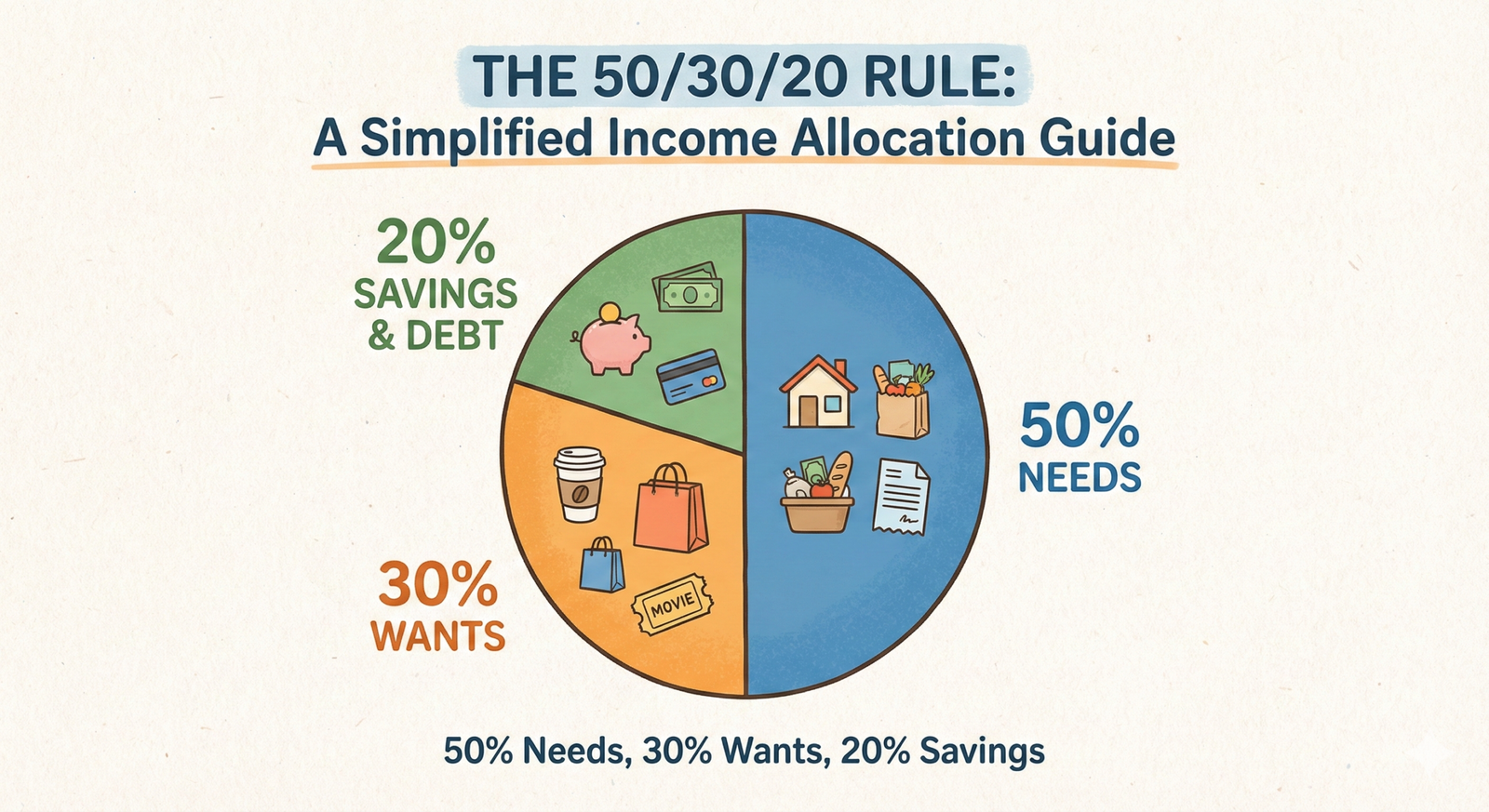
The 50/30/20 Rule
A simplified framework excellent for beginners. You prioritize 50% of your net income to Needs (The Four Walls, minimum debt payments), 30% to Wants (Discretionary spending), and 20% to Savings/Investing/Extra Debt Payoff. If your Needs exceed 50%, you must adjust your lifestyle.
24. Advanced Wealth Management: The Final Tier
Once you have mastered the foundational priorities of a budget, your cash flow will expand drastically. When you no longer have a car payment, credit card payment, or student loan payment, you will have thousands of extra dollars every month at your disposal.
At this stage, you graduate to advanced wealth management strategies. Your budget priorities shift from survival and debt reduction to asset accumulation. You may begin prioritizing real estate investing for passive cash flow, or researching the best investments 2026 to diversify your portfolio across emerging markets and technologies.
At this level, many households also begin prioritizing basic estate planning — a will, beneficiary designations on retirement accounts, and potentially a revocable trust — since protecting accumulated wealth becomes just as important as growing it. Some also pursue financial independence targets, calculating the portfolio size needed to cover their Four Walls indefinitely through investment income alone, which reframes every remaining budgeting decision around a concrete, personal timeline rather than an open-ended savings rate.
25. Conclusion: Your Budget is Your Blueprint
Understanding what should be prioritized when creating a budget transforms money from a source of stress into a tool for freedom. By establishing a rigid hierarchy—protecting your Four Walls, building an emergency shield, destroying toxic debt, paying your future self, and planning for known expenses—you mathematically guarantee your financial success.
Remember, a budget is not a static document. It is a living, breathing plan that requires monthly review. Life changes, incomes fluctuate, and emergencies happen. But as long as you adhere to this hierarchy of priorities, you will weather any economic storm and inevitably build the wealth you deserve.
Explore Advanced Wealth Building Strategies Now