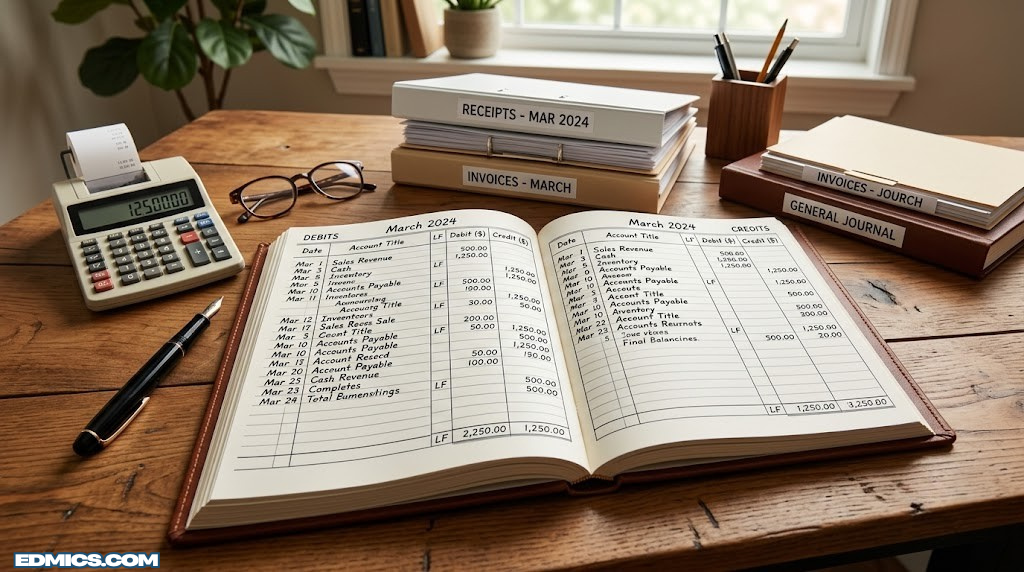

Every business transaction you have ever made — every sale, every expense, every loan repaid — has two sides to it. Double-entry bookkeeping is the discipline of recording both of them, every time, without exception. It is the reason accountants can produce a balance sheet, and the reason that balance sheet actually balances.
Whether you run a sole proprietorship, manage the books for a mid-sized manufacturer, or are studying for a finance qualification, understanding double-entry bookkeeping is not optional — it is the operating system underneath all of modern accounting. This guide walks through the complete system: its history, its logic, its mechanics, and the practical techniques that keep it from becoming overwhelming.
1. What Is Double-Entry Bookkeeping?
Double-entry bookkeeping is an accounting method in which every financial transaction is recorded in at least two accounts simultaneously — once as a debit and once as a credit of equal value. The total of all debit entries must always equal the total of all credit entries, which keeps the books mathematically balanced at all times.
The concept is deceptively straightforward: if your business buys a laptop for $1,200 in cash, two things happen at once. Your cash (an asset) decreases by $1,200, and your equipment (another asset) increases by $1,200. You record both movements. Neither can exist without the other.
The name “double-entry” refers to the requirement that every transaction touches at least two accounts. More complex transactions can touch three, four, or more accounts — but debits and credits must always sum to the same total on both sides.
This is distinct from single-entry bookkeeping, which works more like a personal bank register — you record income when money comes in and expenses when it goes out, but you never capture the full story of what changed and why. Double-entry tells the complete story of every transaction, which is why it underpins every formal set of financial statements from the simplest LLC to the largest multinational corporation.
Understanding this system at a deep level is one of the most durable skills in business and finance. If you want to read a balance sheet, assess an income statement, or understand the basics of accounting in full, double-entry is your starting point. As you deepen that understanding, you will find that concepts like the accounting equation and the golden rules of accounting flow naturally from the double-entry framework.

Adams Account Book — 7-Ring Ledger Journal
A professional columnar ledger pad for manual double-entry recording. Ideal for small businesses keeping traditional books alongside their software.
View on Amazon2. The 500-Year History of Double-Entry Bookkeeping
The story of double-entry bookkeeping begins not in a corporate boardroom but in the trading cities of 13th-century Italy. Merchants in Venice, Florence, and Genoa were managing increasingly complex trading operations — importing silk and spices from the East, financing voyages across the Mediterranean, and managing partnerships with investors scattered across Europe. They needed a system that could handle complexity and catch errors, and they found it in the practice of recording both sides of every transaction.
“Without order there is no knowledge, and without knowledge there can be no certainty.” The merchants of Venice understood this instinctively — which is why the method that Luca Pacioli documented in 1494 was already decades old when he put it to paper.
— Historical context from the development of the Venetian methodLuca Pacioli and the Summa de Arithmetica
In 1494, the Italian friar and mathematician Luca Pacioli published his monumental work Summa de Arithmetica, Geometria, Proportioni et Proportionalità. Within it was a section titled Particularis de Computis et Scripturis — “Details of Accounting and Recording” — which systematically described the Venetian method of double-entry bookkeeping for the first time in print.
Pacioli did not claim to have invented the system. He documented what skilled Venetian merchants had already been doing. But his publication spread the method across Europe as literacy, printing, and trade expanded simultaneously. Within a century, variations of the system were in use in England, Germany, and the Netherlands.
What makes this remarkable is that the core logic Pacioli described has not fundamentally changed. Every accounting software sold today — QuickBooks, Xero, Sage, and the rest — is built on the same debit-must-equal-credit foundation that Renaissance merchants were applying in their counting houses. The methods we use for reading balance sheets and tracking cash flow today trace a direct line back to 15th-century Venice.
From Ledger Books to Cloud Software
For most of its history, double-entry bookkeeping was a physical practice: leather-bound journals, quill pens, and meticulous columns ruled by hand. Errors had to be corrected by drawing a line through the mistake (never erasing — that was considered fraudulent) and writing the correction above. The discipline required patience, precision, and a good deal of mental arithmetic.
The 20th century brought mechanical adding machines, then electronic calculators, and eventually the spreadsheet — which allowed accountants to structure double-entry records in columns that summed themselves automatically. The late 20th and early 21st centuries brought purpose-built accounting software that largely hides the mechanics of double-entry from non-specialist users while preserving the underlying system perfectly intact.
Today, even a freelancer using simple invoicing software is generating double-entry records behind the scenes. The method has proven more durable than the technology used to execute it.
3. The Accounting Equation: The Mathematical Backbone
Everything in double-entry bookkeeping flows from a single equation. Every transaction, every adjustment, every closing entry — all of it is designed to keep this equation in balance at all times:
This equation is the reason the system is called “double-entry.” Any transaction that increases one side of the equation must either decrease something else on the same side or increase something on the other side by the same amount.
Reading the Equation
Assets are everything the business owns or controls that has economic value: cash, inventory, equipment, accounts receivable, buildings, intellectual property. Liabilities are everything the business owes to outside parties: loans, accounts payable, tax obligations, customer deposits. Owner’s Equity (also called shareholders’ equity or net worth) is what remains after you subtract liabilities from assets — it represents the owner’s stake in the business.
Think of it this way: if you sold every asset the business owns and used the proceeds to pay off every liability, what’s left belongs to the owner. That’s equity.
How Double-Entry Keeps the Equation Balanced
Consider three common transactions and observe how the equation holds in each case:
| Transaction | Effect on Assets | Effect on Liabilities | Effect on Equity | Equation |
|---|---|---|---|---|
| Owner invests $10,000 cash | Cash +$10,000 | No change | Capital +$10,000 | ✓ Balanced |
| Buy equipment for $3,000 on credit | Equipment +$3,000 | Loan Payable +$3,000 | No change | ✓ Balanced |
| Earn $500 in service revenue (cash) | Cash +$500 | No change | Retained Earnings +$500 | ✓ Balanced |
| Pay $200 rent expense in cash | Cash −$200 | No change | Retained Earnings −$200 | ✓ Balanced |
| Repay $1,000 of loan with cash | Cash −$1,000 | Loan Payable −$1,000 | No change | ✓ Balanced |
Notice that in every case, the left side (Assets) equals the right side (Liabilities + Equity). This is not a coincidence. It is guaranteed by the structure of double-entry recording. For a deeper understanding of how this connects to formal financial reporting, our guide to reading a balance sheet builds directly on these principles.
Because every transaction must maintain the equation’s balance, errors in recording are detectable. If your books don’t balance, you know immediately that something was recorded incorrectly — and you have a systematic way to find and fix it.
4. The Five Account Types in Double-Entry Bookkeeping
Every transaction in a double-entry system flows through one or more of five fundamental account types. Understanding the nature of each type — and the direction in which debits and credits affect it — is the essential skill at the heart of bookkeeping.
| Account Type | What It Represents | Examples | Normal Balance | Increased By | Decreased By |
|---|---|---|---|---|---|
| Assets | Resources the business owns | Cash, inventory, equipment, receivables | Debit | Debit ✓ | Credit ✗ |
| Liabilities | Obligations owed to others | Loans, accounts payable, taxes owed | Credit | Credit ✗ | Debit ✓ |
| Equity | Owner’s stake in the business | Capital, retained earnings, drawings | Credit | Credit ✗ | Debit ✓ |
| Revenue | Income earned from operations | Sales, service fees, rental income | Credit | Credit ✗ | Debit ✓ |
| Expenses | Costs incurred to generate revenue | Rent, wages, utilities, supplies | Debit | Debit ✓ | Credit ✗ |
A mnemonic that many accounting students find helpful is DEALER: Dividends (a sub-type of equity draws), Expenses, and Assets are increased by debits; Liabilities, Equity, and Revenue are increased by credits.
Why Revenue and Expenses Connect to Equity
You might notice that the table above doesn’t place revenue and expenses directly in the accounting equation — that’s because they are temporary accounts that ultimately flow into equity through the closing process at the end of an accounting period. When a business earns revenue, it increases the owner’s stake in the business (equity). When it incurs expenses, it reduces that stake. At period-end, the net difference (profit or loss) is transferred to retained earnings, which is a component of equity.
This is why the income statement and the balance sheet are intimately connected. Net income from the income statement flows directly into retained earnings on the balance sheet, and the system remains balanced throughout that transfer.
5. Debits and Credits Demystified
No concept confuses accounting newcomers more reliably than debits and credits. The confusion is understandable — in everyday language, “credit” suggests something positive (a credit to your bank account means money arrived) while “debit” sounds negative (a debit card purchase reduces your balance). In accounting, the terms mean something entirely different — and more precise.
In accounting, debit does NOT mean “decrease” and credit does NOT mean “increase.” Debit simply means “left side of the T-account” and credit means “right side.” Whether an entry increases or decreases an account depends on what type of account it is.
A debit entry records on the left side of a T-account. A debit:
- Increases Asset accounts
- Increases Expense accounts
- Increases Dividend/Draw accounts
- Decreases Liability accounts
- Decreases Equity accounts
- Decreases Revenue accounts
A credit entry records on the right side of a T-account. A credit:
- Increases Liability accounts
- Increases Equity accounts
- Increases Revenue accounts
- Decreases Asset accounts
- Decreases Expense accounts
- Decreases Dividend/Draw accounts
A Practical Memory Device
Think about what happens when your bank gives you a “credit” to your account. From the bank’s perspective, your account is a liability — they owe you that money. So crediting a liability account increases it. That’s consistent with the rules above. The bank is using accounting language correctly; everyday usage just sees it from the customer’s side rather than the bank’s side.
The Symmetry of Every Transaction
Because every transaction must have equal debits and credits, you can always ask yourself: “What went up, and what went down?” or “What did I get, and what did I give?” Those questions map directly to the debit and credit structure. You receive (debit the account received into), and you pay or give (credit the account that gave).
This structure connects deeply to the golden rules of accounting, which provide a shorthand for applying debit and credit logic across the three traditional account categories used in traditional bookkeeping: personal, real, and nominal accounts.
6. How to Record Journal Entries
A journal entry is the formal record of a financial transaction. It is always recorded in the general journal before being transferred (posted) to the individual ledger accounts. A complete journal entry contains five elements: the date, the account being debited (listed first), the account being credited (listed second, indented), the amounts, and a brief description called a narration.
The Standard Format
Four Real-World Journal Entry Examples
Example 1 — Owner invests cash into the business
Example 2 — Purchase supplies on account (credit)
Example 3 — Earn service revenue in cash
Example 4 — Pay monthly rent
Compound Journal Entries
When a transaction affects more than two accounts, you use a compound journal entry. The rule still holds: the sum of all debits must equal the sum of all credits.
This is a compound entry. Notice that $5,000 total debits = $2,000 + $3,000 total credits. The rule holds.

Texas Instruments BA II Plus Financial Calculator
The industry-standard financial calculator used by accounting and finance professionals worldwide. Essential for time-value-of-money calculations and financial analysis.
View on Amazon7. The General Ledger and T-Accounts
Once journal entries are recorded, they must be organized by account. That is the purpose of the general ledger — the master record of every account a business maintains, each showing its running balance over time.
A T-account is a simplified, visual representation of an individual ledger account. It gets its name from the T-shape formed by its structure: a horizontal line across the top (the account name), a vertical line dividing the middle into two columns, debits on the left and credits on the right.
T-Account Examples: A Sample Month in One Business
The business below starts the month fresh. Over four weeks, it: receives a $15,000 owner investment, buys $3,000 of equipment on credit, earns $4,500 in revenue, pays $1,000 in wages, and pays $800 in rent. Here is how the key T-accounts look after posting all entries:
Figure 1: T-Account structure showing how debits and credits are recorded and how a balance is calculated.
From T-Accounts to the General Ledger
In a real business, the general ledger contains a T-account for every account in the chart of accounts. A small business might have 20-30 accounts. A large corporation might have thousands. Each account tracks its own running balance, updated every time a journal entry is posted to it.
When you use accounting software, the posting process happens automatically — you record a transaction once, and the software updates every affected ledger account simultaneously. This is why the software can produce a balance sheet instantly: the ledger balances are always current. For those working through bank reconciliation, the ledger’s cash account is the starting point for checking that your internal records match your bank statement.
8. The Trial Balance: Your Built-In Error Detector
At the end of any accounting period — weekly, monthly, or before preparing financial statements — an accountant prepares a trial balance. This is a summary report that lists every ledger account and its closing balance, with debit balances in one column and credit balances in another.
If the total of the debit column equals the total of the credit column, the books are in balance. If they don’t match, there is an error somewhere that must be traced and corrected before moving forward.
Sample Trial Balance
| Account Name | Account Type | Debit (Dr) Balance | Credit (Cr) Balance |
|---|---|---|---|
| Cash | Asset | $17,700 | — |
| Equipment | Asset | $3,000 | — |
| Accounts Payable | Liability | — | $3,000 |
| Owner’s Capital | Equity | — | $15,000 |
| Service Revenue | Revenue | — | $4,500 |
| Wages Expense | Expense | $1,000 | — |
| Rent Expense | Expense | $800 | — |
| TOTALS | $22,500 | $22,500 |
The debits ($22,500) equal the credits ($22,500). The books are in balance. ✓
What a Trial Balance Can and Cannot Detect
A balanced trial balance does not mean your books are error-free. It only confirms that debits equal credits. It cannot detect errors where the wrong amount was entered on both sides, the wrong accounts were used, or a transaction was omitted entirely. These require a more detailed review.
The types of errors a trial balance catches: posting an entry to only one account, arithmetic mistakes in calculating a balance, posting a debit as a credit or vice versa. The types it misses: recording the wrong amount in both sides, posting to the wrong account (but in the right direction), or omitting a transaction entirely. This is why periodic audits and internal controls matter — they catch what the trial balance cannot. Understanding the purposes and advantages of auditing is a natural complement to understanding what the trial balance can and cannot do.
9. From Ledger to Financial Statements
The ultimate purpose of double-entry bookkeeping is to produce accurate, reliable financial statements. Once the trial balance confirms that the ledger accounts are in balance, an accountant uses those balances to build three core financial statements: the income statement, the balance sheet, and the cash flow statement.
Figure 2: The accounting cycle — how each step feeds the next, culminating in financial statements.
The Income Statement: Revenue Minus Expenses
The income statement draws on all revenue and expense accounts from the ledger. It shows whether the business operated at a profit or loss during the period. Revenue accounts carry credit balances; expense accounts carry debit balances. Net income (or net loss) is the difference.
Using the sample trial balance above: Revenue ($4,500) minus Wages Expense ($1,000) minus Rent Expense ($800) = Net Income of $2,700. This $2,700 flows into retained earnings on the balance sheet. For a deeper walkthrough, the income statement guide explains how to read and interpret each line.
The Balance Sheet: Assets vs. Liabilities + Equity
The balance sheet draws on asset, liability, and equity accounts. It presents a snapshot of financial position at a specific point in time — what the business owns, what it owes, and what belongs to the owner. Because every transaction was recorded using double-entry principles, the balance sheet balances automatically. The complete balance sheet guide walks through how to interpret every section.
The Cash Flow Statement
The cash flow statement tracks the movement of actual cash — operating activities, investing activities, and financing activities. It is derived from the income statement and balance sheet using additional analysis of the changes in ledger account balances. Our cash flow statement guide explains how it fits into the full financial reporting picture.
Accurate financial statements produced through double-entry bookkeeping are not just a compliance requirement — they are essential inputs for sound financial planning. The financial planning strategies that drive business growth all depend on the quality of the underlying bookkeeping data.

Accounting Made Simple by Mike Piper
A clear, jargon-free guide to understanding accounting concepts including double-entry bookkeeping, financial statements, and basic analysis — ideal for entrepreneurs and self-learners.
View on Amazon10. Single-Entry vs. Double-Entry Bookkeeping: A Direct Comparison
For very small sole proprietors with minimal transactions — a freelance writer, a sole trader who sells at a weekend market — single-entry bookkeeping might seem sufficient. It’s simpler to set up and requires less accounting knowledge to maintain. But its limitations become apparent quickly as a business grows.
| Feature | Single-Entry | Double-Entry |
|---|---|---|
| Complexity | Simple — one entry per transaction | More structured — minimum two entries |
| Error Detection | ❌ Poor — errors go undetected | ✅ Built-in — imbalance signals error |
| Balance Sheet | ❌ Cannot produce one | ✅ Produced directly from ledger |
| Fraud Prevention | ❌ Easy to manipulate | ✅ Much harder to falsify |
| GAAP / IFRS Compliance | ❌ Not compliant | ✅ Required by both standards |
| Investor / Bank Reporting | ❌ Insufficient | ✅ Industry standard |
| Tax Preparation | Basic — income/expense tracking only | Complete — all accounts available |
| Best Suited For | Micro-businesses, personal tracking | All formal businesses |
- Self-balancing: errors are immediately visible
- Complete financial picture at any time
- Enables production of full financial statements
- Required by GAAP, IFRS, and most lenders
- Significantly harder to manipulate or commit fraud with
- Supports detailed profitability and cost analysis
- Scalable from startup to enterprise
- Supported by all professional accounting software
- Steeper learning curve than single-entry
- Requires understanding of debit/credit rules
- More time-consuming without software
- Setting up a chart of accounts takes initial effort
- Errors must be traced through multiple accounts
- Can feel overwhelming for very small sole traders
The considerations listed above are real but manageable. Modern accounting software handles the debit/credit mechanics automatically, which means the practical workload difference between single and double-entry is minimal once you’re using the right tools. The advantages, by contrast, remain substantial regardless of what software you use.
Understanding how double-entry connects to broader financial frameworks like GAAP (Generally Accepted Accounting Principles) helps explain why the system is non-negotiable for any business that needs to raise capital, take on investors, apply for credit, or submit audited financial statements.
11. Best Accounting Software for Double-Entry Bookkeeping
The good news for business owners who aren’t trained accountants: you don’t need to manually record debit and credit entries in a ledger book. Every serious accounting platform built for business is constructed on a double-entry foundation — you record transactions in plain language, and the software handles the accounting mechanics in the background.
| Software | Best For | Starting Price | Double-Entry | Financial Statements |
|---|---|---|---|---|
| QuickBooks Online | SMBs, accountants | ~$30/mo | ✅ Full | ✅ All three |
| Xero | Small to mid-size, multi-user | ~$15/mo | ✅ Full | ✅ All three |
| FreshBooks | Freelancers & service businesses | ~$19/mo | ✅ Full | ✅ Core |
| Wave | Micro-businesses, budget-conscious | Free (core) | ✅ Full | ✅ Core |
| Sage Accounting | Growing SMBs, UK-focused | ~$10/mo | ✅ Full | ✅ All three |
| Zoho Books | SMBs in the Zoho ecosystem | Free / $20/mo | ✅ Full | ✅ All three |
For an in-depth comparison of two of the market leaders, the QuickBooks vs. Xero comparison breaks down exactly what you get for your money — and which platform suits which type of business. If you’re also evaluating invoicing-first options, the QuickBooks vs. FreshBooks breakdown is equally detailed.
What to Look For in Accounting Software
- True double-entry engine Ensure the platform is built on a proper double-entry system, not just an enhanced checkbook. Any software that produces a balance sheet is using double-entry under the hood.
- Automatic bank reconciliation The ability to connect your bank feeds and match transactions automatically eliminates the most time-consuming manual task in day-to-day bookkeeping.
- Financial statement generation You need to produce a balance sheet, income statement, and cash flow statement at any time with one click. If the software can’t do this, it’s not sufficient for business use.
- Accountant access When you eventually engage a bookkeeper or accountant (and most businesses eventually do), they need to be able to access and work within your system. Choose a platform your accountant knows.
- Tax integration Tax preparation is dramatically simpler when your bookkeeping software integrates with or exports cleanly to tax software. This is particularly important at year-end. If you use TurboTax or H&R Block, check the detailed comparison to understand which approach fits your needs.

Desk Organizer & File Sorter for Accounting Professionals
Keep your accounting records, invoices, and financial documents organized with a professional desktop organizer. Perfect for maintaining physical records alongside your digital bookkeeping.
View on Amazon12. Common Mistakes in Double-Entry Bookkeeping (And How to Avoid Them)
Even experienced bookkeepers encounter recurring errors. Understanding what goes wrong — and building habits and controls to prevent it — is as important as understanding the theory. Here are the most common mistakes and their corrections.
Figure 3: The six main categories of bookkeeping error — and the tools used to detect them.
Mistake 1: Mixing Personal and Business Finances
One of the most damaging errors for small business bookkeeping is using the same bank account for personal and business transactions. This makes bookkeeping dramatically more complex, introduces errors into the business accounts, and can create serious problems at tax time. Separate accounts are non-negotiable.
Mistake 2: Not Reconciling Regularly
Even with double-entry software, errors creep in. Regular bank reconciliation — matching your ledger’s cash account against your bank statement — catches mispostings, omissions, and timing differences before they compound. The discipline of bank reconciliation should happen at least monthly, and weekly for businesses with high transaction volume.
Mistake 3: Poor Chart of Accounts Setup
If your chart of accounts doesn’t reflect how your business actually works — if you have too few categories, or the wrong ones — your financial statements will be difficult to read and your tax preparation will be unnecessarily complex. Spend time upfront getting the account structure right, and review it annually.
Mistake 4: Ignoring Adjusting Entries
Adjusting entries are journal entries made at the end of an accounting period to account for items like prepaid expenses, accrued revenues, depreciation, and accrued expenses. Skipping adjusting entries means your financial statements don’t accurately reflect the period’s true financial activity. Depreciation in accounting is one of the most commonly missed adjusting entries for asset-heavy businesses.
Mistake 5: Relying on Software Without Understanding the Underlying Principles
Software hides the double-entry mechanics, which is convenient — until something goes wrong. If you don’t understand why debits equal credits, you can’t spot when the software is doing something unexpected. The best users of accounting software understand enough accounting to review their outputs critically. Storing important financial records safely is also essential — our guide to the best fireproof document safes covers how to protect physical financial records.
Review your financial statements every single month — not just at year-end. Patterns that indicate errors or fraud are far easier to spot when you’re looking at one month’s data rather than twelve. Regular review is also the foundation of effective financial planning.
13. Advanced Applications: Where Double-Entry Bookkeeping Gets Powerful
For businesses that have moved beyond the basics, double-entry bookkeeping underpins several sophisticated financial management and analysis techniques that would be impossible with a simpler record-keeping approach.
Ratio Analysis and Financial Health Monitoring
Because double-entry produces complete, balanced balance sheets and income statements, it enables systematic ratio analysis. The current ratio (current assets ÷ current liabilities) measures short-term solvency. The gross margin percentage reveals pricing power. Return on equity shows how effectively the business uses its capital base. These ratios, and dozens more, are only calculable when you have accurate double-entry records underlying each figure.
For businesses thinking about capital structure and investment, understanding how the financial manager’s function relates to these metrics provides essential context. The records produced by double-entry bookkeeping are the raw material that financial managers use to make capital allocation decisions.
Accrual vs. Cash Basis Accounting
Double-entry bookkeeping supports both cash-basis and accrual-basis accounting, though it truly shines with accrual accounting. Accrual accounting recognizes revenue when it is earned and expenses when they are incurred — not just when cash changes hands. This gives a far more accurate picture of business performance, which is why GAAP and IFRS both require accrual accounting for most businesses. Cash-basis accounting is simpler but misses the timing distinctions that matter most for financial analysis.
Cost Accounting and Profitability by Segment
A well-structured chart of accounts with proper departmental coding enables cost accounting — the allocation of costs to specific products, projects, or business units. This allows management to see not just whether the business as a whole is profitable, but which products, services, divisions, or customer segments are contributing most to (or dragging on) overall profitability. This is the kind of insight that drives genuine strategic planning, connecting to the financial and nonfinancial benefits of strategic planning.
Audit Trails and Compliance
Every transaction recorded in a double-entry system creates an audit trail — a traceable record from the original source document through the journal entry, into the ledger account, and ultimately into the financial statements. This trail is what auditors follow when examining a business’s books. It is also what fraud investigators look for when examining suspicious activity. The integrity of double-entry records is a cornerstone of financial compliance and the audit process depends on it entirely.
Connecting Bookkeeping to Investment Decisions
Investors and lenders assess businesses using the financial statements that double-entry bookkeeping produces. A clear set of books accelerates due diligence, increases investor confidence, and often results in better borrowing terms. Whether you are considering real estate investing through a business entity, evaluating the best investment options for business reserves, or thinking about where to put retained earnings, the clarity of your books directly affects the quality of decisions you can make.

Heavy-Duty D-Ring Binder for Financial Records
Organize your printed bank statements, journal entry backups, trial balances, and financial statements in durable, archival-quality binders — the physical backbone of any good audit trail.
View on AmazonFrequently Asked Questions About Double-Entry Bookkeeping
Conclusion: The System That Has Stood for Five Centuries
Double-entry bookkeeping is not a bureaucratic formality or an accounting technicality. It is the logical architecture beneath every accurate set of financial statements ever produced — from a 15th-century Venetian merchant’s ledger to today’s cloud-based general ledger updated in real time.
The core insight has not changed: every financial transaction has two sides, and recording both of them simultaneously creates a self-checking, self-balancing system that produces reliable, auditable, investor-grade financial information. Master this, and you have mastered the foundation that everything else in accounting and business finance is built upon.
Whether you run the books yourself or work with a professional, understanding why the system works — not just how to follow it — is what turns bookkeeping from a chore into a strategic asset.

Casio fx-991EX ClassWiz Scientific Calculator
For students studying accounting, finance, or bookkeeping — a powerful scientific calculator that handles every calculation from ratio analysis to time-value-of-money problems.
View on Amazon